Climate

What would the world look like after 4°C of global warming?

The global delay in reducing emissions is taking us on a pathway towards 4°C of warming that we may find difficult to avoid, say scientists.
English
Just a few months ago, the UN’s chief climate negotiator was telling chinadialogue that it was still possible to avoid 2C (degrees Celsius) of warming, avoiding what scientists call "dangerous climate change". 
 
While the latest UN climate summit reaffirmed the plan to to adopt a legal agreement to cut emissions "as soon as posisble and no later than 2015", it may not be enough to prevent a much higher 4C of warming. 
 
As researchers at Manchester University have pointed out recently, to limit emissions to around 2 to 2.4C, countries would actually have to start reducing them by 2015 – very different from simply "agreeing" to cut them. At present, they explain, current global greenhouse gas emissions are taking us on a pathway towards 4C of warming.
For many countries that kind of warming is a drastic prospect.

The Doha outcome puts the world on track for three, four or even five degrees of warming, Mónica López Baltodano, of Centro Humboldt Nicaragua, an environmental NGO, has said. She attended Doha as a delegate from the South Pacific island nation of Nauru and represents the Alliance of Small Island States – the ones most likely to be wiped out first by rising sea levels.
 

"We’re not talking about how comfortable your people (in developed world) may live but whether our people live. The lives of our people are on the line here," said Baltodano.
 

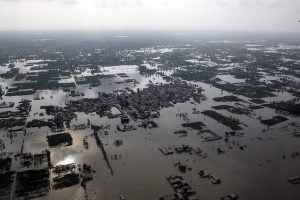
It is not just low-lying island states that will be effected either. As the World Bank reported recently, a 4C world would be one of unprecented heat waves, severe drought and major floods in many regions.

The UK meteorological office produced a illustrative map a few years ago, detailing what a 4C world would look like. You can see the 4C map in full on their website. Although the average temperature rise over the globe is 4C (7 Farenheit) the rise will not be spread uniformly across the globe. The land will heat up more quickly than the sea, and high latitudes, particularly the Arctic, will have larger temperature increases. The average land temperature will actually be 5.5C above pre-industrial levels.

The impacts of the temperature rise will include a decline in major cereal crop yields, water availability issues in western China, where much of the river flow comes from glacial melt water and risks of flooding and storms to low-lying coastal regions (see chinadialogue article on flooding risk in Shanghai).


Cookies Settings

Dialogue Earth uses cookies to provide you with the best user experience possible. Cookie information is stored in your browser. It allows us to recognise you when you return to Dialogue Earth and helps us to understand which sections of the website you find useful.

Required Cookies

Required Cookies should be enabled at all times so that we can save your preferences for cookie settings.

Dialogue Earth - Dialogue Earth is an independent organisation dedicated to promoting a common understanding of the world's urgent environmental challenges. Read our privacy policy.

Cloudflare - Cloudflare is a service used for the purposes of increasing the security and performance of web sites and services. Read Cloudflare's privacy policy and terms of service.

Functional Cookies

Dialogue Earth uses several functional cookies to collect anonymous information such as the number of site visitors and the most popular pages. Keeping these cookies enabled helps us to improve our website.

Google Analytics - The Google Analytics cookies are used to gather anonymous information about how you use our websites. We use this information to improve our sites and report on the reach of our content. Read Google's privacy policy and terms of service.

Advertising Cookies

This website uses the following additional cookies:

Google Inc. - Google operates Google Ads, Display & Video 360, and Google Ad Manager. These services allow advertisers to plan, execute and analyze marketing programs with greater ease and efficiency, while enabling publishers to maximize their returns from online advertising. Note that you may see cookies placed by Google for advertising, including the opt out cookie, under the Google.com or DoubleClick.net domains.

Twitter - Twitter is a real-time information network that connects you to the latest stories, ideas, opinions and news about what you find interesting. Simply find the accounts you find compelling and follow the conversations.

Facebook Inc. - Facebook is an online social networking service. China Dialogue aims to help guide our readers to content that they are interested in, so they can continue to read more of what they enjoy. If you are a social media user, then we are able to do this through a pixel provided by Facebook, which allows Facebook to place cookies on your web browser. For example, when a Facebook user returns to Facebook from our site, Facebook can identify them as part of a group of China Dialogue readers, and deliver them marketing messages from us, i.e. more of our content on biodiversity. Data that can be obtained through this is limited to the URL of the pages that have been visited and the limited information a browser might pass on, such as its IP address. In addition to the cookie controls that we mentioned above, if you are a Facebook user you can opt out by following this link.

Linkedin - LinkedIn is a business- and employment-oriented social networking service that operates via websites and mobile apps.