Business

Arctic region is a “low-priority” for China

China is keen to gain access to economic opportunities in the Arctic, rather than territorial rights, suggests a recent report.
English
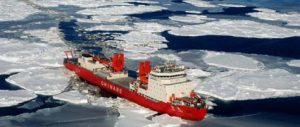
China’s interest in the Arctic appears to have leaped forward in recent years; the building of polar ice-breakers, lobbying for an Arctic Council role and visits to Nordic countries, including president Hu Jintao’s state visit to Denmark in June this year.
 
However, China’s apparent assertiveness over its Arctic claims have been overstated, according to new analysis from the Stockholm International Peace Research Institute (SIPRI).
 
The growing extent of summer sea-ice melt in the Arctic region is creating concern among environmentalists, but even bigger interest from the mining and shipping sectors.

As well as oil and gas reserves, an ice-free Arctic could open up the Northwest passage and significantly reduce shipping distances between the US/Europe and Asia. 

 
China’s primary interest, with no sovereign rights in the region, is in access to shorter shipping routes for food and resource security, but there is also a secondary objective, namely China’s quest to be seen as a major power, says the SIPRI.
 
"Chinese Government officials emphasise the global, rather than regional, implications of the melting ice," says the report. "This is noteworthy because China, as a rising global power, rejects the notion that the Arctic states alone should decide Arctic issues because many non-Arctic states, China among them, will be affected by the Arctic’s changing environment. Chinese analysts today refer to China as a ‘near- Arctic state’ and an ‘Arctic stakeholder’."
 
However, in comparison to Antarctica, the Arctic is of limited importance to Chinese officials, with just one-fifth of China’s polar resources devoted to the Arctic, says the report. 

What’s more, it points to China’s uneasy relationship with Norway, an Arctic Council member and world leader in deep-sea and cold-climate drilling technology, in recent years. If the Arctic were a priority for China it would not have upheld punitive measures against Norway for more than two years, says the report.

 
While the struggles of Chinese tycoon Huang Nubo to acquire land in Iceland have grabbed media headlines over the past year, China’s main objective remains shipping access, rather than land. 
 
"In the short term, ensuring access for Chinese vessels to the Arctic shipping routes will be a priority simply because the melting ice will permit regular ship transits sooner than resource exploration and exploitation. This means that China will be dogmatic in emphasising the rights of non-Arctic states when issues such as sea and rescue requirements, environmental standards and ice-breaker service fees are decided."
 
Rather than land-grabs and diplomatic stand-offs, the report expects large-scale financial investments by China in co-development projects with major Arctic countries like Canada and Russia.
Cookies Settings

Dialogue Earth uses cookies to provide you with the best user experience possible. Cookie information is stored in your browser. It allows us to recognise you when you return to Dialogue Earth and helps us to understand which sections of the website you find useful.

Required Cookies

Required Cookies should be enabled at all times so that we can save your preferences for cookie settings.

Dialogue Earth - Dialogue Earth is an independent organisation dedicated to promoting a common understanding of the world's urgent environmental challenges. Read our privacy policy.

Cloudflare - Cloudflare is a service used for the purposes of increasing the security and performance of web sites and services. Read Cloudflare's privacy policy and terms of service.

Functional Cookies

Dialogue Earth uses several functional cookies to collect anonymous information such as the number of site visitors and the most popular pages. Keeping these cookies enabled helps us to improve our website.

Google Analytics - The Google Analytics cookies are used to gather anonymous information about how you use our websites. We use this information to improve our sites and report on the reach of our content. Read Google's privacy policy and terms of service.

Advertising Cookies

This website uses the following additional cookies:

Google Inc. - Google operates Google Ads, Display & Video 360, and Google Ad Manager. These services allow advertisers to plan, execute and analyze marketing programs with greater ease and efficiency, while enabling publishers to maximize their returns from online advertising. Note that you may see cookies placed by Google for advertising, including the opt out cookie, under the Google.com or DoubleClick.net domains.

Twitter - Twitter is a real-time information network that connects you to the latest stories, ideas, opinions and news about what you find interesting. Simply find the accounts you find compelling and follow the conversations.

Facebook Inc. - Facebook is an online social networking service. China Dialogue aims to help guide our readers to content that they are interested in, so they can continue to read more of what they enjoy. If you are a social media user, then we are able to do this through a pixel provided by Facebook, which allows Facebook to place cookies on your web browser. For example, when a Facebook user returns to Facebook from our site, Facebook can identify them as part of a group of China Dialogue readers, and deliver them marketing messages from us, i.e. more of our content on biodiversity. Data that can be obtained through this is limited to the URL of the pages that have been visited and the limited information a browser might pass on, such as its IP address. In addition to the cookie controls that we mentioned above, if you are a Facebook user you can opt out by following this link.

Linkedin - LinkedIn is a business- and employment-oriented social networking service that operates via websites and mobile apps.