A climate-themed art exhibition opened in Beijing last month. The exhibition, staged by UK-based arts charity Cape Farewell, looks to promote a cultural response to climate change, as a way of changing the debate.
The exhibition is a collection of works showing artists’ reactions to the environmental impact they witnessed in Greenland, Peru and the Arctic, on trips organised by Cape Farewell.
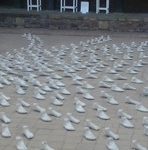
Works range from photographs of melting icebergs projected with slogans like “Discounting the Future”, to an artificial diamond created from the ash of a polar-bear skeleton two artists discovered on their trip to the Arctic.
Overall the exhibition is upbeat: “We want to show that climate change is not a threat” said Cape Farewell founder David Buckland. “We want to encourage audiences to think about how we can make our future slimmer and greener…..When talking about climate change, people talk about science and politics, but we think climate is culture," he said.
Curators Chris Wainwright and David Buckland talked to chinadialogue about the role of artists in our climate crisis.
chinadialogue (CD): Most of the artists in the show are from the West (and none from China). Why didn’t you select a more diverse group of artists?
Chris Wainwright (CW): If you look at Cape Farewell as an organisation, and not just the exhibition, it has been involved with Native American Indians and people from countries around the world. The work in the show is more important than the people who made it because it addresses questions of climate change.
David Buckland (DB): We treat climate as a global phenomenon. The reason we are not doing anything about it, finding solutions, is pretty much the same globally. There is such a monopoly of money driving the system to stay the same that it doesn’t matter where you are. You have got the same problem.
CD: How do you compare the work of environmental NGOs and the work of these artists?
DB: Even in the greenest communities, like Amsterdam in Holland, they [NGOs] only reach 15% of the population. Most people look at the work they do and switch off. But if you have a major display of artwork, then a wider audience will engage with it. It is not the case of one being wrong and the other being right. If you aggressively approach people, then they will back away, which is what often happens when you have activists. People just go blank.
CW: NGOs often only have a single agenda. We are challenging artists to think about their role differently. How can artists create new ways of working and new audiences? So we’ve got multiple agendas. We have the same climate agenda as a NGO, but we also have the agenda to create new art. I think that is a fundamental difference.
DB: Just before the Copenhagen Summit in 2009, we had an exhibition at the Royal Academy of Arts, one of the biggest art galleries in London. It was extraordinary, because Copenhagen was such a disaster and the stories coming out if it were so poor that the press wrote about our exhibition more than they wrote about Copenhagen. That’s what art does. Art captures the imagination in a very different way.
CD: Have these artists used climate science as inspiration for their work?
CW: If you look at the entire exhibition here, talk to all the artists, they will all know about climate from a scientific position. They talk to scientists and a wide range of people. They read. They gather information. They can talk to you about science because their work is informed by science. They are not scientists, but they understand what scientists are saying. That’s a big change for artists to make. It is not just enough to express your emotional romantic feelings. You’ve got to get to the root of the issues.
CD: The introduction to this exhibition says that the art work is sometimes contradictory. What does that mean?
CW: You can say many of them are contradictory because of the conditions they were made under. We all visited the Arctic, or Peru or different part of the world, and so we are actually helping to create the problem by traveling. That’s a big contradiction. We flew here from London. Then after arriving, we talk about how we shouldn’t fly so much. That’s an obvious contradiction. I think the reason we continue is because it is important to get the visibility. Sometimes you have to understand that you are contributing to the problem at the same time you are trying to solve the problem.
That’s the same for all of our lives. You can recycle everything in your home. You can buy food that grown locally. But you still drive a car. We have to accept that sometimes we will contradict ourselves. I think artists are in some way doing the same thing. Some of the materials that they use in the work are materials that maybe they shouldn’t be using. But they have to use them to get the message across.
CD: As an artist, are you optimistic about international climate negotiations?
DB: If it was true negotiation, yes. But I think everybody arrives at those things with a power play. One of the reasons Copenhagen didn’t work was the Chinese government position. They said, "We don’t want any decisions to be made." The US came in with exactly the same attitude. There were a lot of people who wanted results and they just got derailed. I was in Copenhagen with mayors from many cities in the world, representing nearly 60% of the global population. The mayors all gave targets for reducing the carbon and explained all the things they were doing. Outside of Copenhagen, it was a huge success on the local level. I think that’s a much better way to go forward.
CD: What is the role of artists in addressing the whole climate crisis?
DB: In order for this whole climate issue to be addressed, you are going to need a huge cultural shift. You’ve got to reinvent a lot of things in our culture in order to stop polluting, destroying our future. I think that institutional structures cannot deliver that change quickly; it will need to come through a culture shift. I think artists could be very influential. Nobody has an answer at the moment. Nobody is achieving anything. So you need something else.
CD: Why is the project called Cape Farewell?
The bottom of Greenland is called Cape Farewell. In English, the word farewell has two meanings. "Farewell" like goodbye, or fare well into the future (be good into the future). Right now we are at the point where we can say "goodbye" and the whole thing will end in disaster. Or we can turn it around and be in a good place. And "Cape", if you are a sailor, you never stay on a cape because it the most dangerous place to sail. So you decide you’ve got to go left or right, but you have to make a decision. So the whole thing is about making a decision to go one way or the other.