Pollution

Scepticism over China’s air pollution plans

After months of negotiations, China has released a five-year action plan for cutting air pollution, which includes a ban on new coal-fired power stations. But Green groups say there is no chance of Beijing meeting its air quality targets
English

China’s action plan for air pollution, published this week, requires cuts in PM2.5 levels of 25% in the Beijing-Tianjin-Hebei area, 20% in the Yangtze delta, and 15% in the Pearl River delta, all by 2017.

Talks on the plan have been underway since spring this year, with a well-publicised tug of war between central and provincial governments over coal use.

The plan lists 33 measures, including further incentives for new-energy vehicles, fuel quality improvements, dealing with small coal furnaces and reductions in coal use in the three key regions.

Notably, there is a ban on new coal-fired power stations in three regions surrounding Beijing, Shanghai and Guangzhou, with the exception of combined heat and power plants: “On the precondition that the highest environmental standards are met and water supplies are guaranteed, the commercialised and scaled development of the gas-from-coal sector.”

Other quantified targets for 2017 include a drop of around 20% in energy intensity of industrial added value on 2012 levels; and a fall in the percentage of coal use in total energy consumption to 65% or less. By 2015 150 billion cubic meters of new natural gas pipeline capacity will come online in the three key regions.

However, Greenpeace says that despite the government’s laudable determination, there is no chance of a 25% drop in PM2.5 levels in Beijing over the coming five years.

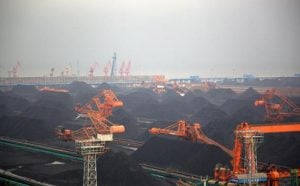
It has calculated that to achieve the 2017 target of a 25% cut in PM2.5 levels, coal use will have to fall by between 80 million and 90 million tonnes in the Beijing-Tianjin-Hebei region over the next five years, while annual increases in coal use in Shanxi and Inner Mongolia will have to be restricted to 2% or less. The figures released by Beijing and its neighbours do not go this far.

Huang Wei, Greenpeace’s climate and energy campaigner, said that China’s air pollution problems are due to an over-reliance on coal. She said the action plan only talks about reducing coal. “There aren’t any genuine binding targets, and provincial governments are left to make their own commitments. That means any benefits for air pollution will be heavily discounted.”

Cookies Settings

Dialogue Earth uses cookies to provide you with the best user experience possible. Cookie information is stored in your browser. It allows us to recognise you when you return to Dialogue Earth and helps us to understand which sections of the website you find useful.

Required Cookies

Required Cookies should be enabled at all times so that we can save your preferences for cookie settings.

Dialogue Earth - Dialogue Earth is an independent organisation dedicated to promoting a common understanding of the world's urgent environmental challenges. Read our privacy policy.

Cloudflare - Cloudflare is a service used for the purposes of increasing the security and performance of web sites and services. Read Cloudflare's privacy policy and terms of service.

Functional Cookies

Dialogue Earth uses several functional cookies to collect anonymous information such as the number of site visitors and the most popular pages. Keeping these cookies enabled helps us to improve our website.

Google Analytics - The Google Analytics cookies are used to gather anonymous information about how you use our websites. We use this information to improve our sites and report on the reach of our content. Read Google's privacy policy and terms of service.

Advertising Cookies

This website uses the following additional cookies:

Google Inc. - Google operates Google Ads, Display & Video 360, and Google Ad Manager. These services allow advertisers to plan, execute and analyze marketing programs with greater ease and efficiency, while enabling publishers to maximize their returns from online advertising. Note that you may see cookies placed by Google for advertising, including the opt out cookie, under the Google.com or DoubleClick.net domains.

Twitter - Twitter is a real-time information network that connects you to the latest stories, ideas, opinions and news about what you find interesting. Simply find the accounts you find compelling and follow the conversations.

Facebook Inc. - Facebook is an online social networking service. China Dialogue aims to help guide our readers to content that they are interested in, so they can continue to read more of what they enjoy. If you are a social media user, then we are able to do this through a pixel provided by Facebook, which allows Facebook to place cookies on your web browser. For example, when a Facebook user returns to Facebook from our site, Facebook can identify them as part of a group of China Dialogue readers, and deliver them marketing messages from us, i.e. more of our content on biodiversity. Data that can be obtained through this is limited to the URL of the pages that have been visited and the limited information a browser might pass on, such as its IP address. In addition to the cookie controls that we mentioned above, if you are a Facebook user you can opt out by following this link.

Linkedin - LinkedIn is a business- and employment-oriented social networking service that operates via websites and mobile apps.