Climate

Canada pledges 30% CO2 cut by 2030, draws scorn from green groups

Canada’s failure to curb emissions from its huge oil sands industry means its 2030 target falls far below that of the EU and US
English

Canada has become the latest big greenhouse emitter to submit a proposed CO2 reduction target to the UN, but the country’s actions are much less ambitious than those promised by the US and the EU.

The world’s tenth-largest emitter pledged to curb emissions 30% below 2005 levels by 2030, but Canada’s climate plan won’t target surging emissions from the production of oil from tar sands, putting longer term commitments on emissions cuts in grave doubt, environmentalists said.  

“Canada’s climate target is less-than-meets-the-eye and another disappointing sign of its reluctance to fight climate change,” said the Natural Resources Defence Council in a statement.  

Green groups have pointed out that its 2030 pledge would have required at least an 38% cut to meet its stated 2050 reduction target of 80%, an aim that was agreed by all G8 nations at a 2009 summit.

Although recently-submitted targets by the US and the EU are not without their critics, the pledges made by Washington and Brussels are viewed as broadly in line with the 2050 committment and are based wholly on domestic action. 

in contrast, Stephen Harper’s government has said that it will use carbon offset credits to meet its 2030 target, meaning it would have to do less domestically.

Despite promises in previous years that Canada would take strong action to reduce CO2 emissions from oil sands, the climate plan failed to outline new measures and instead will deliver the bulk of emissions cuts from power generation and transport.

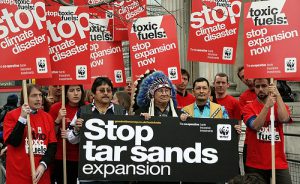
Canadian Prime Minister Harper has refused to impose tougher emissions standards on tar sands, saying it would be “crazy” to add new burdens on producers at a time of low prices, particularly as US producers wouldn’t be saddled with similar legislation.

Environmentalists say that Canada’s reliance on tar sands has prompted a big reduction in support for climate research, cuts in public money for renewable energy, weaker environmental laws and a big increase in subsidies for the oil and gas sector.

Sceptics say the primacy given to the oil sands industry  – an important source of earnings  – will mean that Canada may be blasé about missing a 2030 target, should production from unconventional oil be higher than forecast.

Canada withdrew from the 1997 Kyoto Protocol and admitted last year that it will miss a commitment agreed at the 2009 Copenhagen summit to cut GHG emissions 17% by 2020 from 2005 levels. 
Cookies Settings

Dialogue Earth uses cookies to provide you with the best user experience possible. Cookie information is stored in your browser. It allows us to recognise you when you return to Dialogue Earth and helps us to understand which sections of the website you find useful.

Required Cookies

Required Cookies should be enabled at all times so that we can save your preferences for cookie settings.

Dialogue Earth - Dialogue Earth is an independent organisation dedicated to promoting a common understanding of the world's urgent environmental challenges. Read our privacy policy.

Cloudflare - Cloudflare is a service used for the purposes of increasing the security and performance of web sites and services. Read Cloudflare's privacy policy and terms of service.

Functional Cookies

Dialogue Earth uses several functional cookies to collect anonymous information such as the number of site visitors and the most popular pages. Keeping these cookies enabled helps us to improve our website.

Google Analytics - The Google Analytics cookies are used to gather anonymous information about how you use our websites. We use this information to improve our sites and report on the reach of our content. Read Google's privacy policy and terms of service.

Advertising Cookies

This website uses the following additional cookies:

Google Inc. - Google operates Google Ads, Display & Video 360, and Google Ad Manager. These services allow advertisers to plan, execute and analyze marketing programs with greater ease and efficiency, while enabling publishers to maximize their returns from online advertising. Note that you may see cookies placed by Google for advertising, including the opt out cookie, under the Google.com or DoubleClick.net domains.

Twitter - Twitter is a real-time information network that connects you to the latest stories, ideas, opinions and news about what you find interesting. Simply find the accounts you find compelling and follow the conversations.

Facebook Inc. - Facebook is an online social networking service. China Dialogue aims to help guide our readers to content that they are interested in, so they can continue to read more of what they enjoy. If you are a social media user, then we are able to do this through a pixel provided by Facebook, which allows Facebook to place cookies on your web browser. For example, when a Facebook user returns to Facebook from our site, Facebook can identify them as part of a group of China Dialogue readers, and deliver them marketing messages from us, i.e. more of our content on biodiversity. Data that can be obtained through this is limited to the URL of the pages that have been visited and the limited information a browser might pass on, such as its IP address. In addition to the cookie controls that we mentioned above, if you are a Facebook user you can opt out by following this link.

Linkedin - LinkedIn is a business- and employment-oriented social networking service that operates via websites and mobile apps.