Energy

China’s climate action since the 12th Five-Year Plan 

A look back at China's path towards renewable energy and its shift away from coal
English
China’s leaders have stated that the old growth model has run its course, and that the country will build toward a more environmentally and economically sustainable model of development. Recent signs show that the country is already beginning to shift in this direction, and the new Five-Year Plan provides the opportunity to build on that progress.See also: Climate, energy and China’s 13th Five-Year Plan in graphics

China has made significant strides in decoupling energy use and emissions from economic growth—as of 2014 China was on track to exceed its 2015 energy and carbon intensity reduction targets. Three key trends have emerged:

  • Rebalancing the Economy: China’s leaders clearly intend to shift the impetus of the economy away from investment in heavy industry and toward consumer spending, services (such as retail businesses), innovation, and more innovative and efficient manufacturing. Under China’s 12th Five-Year Plan, services moved from 43 percent of the economy in 2010 to 51 percent last year, replacing manufacturing (which went from 47 percent to 41 percent of the economy) as the largest contributor to China’s GDP. Services continue to grow at a faster pace than manufacturing.
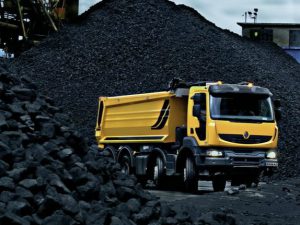
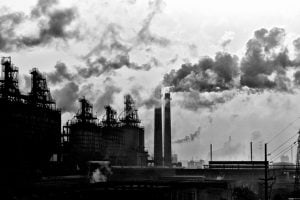
  • Limiting Coal: After years of steep growth in coal consumption, regional coal and carbon limits and new-coal-plant bans have been followed by a leveling off of coal use in 2014 and reduced output in heavy industries like steel (down 2 percent last year) and cement (down 6 percent). A continued shift away from these energy-intensive industries would weaken a major driver of air pollution and greenhouse gas emissions.
  • Non-Fossil Energy: China is the world leader in renewable energy, breaking records last year for installation of wind (32 gigawatts last year, 129 total) and solar power capacity (18 gigawatts last year, 43 total), and clean energy investment ($111 billion, nearly double U.S. investment).

China’s 13th Five-Year Plan will be an important foundation for this new action. The 12th Five-Year Plan outlined high-level policies and set targets, such as those for reductions in energy intensity and carbon intensity and an increase in the share of energy used from non-fossil sources. The new plan will likely define similarly broad goals and a framework for boosting further progress.
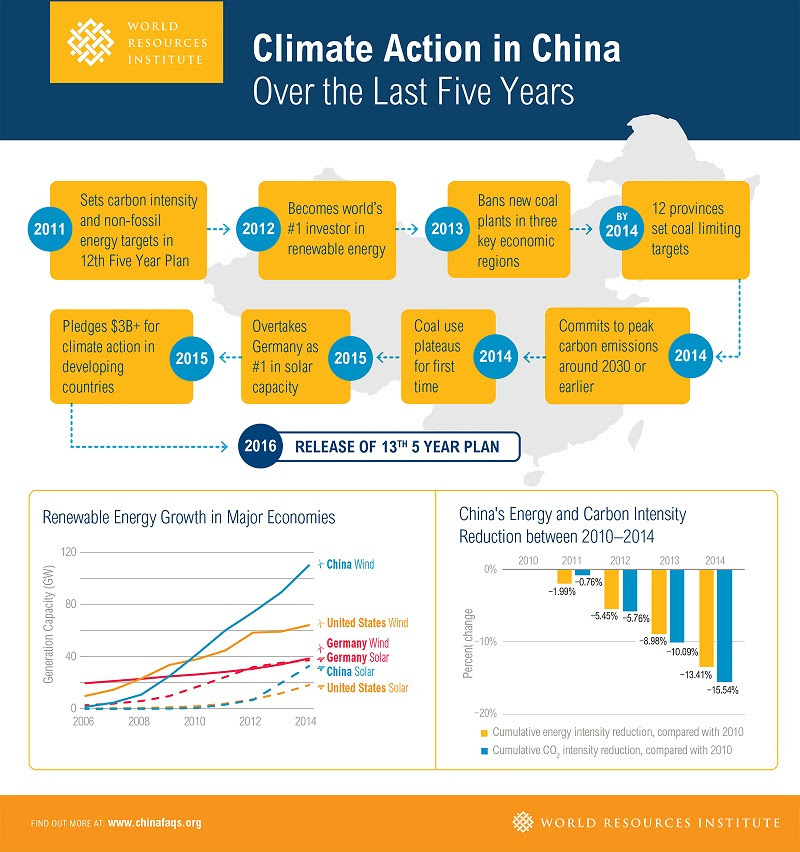
climate action in China over the last five years. in 2011 - set carbon intensity and non-fossil energy targets in 12th Fiver Year Plan. 2014 - Coal use plateaus for first time, 2014 - Pledges $38+ for climate action in developing countries

This blog has been edited from the original written by Geoffrey Henderson and Paul Joffe. It has been republished here with thanks to WRI
Cookies Settings

Dialogue Earth uses cookies to provide you with the best user experience possible. Cookie information is stored in your browser. It allows us to recognise you when you return to Dialogue Earth and helps us to understand which sections of the website you find useful.

Required Cookies

Required Cookies should be enabled at all times so that we can save your preferences for cookie settings.

Dialogue Earth - Dialogue Earth is an independent organisation dedicated to promoting a common understanding of the world's urgent environmental challenges. Read our privacy policy.

Cloudflare - Cloudflare is a service used for the purposes of increasing the security and performance of web sites and services. Read Cloudflare's privacy policy and terms of service.

Functional Cookies

Dialogue Earth uses several functional cookies to collect anonymous information such as the number of site visitors and the most popular pages. Keeping these cookies enabled helps us to improve our website.

Google Analytics - The Google Analytics cookies are used to gather anonymous information about how you use our websites. We use this information to improve our sites and report on the reach of our content. Read Google's privacy policy and terms of service.

Advertising Cookies

This website uses the following additional cookies:

Google Inc. - Google operates Google Ads, Display & Video 360, and Google Ad Manager. These services allow advertisers to plan, execute and analyze marketing programs with greater ease and efficiency, while enabling publishers to maximize their returns from online advertising. Note that you may see cookies placed by Google for advertising, including the opt out cookie, under the Google.com or DoubleClick.net domains.

Twitter - Twitter is a real-time information network that connects you to the latest stories, ideas, opinions and news about what you find interesting. Simply find the accounts you find compelling and follow the conversations.

Facebook Inc. - Facebook is an online social networking service. China Dialogue aims to help guide our readers to content that they are interested in, so they can continue to read more of what they enjoy. If you are a social media user, then we are able to do this through a pixel provided by Facebook, which allows Facebook to place cookies on your web browser. For example, when a Facebook user returns to Facebook from our site, Facebook can identify them as part of a group of China Dialogue readers, and deliver them marketing messages from us, i.e. more of our content on biodiversity. Data that can be obtained through this is limited to the URL of the pages that have been visited and the limited information a browser might pass on, such as its IP address. In addition to the cookie controls that we mentioned above, if you are a Facebook user you can opt out by following this link.

Linkedin - LinkedIn is a business- and employment-oriented social networking service that operates via websites and mobile apps.