Every time you see a ladybird beetle, you should tuck the bug in your wallet as they are prosperity-bringing lucky charms, according to folklore in many countries.
There’s a grain of truth in the old stories. Every ladybird in a cotton field in the North China Plain provides an economic benefit to farmers of at least 0.05 yuan (US$ 0.01).
This may not sound like much but doubling the current ladybird density in two-thirds of Chinese cotton fields could bring farmers around US$300 million per year.
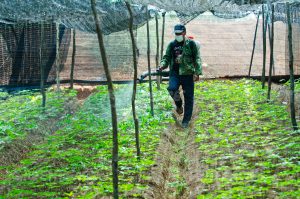
Ladybirds eat aphids that destroy cotton plants. Chinese farmers generally kill aphids using chemical insecticides. Long seen as the easiest and most affordable pest control method, insecticides are used on a mass scale worldwide.
Natural solutions
But chemical insecticide use suppresses the services nature offers for free. For aphids, the pretty and popular red and black beetles are vicious predators. Unleashed onto a field, it is estimated that one ladybird can kill 50 aphids per day, or some 5,000 in its lifetime.
Combining insect sampling and household surveys our research found significant economic benefits arising from ladybird beetles (for insect geeks: it’s mainly harmonia axyridis, propylea japonica, and coccinella septempunctata). We’ve calculated that each adult bug provides services worth 0.05 yuan per year, even alongside substantial insecticide use.
But most farmers don't know this.
Chinese fields host about 13,500 ladybirds per hectare. Doubling the average density of our spotted friends could potentially increase farmers’ income by 644 yuan (US$93.67) per hectare. Spread across two-thirds of cotton acreage in China, and that’s nearly two billion yuan (US$290.8 million) pumped into the economy per year.
Wide benefits
Proliferation of ladybird beetles could address more than the aphid problem. There are health and environmental benefits to farmers and society if chemical insecticide use is reduced.
Excessive use of insecticides by Chinese farmers carries environmental costs as the chemicals infiltrate food, water and ecosystems.
Insecticide exposure can cause negative health effects to farm workers, consumers, residents and livestock.
Excessive pesticide use also disrupts natural pest suppression systems by killing not only pests but other important organisms, such as ladybirds, feeding into a vicious cycle of increasingly frequent pest outbreaks due to pesticide resistance.
Pesticides can also undermine the profitability of farms. Insecticide use is expensive and can put farmers on a “pesticide treadmill” where they forgo other solutions. China’s farmers could bolster their long-term bottom line by purchasing less insecticide.
Escalating gains
Our research shows that the less pesticides farmers use, the more ladybirds can expand their aphid-killing services.
If we cut current, excessive insecticide use of 22.35 kilograms per hectare to one quarter of this amount, the marginal value of the ladybirds would rise from more than two and a half times, from 48 yuan (US$6.98) to 118 yuan (US$17.6) per hectare.
Once the biological control services – in this case ladybird services in cotton fields – begin to flourish, farmers may reduce insecticide use even further, though additional incentives may be needed. However, the value of ladybird beetles and other natural predators could rise, creating the virtuous cycle that sustainable agriculture urgently needs.
The findings provide a strong economic, health and environmental case for policies that move away from chemicals and provide more support to farmers to reduce pest risks.
But too often, farmers and policymakers lack this knowledge. How can we change this? First, we need to quantify and disseminate the hidden values of biological pest controls. Communicating these should be prioritised, for example, through the agricultural extension service, which can also share information on health risks and adverse environmental effects of agrochemicals.
Five facts about ladybirds
- Ladybugs aren’t in fact bugs, but beetles
- The lady in the name ladybird refers to the Virgin Mary. In the Middle Ages, farmers whose crops were plagued by the beetles would pray to the Blessed Lady for deliverance.
- Ladybirds are cannibals
- The properties of ladybird wings are currently being researched for robotics, mechanics and aerospace engineering (for their storage qualities and strength)
- Ladybirds release noxious compounds from their knees when threatened
The authors acknowledge financial support from the Ecosystem Services for Poverty Alleviation (ESPA) Programme, the External Cooperation Program of the Chinese Academy of Sciences, Dutch Science Foundation, the National Science Foundation of China, and the Ministry of Science and Technology, Huzhou University, Wageningen University and the Chinese Academy of Agricultural Sciences.