In a new study of 12,740 urban Chinese roads, only 15 scored top marks for pedestrian-friendliness. One in ten roads got no points at all.
The study by the Natural Resources Defense Council (NRDC) and Tsinghua University evaluated streets in 50 Chinese cities using a Google Streetview equivalent to create an Environment Score and a Walk Score.
The Environment Score is a kind of pleasantness metric that factors in the frequency of pedestrian crossings, greenery, the height of surrounding buildings and pavement width.
The Walk Score measures interest and utility by counting up the number and variety of shops, restaurants, parks, banks and other amenities.
Passable does not mean pleasurable
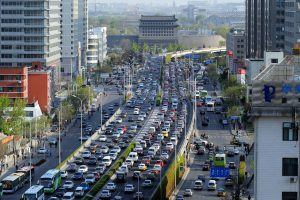
China’s permanent urban population had reached 830 million by the end of 2018. As that number swells so does contention between vehicles and pedestrians. Meanwhile, increasing car ownership contributes to congestion, pollution and other “urban diseases”.
Urban planners are starting to prioritise pedestrians over vehicles. But they must do more than give space to walk. They need to ensure a positive overall experience.
Since 2014, the NRDC has published four reports on China’s pedestrian-friendliness. The first and second considered safety, comfort, accessibility and upkeep. The third looked at how far streets encourage walking, based on criteria like shop variety and frequency (essentially a Walk Score).
The most recent, fourth report introduces the Environment Score and focuses on 71 urban “live-work-play centres” – complex areas with cars, pedestrians, shops and other services.
The nearly 13,000 streets in the report were evaluated from more than 30,000 observation points. The upshot is that China’s streets are less than ideal for pedestrians. The average street Environment Score was only 42% and only 10 live-work-play centres had streets with an average score of more than 50%. Walk Scores were much higher, with 91% of streets earning 90% or more.
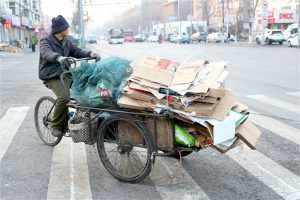
The major problems were a lack of pedestrian crossings, greenery and barriers to keep pedestrians safe from vehicles and bicycles, and pavements being obstructed by objects like street stalls.
Are wider roads better?
Although wide streets between large blocks of buildings are often considered unfriendly for pedestrians, the report gave them much higher Environment Scores than narrower streets.
Yao Yiting, one of the authors of the report and a policy analyst with the NRDC, used the Barkhor area around the Jokhang Temple as an example. In this part of Lhasa there is almost no separation of pedestrians and vehicles, putting safety at risk. The same is seen in many historic urban centres, which feature traditional residences or historical attractions, narrow streets with no possibility of widening, poor facilities and a lack of management.
In contrast, China’s wider streets tend to be key urban routes, where maintenance is well funded.
Liu Shaokun, vice country director for the Institute for Transportation and Development Policy, said that wider roads are better for pedestrians, giving them more room and reducing problems such as cars parked on pavements.
Yao Yiting thinks there are pros and cons to both layouts, and the scores don’t mean wider roads are necessarily better – just that they happen to be better built. “As urban transport planners, we still much prefer smaller streets.” Main urban routes may be more pedestrian-friendly, but cannot reach every part of the city. Using smaller streets as the “capillaries” would aid pedestrian-friendliness, Yao Yiting added.
Public doubts
The highest-rated streets in the report include Zhongguancun in Beijing, Tianhe Street-Tiyuguan East Street in Guangzhou and Shanda North Road in Jinan. But the public are not convinced that these are actually pedestrian-friendly.
A Weibo post on coverage of the report in thepaper.cn garnered 650 comments. Of the 10 top-rated comments, six disagreed with Zhongguancun receiving the highest score.
One commenter said: “I’ve worked in Zhongguancun for years. It’s not set up well, and it’s a nightmare with all the people at rush hour.”
Yao Yiting responded that the report carried out a virtual assessment, with scorers looking at photos of the streets, and so couldn’t cover every characteristic of the streets: “The pedestrians have a more comprehensive experience, so there are differences.”
Liu Shaokun said: “In 20 years the vast majority of Chinese people will be living in cities, and we’re starting to see changes in ideas of development. But only a start. There are challenges at every level as we move from how we think about management of our streets, to how we implement that thinking and how we maintain it.”
According to the report, cities should spend more money improving smaller streets, and prioritise reclaiming space taken up by cars and traders.
“Focus on pedestrian-friendliness is one form of a city’s soft power,” the report says, “and soft power is key if a city is to win the competition to attract talented residents.”