From her house in Labota village, Nurjana sees the towering chimneys of the Sulawesi Labota power station spewing white smoke day in, day out.
Editor’s note:
This is the fourth in a five-part series on Indonesia’s captive coal – private, off-grid coal plants that are being built to power industrial operations. Largely invisible in national energy transition plans, captive coal is justified by the country’s export strategy. Our series investigates the loopholes that have kept coal expanding, who is benefitting, and what it means for a country caught between climate commitments and industrial ambition.
Read parts one, two and three here.
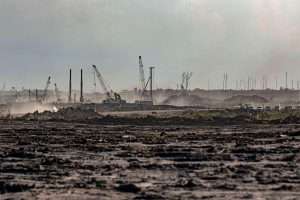
The power station is located inside the Indonesia Morowali Industrial Park (IMIP) in Central Sulawesi province. It contributes to the park’s 3.36 gigawatts of generation capacity, dedicated to the various nickel smelting and processing operations of IMIP’s tenants.
“There are loud noises, vibrations, and also the ashes from coal,” said Nurjana.
Her house is 50 meters from the shore of residential area Dusun 3 Labota, where a coal barge is docked.
“There are coal power plants at the front and a coal barge at the back. We’re surrounded by coal,” she told Dialogue Earth.
In the neighbouring province of North Maluku, the people of Kawasi village on Obi Island in South Halmahera have seen their livelihoods upended in more ways than one. This is following the arrival of nickel mining and extraction company Harita Nickel, whose operations are powered by captive coal plants.
Since 2024, some residents of Kawasi have gradually moved to a new settlement. According to a Harita Nickel media statement released that year, this was initiated by the South Halmahera Regency government with the company’s support.
As of September 2024, 216 families have moved to the new settlement, while 116 choose to stay, according to a paper in the Journal of Administration and Development (Jadment). Environmental advocacy group WALHI told Dialogue Earth that as of May this year, “around 100-plus” households remain in the original settlement.
In an August 2026 media statement, Harita Nickel says the new Kawasi settlement is equipped with electricity and clean water facilities, as well as educational and healthcare services.
In the statement, Harita said it continues to support residents who remain in the original settlement by maintaining its electricity supply. It also said the South Halmahera Regency Government has officially handed over land ownership certificates to residents in the new settlement.
However, Kawasi villagers have expressed various concerns about the new settlement. A villager was quoted in the Jadment paper as saying it is located about one kilometre away from the shore, while its previous location was right on the shoreline. This, he said, threatened the sustainability of his work as a fisher.
We don’t want to exchange our ancestors’ land with moneyNurhayati Jumadi, who lives in the village of Kawasi and has not moved
Nurhayati Jumadi is a Kawasi villager whose mother and siblings moved to the new settlement. She said they were initially compensated for their house but not their land. After complaining, the company agreed to pay IDR 10,000-12,000 (USD 0.56-0.68) per square metre for the land, she noted. In addition, they were also promised compensation of IDR 15 million (around USD 850) per month, which she said they did not receive.
“The first and foremost reason why we refuse to move is because we don’t want to exchange our ancestors’ land with money,” said Jumadi at a press conference at WALHI’s headquarters in Jakarta in May 2026, which Dialogue Earth attended.
Harita Nickel has yet to respond to Dialogue Earth’s requests for comment on the relocation of Kawasi residents.
Sulawesi and North Maluku are hotspots for Indonesia’s boom in nickel, a critical mineral used in the production of electric vehicles (EV) as well as stainless steel. This boom drives the rise of captive coal power plants – ones that are off-grid and dedicated to industrial facilities – prompting more demands for coal and compromising Indonesia’s energy transition targets, notably of reaching net-zero emissions by 2060.
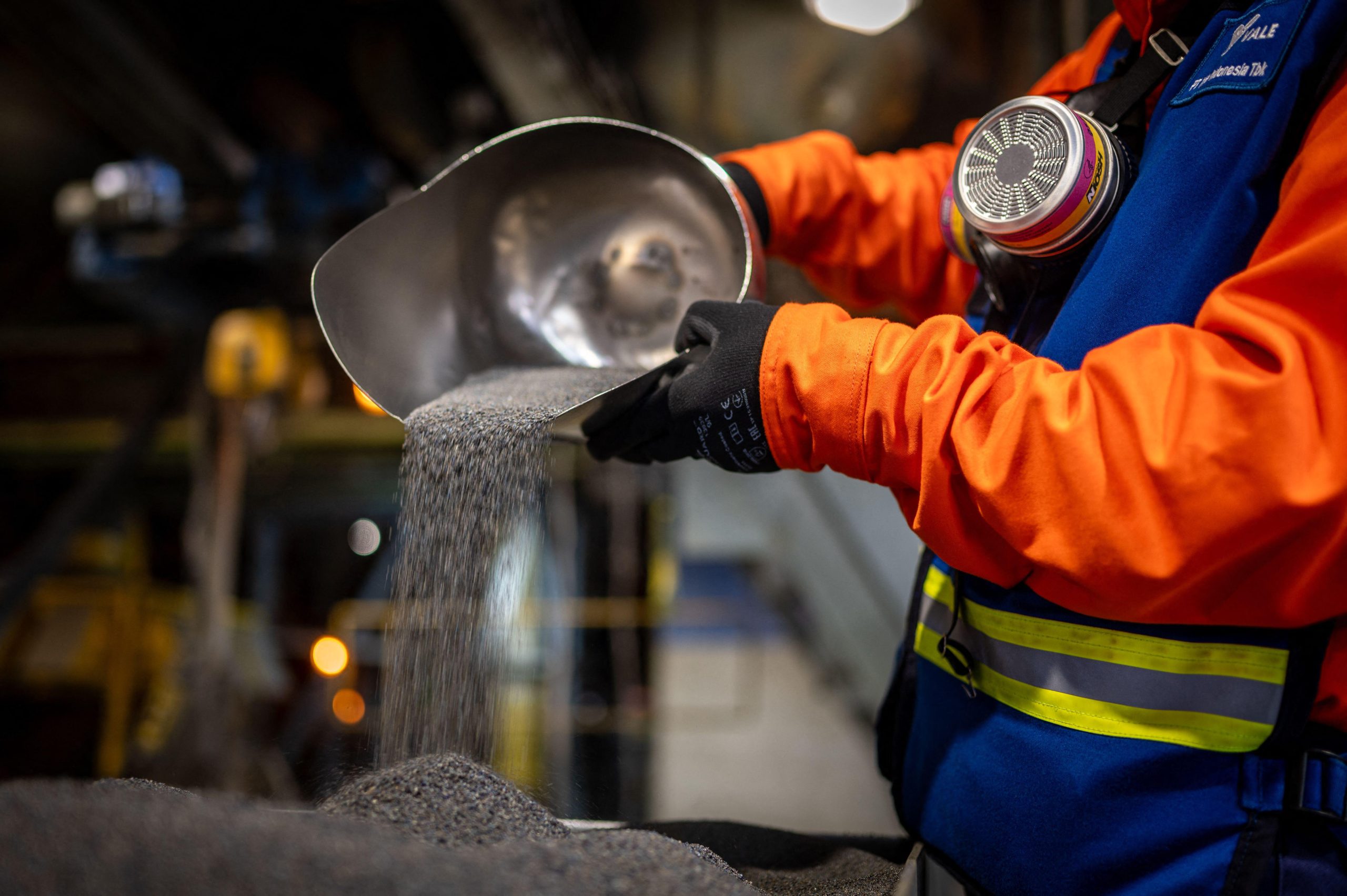
A 2026 report by the Center for Research on Energy and Clean Air and Global Energy Monitor stated that Sulawesi and North Maluku are “firmly established as the island groups with the highest captive coal power generation capacity in Indonesia”. When broken down by industries, nickel remains the main driver of captive coal, with 15.4 gigawatts (GW) in operation and 2.5 GW in construction.
Under the Just Energy Transition Partnership (JETP), Indonesia set up an ambitious agreement back in 2022 to mobilise USD 20 billion in public and private financing to support the shift to renewables in a fair manner. However, the reality is far from this ideal.
These finance agreements support developing countries in transitioning to cleaner energy sources and are primarily shaped to be as equitable as possible.
The funding is provided by a group of countries initially comprised of Canada, Denmark, France, Germany, Italy, Japan, Norway, the Netherlands, the United Kingdom and the US.
The first JETP, dedicated to South Africa, was announced at the UNFCCC’s COP26 in 2021. Since then, Indonesia, Vietnam and Senegal have also established Just Energy Transition Partnerships.
“The extraction of natural resources sits at the forefront of Indonesia’s energy transition process, while on the other hand, the people in North Maluku don’t necessarily enjoy the benefits of the nickel downstreaming itself,” said Faisal Ratuela, WALHI’s anti-mining and just energy transition campaigner, during the May press conference.
Living in ruins
A 2025 report by Women’s Solidarity Palu (SP Palu) examined effects of captive coal plants on women in Labota and Fatufia villages, both located near IMIP.
The report found that the marine ecosystems in the area have been affected by both pollution from coal combustion waste, and disturbance from vessels carrying coal, impacting both the livelihood and health of village residents.
For instance, women now struggle to harvest meti, a type of clam which was a source of income and sustenance. Due to the harvest area being used for the construction of a coal jetty, women now have to buy the meti they consume. They travel to a different island to do so, paying an additional IDR 60,000 (USD 3.38) per person for the trip.
Wastewater discharge from the captive coal plants have warmed the seawater, causing fish to migrate further away, the report noted. “Before, they could just catch fish near their home, but now, women need to travel further away, around three kilometres, to catch fish,” said Isna Ragi, programme coordinator at SP Palu and co-author of the report.
“Everything is ruined,” said Nurjana. Now, she relies solely on her husband’s income as an ambulance driver. Other women have been forced to find alternate sources of income, from opening boarding houses to scavenging for discarded plastic bottles.
The report also said that in Fatufia, a foul smell has emerged from the coal discharge, which is strongest at night, from 8 pm to 3 am. The community has also had to deal with fly ash, a by-product of coal combustion.
“Usually, women just need to sweep their house once a day, but because of the ashes from coal, they need to sweep up to nine times a day,” said Ragi. “It’s just one example of the extra burden [faced] by women in captive coal areas.”
This has also taken a toll on the communities’ health. According to a 2025 investigative report by news outlet Tempo, the Central Sulawesi Health Agency recorded nearly 340,000 cases of acute respiratory tract infection in 2024, which is almost 9% more than the year before. Around 66,000 of them were in the Bahodopi district, where Labota, Fatufia and IMIP are located. “The presence of industry in Morowali caused respiratory infections and diseases caused by the environment to rise significantly,” Ashar Ma’ruf, head of the Morowali Regency Health Office, told Tempo.
“We often cough, or experience difficulty breathing, or flu. If the wind is strong, we have to wear a face mask because the fly ash would be everywhere,” said Nurjana.
Left out
The ones bearing the brunt of impacts of development are also being left out of conversations about it.
“The people in Labota village are confused as to why such developments are already underway without [consultation with] the locals,” said Nurjana.
A 2025 report on Indonesia’s regulatory and institution framework noted that public participation in the country is weak. This has been demonstrated by Indonesia’s top-down implementation of National Strategic Projects (PSNs), it noted. The designation allows industrial developments to use captive coal and exempts them from the country’s 2022 ban on new coal-fired power plants.
The report, published by the Indonesian Centre for Environmental Law (ICEL) and the Centre for Economic and Law Studies (Celios), noted that due to existing regulations prioritising the advancement of PSNs, the public is only engaged in the environmental permitting process, rather than consulted from the beginning of projects.
Ragi of SP Palu said though the Bahodopi district is rich with natural resources, it is investors rather than local people who get to enjoy the rewards of the projects.
“Men and women, children and elderly, people with disabilities and other marginalised people, they’re the ones who bear the negative effects of the national strategic projects,” she said.
The local governments of South Halmahera and Morowali did not respond to requests for comment on the impacts of captive coal on local people.
According to data from the Ministry of Investment and Downstream Industry (BKPM), Central Sulawesi is a favoured destination for foreign direct investment, becoming the top recipient of such investment in 2022 when it attracted almost USD 7.5 billion.
Local communities should be able to become the main players in energy transition, notYuyun Harmono, climate and energy campaigner, Greenpeace Indonesia
merely employees
However, a 2024 report by research and public policy institution The Prakarsa noted that such investment has had little impact on reducing poverty rates. In Central Sulawesi, these stood at 13% in 2021, only marginally decreasing to 12.3% in 2022.
Yuyun Harmono, Greenpeace Indonesia’s climate and energy campaigner, emphasised that meaningful participation goes beyond employment in the industry. “Local communities should [be able to] become the main players in [the] energy transition, not merely employees.”
The community does not refuse investment meant for economic distribution and infrastructure, said Jumadi.
“But we do ask: who is this really for? Because we don’t get a taste of it,” she said. “At the very least, we should be able to enjoy the taxes from the nickel trade in the form of infrastructure like village roads and permanent housing.”