Every monsoon, swollen rivers give Nepal a surge of hydropower, creating a surplus. Some of that could supplement downstream neighbour Bangladesh’s fossil-fuel-dependent electricity supply. But as the two countries do not share a border, electricity trade between them must pass through India’s transmission network, which comes with some conditions.
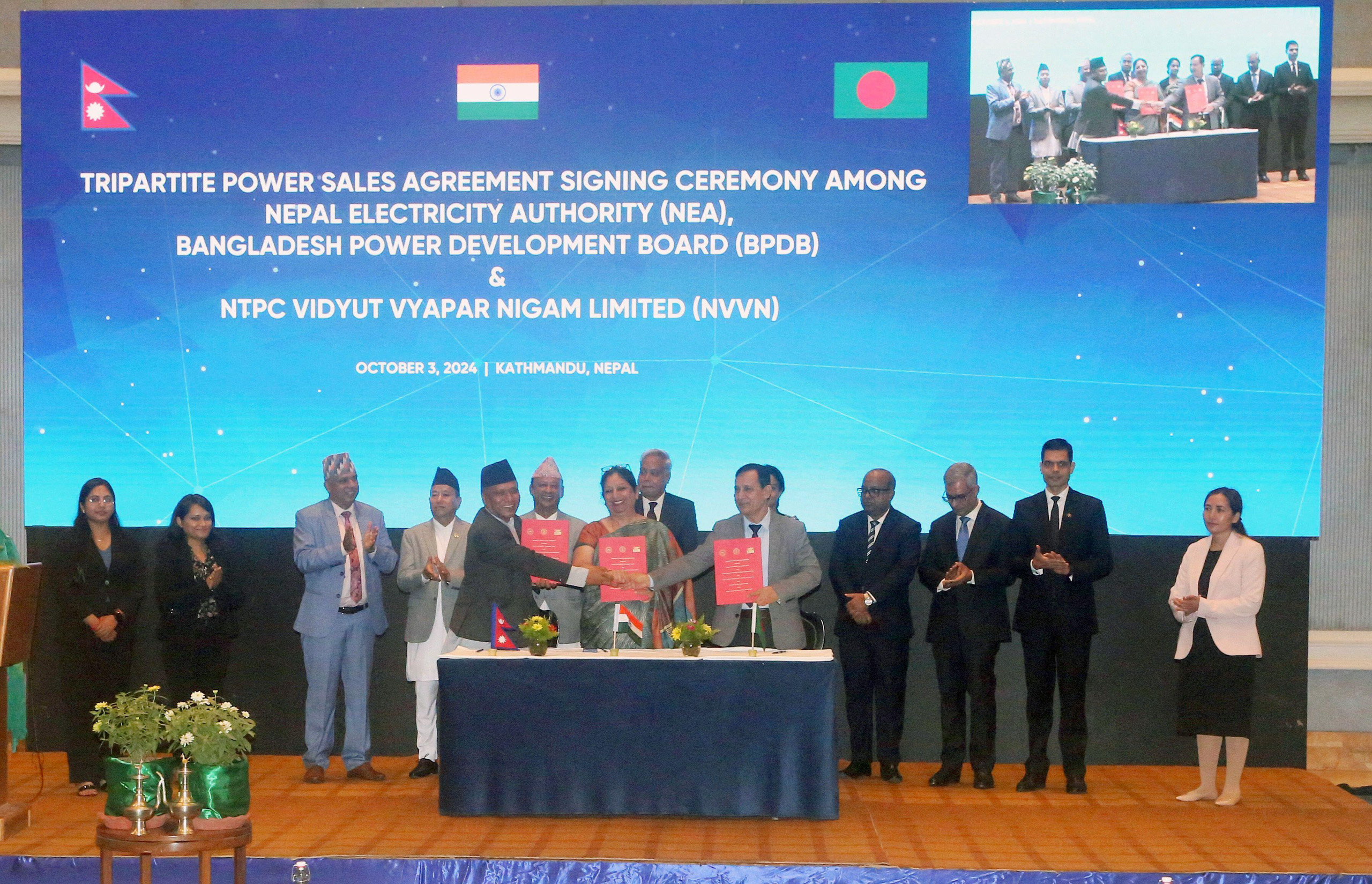
Since 2024, Nepal has been exporting 40 megawatts (MW) of electricity to Bangladesh through India’s transmission network every June to November. It wants to export 20 MW more. But this June, the Indian power trading company which manages cross-border grid operations with Bangladesh declined the request, Nepali government officials told the Kathmandu Post. The company, NTPC Vidyut Vyapar Nigam Limited, reportedly cited capacity constraints on the India-Bangladesh transmission line.
In July, India held energy cooperation talks with Nepal. While there was development on bilateral energy coordination, there was no resolution on the 20 MW issue.
That amount is minuscule compared to the size of the three countries’ electricity grids, which have a combined total installed capacity of around 586 GW. But energy experts, officials and power-sector analysts in those countries told Dialogue Earth the 20 MW impasse is more nuanced than it appears. There are technical, procedural and political factors at play, they note.
While Bangladeshi and Nepali experts point to unused capacity on the India-Bangladesh transmission link, Indian experts say there could be a genuine capacity limitation on the line. In the absence of a regional body and trade mechanism dedicated to energy, procedural lapses and politics also have major roles to play, they note. Strained India-Bangladesh relations since Bangladesh’s 2024 change of government may also be involved.
Nepal’s growing role as a hydropower exporter must also be viewed together with its vulnerabilities. On 26 August, a flash flood swept through the Bhotekoshi and Trishuli river systems, killing at least 900 people. The flood also damaged 12 hydropower plants and critical transmission infrastructure, according to India Today. A Nepal energy ministry official told Bloomberg nearly 360 MW of hydropower capacity has been damaged, and that the country may seek electricity from India to bridge shortages. It is too early to know how the catastrophe will affect Nepal’s energy exports.
Why Bangladesh wants Nepal’s hydropower
Nepal and Bangladesh have complementary electricity needs. The summer monsoon gives Nepal surplus hydropower, which Bangladesh can use to diversify its energy sources. In the dry winter, these roles reverse somewhat – Nepal faces shortages while Bangladesh’s demand dips – making cross-border trade beneficial in both directions over the year.
In 2025-2026, Nepal’s total installed capacity reached 4.1 GW, but monthly peak domestic demand stood at only around 2.5 GW, according to the Nepal Energy Authority. Electricity exports bring total demand up to about 3.2 GW.
Bangladesh has 32 GW of installed power generation capacity, 98% of which is dependent on fossil fuels, according to energy think-tank Ember. The country wants to diversify sources to meet its current demand. Bangladesh also aims to cover 20% of its electricity needs from non-imported renewables by 2030.
Energy trade between Nepal and Bangladesh therefore makes “economic sense”, says Shahriar Ahmed Chowdhury, director of the Centre for Energy Research at United International University in Dhaka.
“Hydropower from Nepal and Bhutan could provide Bangladesh with a cheaper source of electricity than many of the country’s existing generation sources,” says Shafiqul Alam, lead analyst for Bangladesh energy at the Institute for Energy Economics and Financial Analysis.
“Ideally, electricity trade should work both ways,” Chowdhury says. But expanding such trade is “a political decision”, he notes. “The volume is small, but it is important because it marks the beginning of cross-border electricity cooperation.”
Cross-border electricity trade helps Bangladesh primarily by shielding it from geopolitical disruptions to energy supplies, volatility in international fuel prices and diversification, experts say.
After all, the additional 20 MW will not help Bangladesh meet its 20% renewables target. There is no plan to include imports within what is a domestic generation target, says Aninda Islam Amit, Bangladesh’s state minister for power, energy and mineral resources. He expects the country’s private sector to “take the lead” on renewables as there are “incentives for private entrepreneurs”, he tells Dialogue Earth.
For Nepal, the energy trade is part of a much larger ambition. During the July energy talks, it agreed to increase its export capacity as India ups its import capacity. Nepali energy minister Birajbhakta Shrestha tells Dialogue Earth that the deal is another step towards fulfilling the country’s agreement to export 10 GW of electricity to India, signed in 2024.
A Nepali energy ministry official, requesting anonymity, says the immediate 20-MW issue could be resolved through trilateral discussions between Nepal, India and Bangladesh.
India holds the missing link
The 40 MW Nepal currently exports to Bangladesh is transported by the Baharampur-Bheramara high-voltage DC interconnection from east India, where it arrives on a transmission line from southern Nepal.
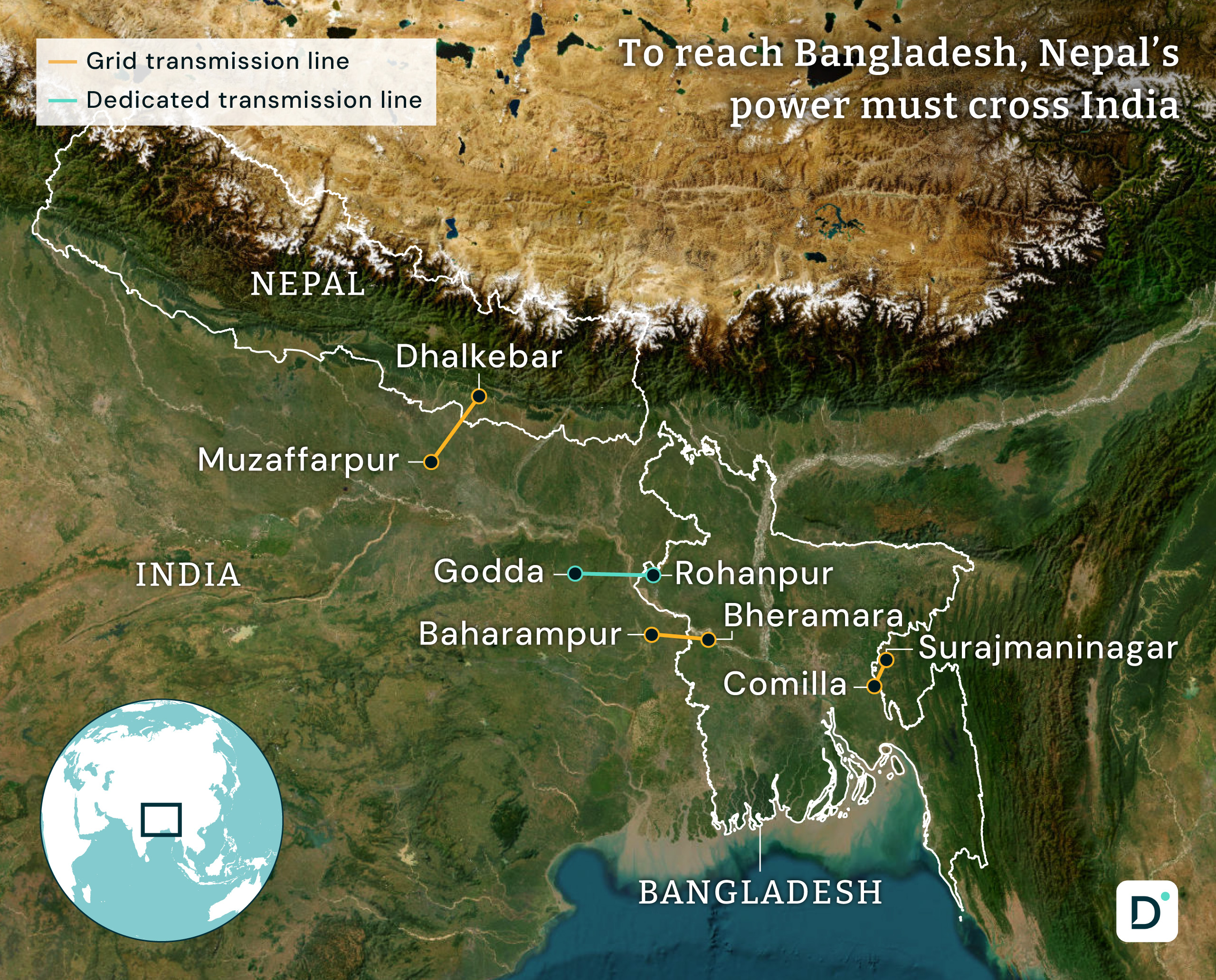
The Baharampur-Bheramara link between India and Bangladesh has a transfer capacity of 1 GW. The country typically receives around 920-930 MW through the link, leaving some unused transfer capacity, said a Bangladesh Power Division official speaking on condition of anonymity.
Nepal has also been considering alternatives. “If power cannot be exported via the Baharampur-Bheramara line, there is option for Nepal to export the additional 20 MW through other Indian transmission lines connected to Bangladesh,” says Manoj Silwal, former deputy managing director of the Nepal Electricity Authority.
Apart from the Baharampur-Bheramara link, Bangladesh also imports nearly 1.7 GW from India: 160 MW through the Surajmaninagar to Comilla interconnection, and 1.5 GW from Godda to Rohanpur, the latter operated by Adani Power.
However, transporting the 20 MW via existing corridors may not be feasible for a few reasons, says Nikit Abhyankar, an energy efficiency expert at the University of California, Berkeley. It is possible that these corridors are fully utilised.
Additionally, the average amount of electricity a transmission line carries is not necessarily the capacity that is safely available, Abhyankar notes. At times of peak demand, power flows can be much higher, and some capacity must be reserved to manage unexpected failures elsewhere in the system. “I would be very surprised if they are actually going to operate a 1,000 MW line at 1,000 MW capacity,” Abhyankar says.
A line may also be unable to deliver its rated amount of electricity due to losses from transfers. In a high-voltage DC connection, such as Baharampur-Bheramara, some electricity is lost when power is converted from AC to DC, as it travels along the transmission line, and when converted back to AC at the receiving end. Abhyankar estimates that roughly 40-50 MW could be lost on a 1-GW line.
The Baharampur-Bheramara corridor is also loaded with India’s own exports to Bangladesh. India’s Central Electricity Authority “doesn’t want to run the line close to its thermal limit … on a line that also carries India’s own bilateral exports”, notes Binit Das, deputy programme manager for renewable energy at the Centre for Science and Environment (CSE).
For the India-Bangladesh link, battery storage could potentially help if the line has spare capacity during periods of lower demand, Abhyankar adds. But feasibility depends on how much the power flow on the interconnection varies over the day.
Politics complicates power trade
Geography presents India with an unavoidable role in any future Nepal-Bangladesh electricity trade. “There is no other way that Bangladesh can get power from either Nepal or Bhutan without that being facilitated by India,” says Bipul Chattopadhyay, executive director of the Consumer Unity & Trust Society (CUTS), India.
Experts see this 20 MW episode as a litmus test for how India prioritises capacity across competing uses of a shared asset. During this impasse, India and Nepal separately reached a much bigger capacity decision: to raise Nepal’s export quota from 1.1 GW to 1.65 GW.
“The asymmetry between how quickly that bilateral decision happened and how long the trilateral 20 MW has languished is itself the clearest evidence of where the region’s integration problem actually sits,” says Das of the CSE.
India’s role in Nepal’s hydropower sector also complicates the picture. Several Indian companies are developing major hydropower projects in Nepal, while India is also Nepal’s principal electricity export market and the transit country for its exports to Bangladesh.
India could increasingly draw on Nepal’s hydropower to meet its own rising demand, Chattopadhyay says. The challenge is to develop a framework that works for all the countries involved.
“It should be win-win for all three parties,” he says. “That model is not difficult to develop, but that is something which is still missing in our current political-economic discourse.”
He also raises political considerations in the 20-MW denial. Relations between India and Bangladesh have been strained since former prime minister of Bangladesh, Sheikh Hasina, went into exile in India in August 2024, where she remains.
“After the change in government in Bangladesh, [the] India-Bangladesh relationship is yet to get on the right track … it’s very frosty,” notes Chattopadhyay.
A South Asian electricity market?
The difficulty of moving a mere 20 MW points to bottlenecks in cross-border energy trade in a region with growing energy needs.
Every prior expansion of the transmission corridor, including the original 40 MW, was formalised through a Joint Steering Committee (JSC) decision followed by a tripartite agreement. The 13th Nepal-India JSC meeting was held in July, having last convened in February 2025, but failed to yield success with the 20 MW addition.
There is also a broader institutional problem. Cross-border electricity trade between Bangladesh, Bhutan and Nepal, where it goes through India, requires multiple layers of approval. This includes a tripartite power sale agreement, clearance from India’s Central Electricity Authority and a JSC to anchor the decision.
Over the last few years, Bangladesh, Bhutan and Nepal have signed bilateral agreements with India to develop electricity trade. As of April, India has entered into 17 power-sector agreements with neighbouring countries. It is also involved in 13 cross-border power-generation projects and 30 transmission-link projects.
Trilateral and regional transactions carry a layer of political and procedural friction that bilateral ones don’t, Das says. This makes the region’s power systems interconnected yet fragmented.
The potential benefits of deeper integration are significant. Cross-border electricity trade can allow these countries to complement one another’s demands, reducing reliance on fossil fuels while improving energy security and lowering costs, joint research by CUTS and Chintan Research Foundation found.
The stakes are also different for countries of different sizes. “For a large system like India … small cross-border trade doesn’t really make a huge difference. But for countries like Nepal to sell their hydroelectricity [and] for countries like Bangladesh to meet their electricity demand reliably, cross-border trade becomes important,” says Abhyankar.
Yet there is still no subregional institution focused on coordinating and facilitating cross-border electricity trade. A regional power exchange, an agreed open-access framework, or institutionalised, calendar-bound trilateral bodies could provide a more predictable way of handling third-country transit, says Das.
“Without such a mechanism, episodes like the 20-MW holdup could continue to recur even as the region’s growing hydropower surplus and complementary electricity demand make the case for trade increasingly obvious,” he says.