Around half of the world’s offshore wind capacity is in China and that share is growing.
In July, the country set an ambitious target to grow its roughly 47 gigawatts (GW) of capacity to 100 GW by 2030.
Debate over offshore wind often returns to a simple objection: each kilowatt-hour costs more to generate than one from solar or onshore wind. But that comparison misses some of offshore wind’s value.
Much of China’s cheapest wind and solar resource is far inland to the west and north, while its largest centres of electricity demand lie along the eastern seaboard. Generation costs alone do not show what coastal provinces might gain from producing more of their own power.
In a study published in Communications Earth & Environment, we found that reaching 1,000 GW by 2050 could turn China’s coastal region from a net electricity importer into an exporter. It could also increase employment in coastal provinces’ power sectors, while reducing the need for new long-distance transmission.
China has yet to set a national-level offshore wind target beyond 2030. We argue that aligning local priorities with national decarbonisation goals can motivate policymakers to set more ambitious offshore wind targets and better engage local stakeholders in the scale-up.
What the model tested
Using GridPath, an open-source power systems simulator, we represented China’s system as 32 provincial nodes connected by 184 transmission corridors.
In the baseline scenario, which uses BloombergNEF technology cost trends, offshore wind capacity reaches about 214 GW by 2050.
In the moderate scenario, envisaging a 43% decline in offshore wind costs by 2050, that rises to 250 GW. (The drop in costs is consistent with the advanced scenario in the 2022 Annual Technology Baseline database from the National Renewable Energy Laboratory in Colorado.)
In the aggressive scenario, it’s 1,000 GW. Based on the same 43% cost decrease, this assumes China will achieve its ambitious 2030 target of 100 GW and then accelerate from there.
The highest figure is not a forecast but an exploration of what’s possible. It is informed by targets in other large economies and remains within published estimates of China’s technical potential.
Coastal provinces could produce more of their own power
The large distances between China’s best renewable resources and its centres of power demand has encouraged large flows of electricity across provincial borders, and continued investment in long-distance transmission.
Between 2021 and 2023, several coastal provinces had to ration power. Since early 2022, China has approved over 150 GW of new coal capacity, much of it justified by exactly this reliability anxiety.
Offshore wind offers a large clean resource close to coastal demand. Compared with the baseline scenario’s 813 terawatt-hours (TWh) of net imports in 2050, in the aggressive scenario the ten coastal provinces become net exporters of 88 TWh. Their average energy self-sufficiency rises by 26 percentage points compared with the baseline.
The provincial picture varies in the aggressive scenario. Zhejiang exports 409 TWh, equal to 44% of its own demand. For Jiangsu it’s 228 TWh, Shandong 123 TWh, Fujian 92 TWh and Guangdong 77 TWh. Other coastal provinces continue to import electricity, which is why the region’s combined net export is much smaller than for these five provinces alone.
Offshore wind’s share of coastal generation rises from 20% in 2030 to 45% in 2050. In Jiangsu and Guangdong, it becomes the largest source of electricity, overtaking nuclear power. These results point to an energy security case for offshore wind alongside the climate case.
Investment and employment shift towards the coast
In the aggressive scenario, cumulative investment in coastal power generation reaches about USD 2.6 trillion in 2025-2050, around 15% more than in the baseline.
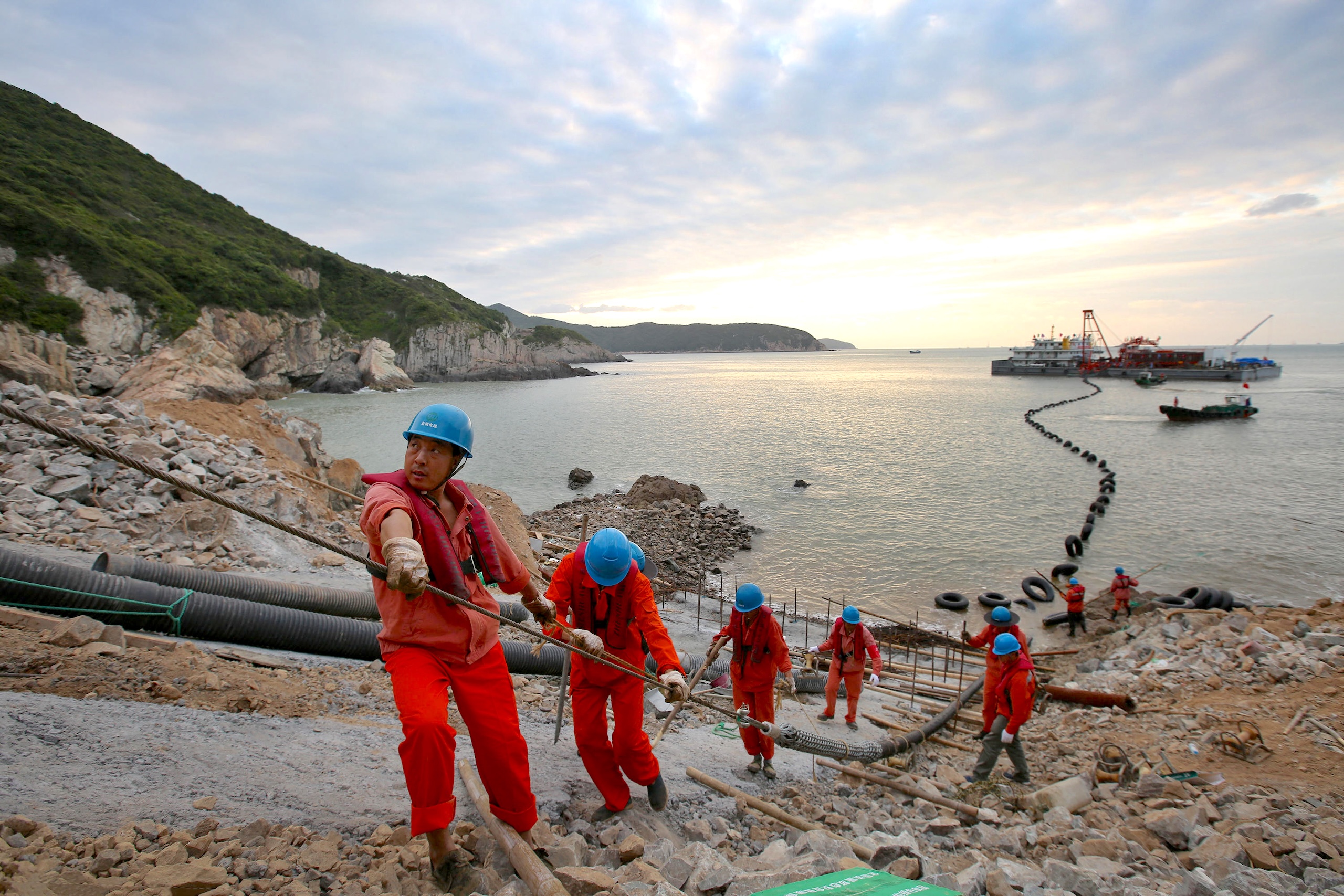
Cumulative employment across the ten coastal provinces rises from 41.7 million to 48.3 million “job-years”, meaning one full-time job for one year. The model includes work in equipment manufacturing, construction and installation, and operations and maintenance.
The shift also creates trade-offs. Investment in inland generation falls by 6%. Inner Mongolia, currently China’s largest electricity-exporting region, sends 318 TWh less power to other provinces than in the baseline. Provinces that have built industries around supplying electricity to the east could therefore see lower investment and exports. National planning would need to account for those regional effects.
Less pressure on transmission and storage
Building generation close to demand changes how the wider grid is used.
In the aggressive scenario, total interprovincial transmission capacity in 2050 is 13% lower than in the baseline. East and south China move towards exporting more power, while the north-west’s role as a supplier declines.
Compared to solar, offshore wind produces power across a different daily and seasonal profile. In the aggressive scenario, this difference reduces the use of storage needed to balance the system. National battery discharge falls by 54 TWh and pumped hydro by 29 TWh. Average annual storage discharge drops by 81% in Zhejiang, 43% in Jiangsu and 19% in Guangdong.
These effects represent system value that a comparison of generation costs does not capture. They do not mean that offshore wind removes the need for storage or transmission. Rather, the model chooses a different mix of infrastructure when more electricity is generated near coastal demand.
How to get on the aggressive pathway?
Three policy questions follow from the results.
First, China’s plans after 2030 will matter. Across the cases tested, offshore wind supplied between 3% and 18% of China’s electricity in 2050. An ambitious long-term policy target would have a large influence on offshore wind deployment.
Second, transmission plans may need to adapt. China’s grid has long been designed to move large volumes of power from west to east. If coastal provinces generate much more electricity offshore, some planned long-distance capacity may no longer be needed. Coordinating offshore development with transmission investment could reduce the risk of overbuilding.
Third, further power-market reform could make it easier to trade coastal surpluses. Interprovincial exchange still relies heavily on bilateral government agreements, while spot trading remains limited across provinces. Provinces are more likely to build beyond their own needs if they have reliable routes to sell the electricity.
Electricity demand is another major uncertainty. In our analysis, offshore wind capacity was 86% higher in a high-demand case than in a low-demand one. Continued electrification and new industrial loads could therefore strengthen the case for a resource located close to the eastern seaboard, although future demand remains uncertain.
China’s offshore wind debate is often framed around carbon and the cost of generation. Our modelling suggests that provincial energy security, regional investment, employment and grid planning could be just as important in deciding how far and how fast the sector grows.