China’s share of global aviation carbon emissions is expected to rise by 18% by 2050, making it the industry’s biggest emitter ahead of the United States. But rapid growth has also created an opportunity for China to lead the world on airline fuel efficiency
New analysis by the International Council on Clean Transportation (ICCT), a US-based think-tank, reveals a large gap in fuel efficiency between airlines around the world.
In the study, ICCT compared the fuel efficiency of 20 major airlines operating nonstop flights between the United States and Asia and Oceania in 2016. The gap between the most- and least-efficient airlines was 64% (measured by passenger-kilometres per litre of fuel).
It found that China’s Hainan Airlines and Japan’s All Nippon Airways (ANA) had the most fuel-efficient fleets on transpacific operations in 2016 (jointly at 36 pax-km/L). Air New Zealand followed closely behind (at 35 pax-km/L). While Qantas Airways was the worst performer (at 22 pax-km/L).
Despite Hainan Airlines coming top of the rankings, in general, fleets registered in mainland China and Hong Kong showed a mixed performance. China Southern and China Eastern came joint 13th-place out of the list of 20, for example. Given the speed at which these airlines are expected to grow, this could be a major climate concern in years to come.
Growth from Asia
The International Civil Aviation Organization (ICAO), the United Nations agency that oversees international aviation, forecast that Asia Pacific will account for 31% of carbon emissions in aviation in 2020. Chinese airlines are a big part of the region’s growth story. In 2017 alone they received over 400 new aircraft. Boeing predicts that over the next 20 years, over 7,000 new aircraft will be needed to service the Chinese aviation market.
This expansion comes at a time when the world is trying to cut CO2 emissions from aviation. Two hundred countries, signatories to the Paris Agreement, have committed to keep global temperatures from rising 2 degrees Celsius above pre-industrial levels before the end of the century, which will require limiting aviation emissions.
According to the Air Transport Action Group, a body of airlines and engine manufacturers, the global aviation industry currently produces 12% of CO2 from all transport sources; and 2% of all human-created CO2. The industry has set a goal to reduce carbon emissions by half by 2050, based on 2005 levels.
Bigger is not better
It’s fair to assume that the larger the plane, the more fuel-efficient. But this conventional wisdom turns out to be wrong. Airlines with smaller twin engine “wide-body” aircraft like the Boeing 787 Dreamliner and Airbus A350, deliver better efficiency, according to the report.
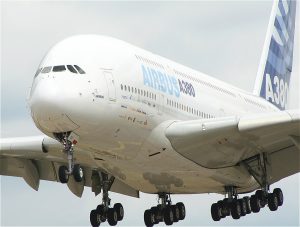
According to the data, the Dreamliner was the most fuel-efficient aircraft. Whereas large, four-engine aircraft, on average, had 31% higher fuel burn per passenger (than aircraft with two engines). Airlines that used the Boeing 747 and Airbus A380, such as Asiana, Korean Air, and Qantas ranked last.
One reason for this is because four-engine aircraft typically have lower seat densities and more premium seats, which are three times more carbon-intensive than economy seats. But “freight share” – how much cargo an aircraft carries in its hold – was the determining factor for overall efficiency.
On average, premium seats are three times more carbon-intensive than economy seats.
Better regulation needed
Despite evidence that large aircraft are worse for the environment, manufacturers are still pursuing orders. Airbus has offered to build the enormous A380 in China, a key market, claiming the new model will “increase their image tremendously”. It certainly won’t improve their environmental credibility.
One option for Chinese carriers is to ignore the A380 and wait for the introduction of the CR929. This wide-body twin-engine aircraft is being developed by Chinese COMAC and Russian UAC for entry into service in 2026.
Regulators are failing to exert serious pressure on airline manufacturers to improve efficiency say ICCT. ICAO has introduced new fuel efficiency standards but most new aircraft already meet the standard that will take effect in ten years.
But there is cause for optimism. China appears interested in filling the vacuum on aviation leadership when it comes to the environment. It was a strong advocate of ICAO’s Carbon Offsetting and Reduction Scheme for International Aviation (CORSIA) and is credited by some for its adoption. CORSIA is a market-based mechanism in which airlines would purchase credits to offset carbon emissions.
Aviation could also be added to China’s national emissions trading scheme, which will enter a trial period in 2019. The National Development and Reform Commission included aviation among ten sectors that must begin providing data on greenhouse gas emissions. Including the national scheme could pressure airlines that are lagging behind on fuel-efficiency to catch up.
But the most pressure will come from the airlines themselves. Fuel is typically the largest operational expense for them, so improving efficiency is really a way to save costs.