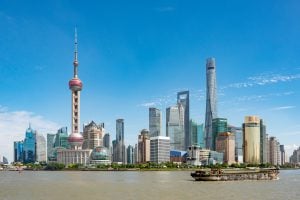
International demand for “green finance” has experienced strong growth in recent years. As Asia's financial centre, Hong Kong is eager to become the primary “green” capital market for Beijing’s colossal Belt and Road Initiative (BRI).
“In 2018, we have seen over US$6 billion in growth of green bond issues in Hong Kong. This has already exceeded the full-year figure for 2017,” said Joseph Chan, under secretary for Financial Services and the Treasury for the Hong Kong government, speaking at a panel on green finance at the Belt and Road Summit in Hong Kong on June 28.
“This reflects the strength of the financial market and confidence that global institutions place in Hong Kong as the region’s green finance hub,” he added.
Last month, the Hong Kong Monetary Authority announced a planned US$12.74 billion green bond programme.
China’s green bond market is among the world’s largest. Some US$30 billion in green bonds were issued last year, comprising more than one-fifth of the global total. This is a significant increase on the US$1 billion issued in 2015, and demand remains strong – particularly as potentially lucrative BRI projects come closer to fruition.
The Asian Development Bank (ADB) estimates that between 2016 and 2030, there will be an annual infrastructure requirement of some US$1.7 trillion, globally. Although Jonathan Drew, managing director of HSBC’s Infrastructure and Real Estate Group, suggested the figure may be conservative.
“I’ve seen higher numbers than that. Globally, it’s seven or eight [trillion]. Asian figures are up nearer to five trillion. When you look at the context, the capital is there. The challenge for those of us in the financial sector is how to bring that capital to where it’s needed,” he said.
Green finance opportunity
Hong Kong’s Mass Transit Railway corporation treasurer David Pang said the shift toward green finance was a logical step for organisations such as his.
“One train can carry passengers equivalent to 25 buses or 1,500 cars. You can see that our carbon emissions are less than other forms of transportation,” he said. “We are a greening business. And whatever finance we raise, we should be doing green finance.”
Belt and Road
KPMG Business Reporting and Sustainability partner Pat-Nie Woo highlighted the importance of seeing BRI and green finance as natural bedfellows, as well as instruments to foster economic growth in developing countries.
“The opportunity really is to help these economies leapfrog into the low-carbon economy. We’ve learned our mistakes in the West, in China… Do we need to repeat those?” he said.
Not all share his optimism.
Risk of greenwashing
“I have great concerns about the way the BRI is shaping up for a whole score of reasons – including what could broadly be called ‘greenwashing’,” conservation biologist Bill Laurance told chinadialogue. Laurence is Distinguished Research professor at James Cook University in Cairns, Australia, as well as founder and director of ALERT (Alliance of Leading Environmental Researchers and Thinkers). He has warned of the devastating impacts of the BRI, calling it “environmentally, the riskiest venture ever undertaken”.
He cautioned that “green financing and green bonds is being used loosely in lots of contexts,” and that in some cases green finance was a means to "tart-up a project that looks like it’s got a lot of environmental problems".
There is also the matter of regulatory disparity.
A 2017 joint report from the European Investment Bank and the Green Finance Committee of the China Society for Finance and Banking called for a harmonised definition of green finance, bonds and projects.
There is no single definition for what qualifies as a green bond, but the market generally accepts that the issuer will use bond proceeds to support projects that protect or improve the environment.
The question of how policies are implemented across borders and regulatory frameworks, along with concerns surrounding oversight and scrutiny of green projects and green-financed initiatives, remain unanswered.
Even if Beijing-led policy has good intentions, implementation at the project level can still fall short, particularly in developing countries.
Currently, BRI host countries have the greater responsibility to enforce environmental and social safeguards. However, these countries often have limited capacity to ensure robust environmental and social oversight is in place.