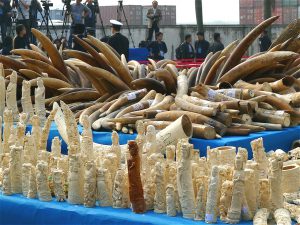
This year a steady trickle of ivory products hidden in mail parcels and shipped from Japan has been seized by Chinese customs.
China banned its domestic ivory trade in January 2018, turning Japan into the largest legal ivory market in the world. Ivory traders are taking advantage of Japan’s vast legal market and minimal government enforcement to traffic ivory to China for resale.
Since 2009, the Environmental Investigation Agency (EIA) has documented nearly 5.9 tons of illegal ivory from Japan seized in China. But this year we noticed a stark increase in seizures. Significantly, Chinese customs officials are making these seizures, not Japanese enforcement officials. China’s General Administration of Customs launched a campaign this year to crack down on illegal imports of prohibited items through the mail and it hit the jackpot when it started scrutinising packages from Japan.
In May, customs authorities in Qingdao reported seizing 13 ivory items in parcels from Japan. Hangzhou Customs recently seized another Japanese parcel containing ivory. That was the 18th ivory seizure (from Japan and elsewhere) made in Hangzhou so far this year, which is more than in all of 2018. In a further case reported in January, customs officers in Guangzhou seized 18 kilogrammes of ivory from Japan.
It is clear that Chinese business owners are taking advantage of Japan’s weak regulations to source ivory for re-sale in China, as in the case of a seizure of 80 ivory pieces in an airport from a man returning from Japan in May. In another important case in April, a network of criminals was found directly exploiting Japan’s ivory market to make purchases online in Japan and then smuggle the ivory through the mail to China from a warehouse in Osaka. The Urumqi customs team eradicated a team smuggling ivory in 14 cities in 11 provinces, seizing more than 52 kilogrammes.
Is new ivory making its way into Japan? If no one is looking, we will never know
These cases demonstrate the abysmal failure of Japan’s ivory regulations and enforcement measures, which EIA and others have consistently pointed out are wholly inadequate to prevent ivory being traded illegally into and out of Japan. EIA has previously documented Chinese traders in Japan boasting about exporting large amounts of ivory in recent years.
Imports are also being ignored by Japanese enforcement officials. During a recent trip to Tokyo, my team met with a government official who was unable to confirm that there is even a single customs employee mandated to look for illegal ivory coming into Japan. With no eyes on the lookout, it’s no wonder there are no seizures of illegal ivory. Is new ivory making its way into Japan? If no one is looking, we will never know.
Japan has made minor changes to its ivory control law to give the appearance of buckling down on the trade. But these do not close the loopholes that nefarious traders take advantage of to launder ivory. Although an agreement was signed by Chinese and Japanese officials in March to strengthen enforcement cooperation and share information, Japan doesn’t appear to be holding up its end of the bargain.
There used to be millions of elephants but the ivory trade has decimated populations, bringing the official number down to less than 400,000 on the African continent. EIA has calculated that since the 1970s, Japan has imported ivory from more than 262,000 elephants. Legal domestic markets make enforcement difficult and enable the laundering of illegal ivory. It is nearly impossible to distinguish illegal from legal ivory once they are intermingled on the domestic market.
In addition to China, nations such as the US, UK, France and Singapore have closed or are closing their ivory markets to protect elephants. At the 2016 meeting of the Conference of the Parties to CITES (Convention on International Trade in Endangered Species of Wild Fauna and Flora), countries agreed to urgently close ivory markets contributing to poaching or illegal trade.
Japan’s domestic ivory market will come under scrutiny at the next Conference of the Parties to CITES, which was slated to start this month in Sri Lanka but has been postponed. African elephant range states are calling on Japan, as well as the European Union, to close their ivory markets urgently to protect elephants.
With the diminished market in China, there is concern that Japan will – again – be the next major destination for ivory from recently poached elephants. Next year, millions of tourists will visit Japan for the Tokyo Olympic Games. Japan needs to significantly increase enforcement measures and enact new investigative mandates to stem the illegal export of ivory sourced from their domestic market before the games begin. Better yet, Japan should act to urgently close its domestic ivory market for good.