Poppy Toland: In your book, The Challenge for Africa, you outline disempowerment as the root to a lot of the problems in Africa. And you mention loss of culture as the main culprit for environmental degradation. How do these processes happen?
Wangari Maathai: A lot of these are actually based on my own personal experiences: working in Africa, trying to do something in Africa which is positive for the community, for the general good, for the common good, but yet finding it very difficult to move forward. And I’ve found that there are so many issues. Quite often people ask, “What’s wrong with Africa? We’ve given Africa so much money; it is an independent region, why aren’t they moving forward?” I wanted to say, it is not just one issue, you cannot say: “Africa is corrupt, therefore…” or, “Africa doesn’t have technology, therefore…” or, “Africa is not democratic, therefore…” There are a lot of issues that all come together to create a very un-conducive environment for development.
So it is the destruction of the African culture as the result of the colonial legacy; it is the creation of artificial states: they are represented as states, it’s a factor that you have communities, which I call tribes or micro-nationalities, who are suddenly expected to work together, as if France and Britain would have worked together 100 years ago!
PT: This is the “sitting on the wrong bus” theory?
WM: Yes. The way to do it is to turn around the bus, but first and foremost is recognising that you are on the wrong bus to begin with. Because if you don’t recognise you are on the wrong bus and keep moving in the same direction, you are actually not going anywhere, because you are on the wrong bus. These are some of the issues that confronted me personally as I was working in my own situation, and I thought that these are the issues that we should really think about and we should address so that we can move forward.
PT: You suggest the example of bed nets: if they are given to people and their value isn’t really understood, people don’t really look after them or mend them properly. Is there a similar issue with the land and with the environment?
WM: Land is different because you can see what you are doing with the land, but also without appreciating the fact that land degrades. If you cut trees, the land degrades. The soil disappears. And if you don’t have the soil, then you’re not going to be able to grow food. And for you to grow food you need rainfall, and rainfall comes because you have forests. So if you don’t understand the relationship between the rains and the rivers and the forest, you will destroy the forest and then you won’t have rain. So, it is this lack of understanding – ignorance – that needs to be addressed.
PT: Is this something that people in the past understood? You talk about the need to re-learn, rather than start from scratch.
WM: In the past, first of all, people were learning from their parents. Now we’ve broken that cycle and send our children to school, but they are not being taught things that are very helpful. They are being taught almost in a vacuum, and that does not connect to the experiences of yesterday. Therefore, they are not able to make the linkages that help them. And at the same time, they are learning in an environment where they are being told that their past doesn’t matter, what their grandparents knew doesn’t matter and it is what they are being taught in school now that matters. Then they come out of school and they realise that with what they have learned, they are not able to manage all the problems that they encounter. So they fail. And they are lost because they don’t know what’s wrong with them, because they think, “But I did everything right that I was told.” There is this disconnect.
PT: You talk about leadership and its problems, and you talk about problems on a small scale, such as those of the macadamia nut farmers. At what level can change be brought about?
WM: I keep coming back to leadership, because I keep coming to the fact that a lot of us need to be guided – and the system needs to help us. The people who are in charge of the system are the government, the leadership. They are the political leadership, the elite, they are the people who came to countries like Britain, they went to America, they went to India, they studied. So I challenge them, not to take advantage of the ignorance of their own people or other people, but to provide the guidance that is needed, because they, more than their people, understand the world in which we live now, in the twenty-first century. I present them as the people who can break the vicious cycle, and I put myself in that position and I say, “OK, I went abroad, I studied, I came back, I wanted to break the vicious cycle and that’s why I have engaged myself in this process”. But I have encountered these problems, because my fellow elite, the leaders, are not ready to turn the bus around – they want us to keep driving in the wrong bus, even though they know it’s the wrong bus. While they are driving in this bus, they are OK. They are not suffering; they have enough to eat; they are living in beautiful houses; they have enough income; their children are going to school and they can go abroad. It is the passengers who are in the bus that need help. So I ask, “You and I know that this is the wrong bus, can we turn it around?”
PT: How do people react when you challenge them like this?
WM: I will see when they read the book. But at least a few people that I have been able to reach in the course of these 30 years, I have seen them turn around. I have also seen the passengers in the bus realise, “Oh, we are in the wrong bus, let us turn.” I have seen them take some very courageous steps, and that is why we can say that today we have a greater democratic space then we had before, that we are able to hold elections which we could not hold before – free elections, that we are able to challenge in ways that we were not able to challenge before.
PT: Have you felt more hopeful in the past five years about the way things have been going?
WM: In 2003, I was very, very hopeful, because in 2002 [Kenya] had managed to get rid of the government that we had been trying to get rid of for a long time, and we brought in a government that we had a lot of hope in. But unfortunately the people turned around and became just the opposite of what I thought they would be. So at the moment we are in a situation which is very hopeless. After what happened last year, it seemed like we were going backwards, where we came from. But I am still hopeful that we will be able to move forward and that we will last at least until 2012 and see what kind of leadership we get.
NEXT: How can China help Africa?
Poppy Toland is a freelance writer based in London.
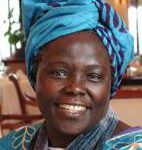
Wangari Maathai is a Kenyan environmental and political activist. In 2004 she became the first African woman to be awarded the Nobel Peace Prize.
Homepage image by greenbeltmovement