As US president Barack Obama visits China, he has the opportunity to appeal to both countries’ growing responsible business interests by issuing a green economy call to arms.
China’s responsible business leaders are emerging with amazing speed. Foreign and local businesses in China – and Chinese businesses globally – are ramping up environmental stewardship and social engagement roles that governments alone cannot. For example, companies like Nike and Adidas, or China’s Li-Ning, now care about eliminating child labour, because it reduces brand risk exposure; financial institutions like HSBC and the Industrial Bank of China have signed up to the Equator Principles on project finance, because they know investments that harm the environment or vulnerable groups also reduce investor and customer confidence. The Chinese government promotes “corporate social responsibility” because it knows this is good for citizens, social stability and building a harmonious society, not to mention the country’s image.
Obama should appeal to Chinese and US business leaders in a new call for common energy independence, common low-carbon prosperity and by validating Chinese president Hu Jintao’s call at last November’s APEC CEO summit for enterprises to embrace “the concept of global responsibility.”
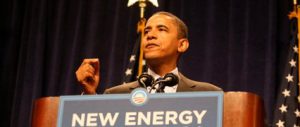
But business cannot do this without strong government support, which is where Obama’s credibility in China as the United States’ first “new energy president” is critical. Obama’s world view does not involve containment or zero-sum-game resource grabs. He is the first US president with any chance of realigning global values to make a sustainable, energy-independent world a reality. And while a global deal on climate change at Copenhagen seems increasingly unlikely, no country can go it alone either.
I suggest a new paradigm: trust that Chinese business leaders are making credible steps to global low-carbon leadership, if for no other reason than that Chinese companies stand to profit enormously from manufacturing the products that will help the global economic transition to low-carbon sustainability.
The numbers support this claim. Chinese auto-makers have an increasingly credible chance to beat Japanese, US and European companies at making the first profitable electric car, as demonstrated in a forthcoming report by AccountAbility and the WTO Tribune, entitled “Responsible Competitiveness in China” (I am co-author) and launching at this month’s EU-China Business summit. Supported by the Chinese ministry of commerce and the EU presidency, this summit is the last big state-level meeting before Copenhagen one week later.
In order to stay on top of this innovation, Obama should be emphasising General Motors’ joint ventures in Shanghai. He should urge other automakers to strengthen such partnerships on both sides of the Pacific. Obama should praise IBM’s global strategists for their “collaboration laboratory”, where innovation speeds up because the doors are open to local universities and government departments.
Obama can trust that Chinese businesses are becoming aware of their global image and how they reflect “brand China” as a whole. China’s top globalising companies, especially China’s many state-owned enterprises (SOEs), have begun to promote corporate citizenship practices that match or surpass aspects of their European and US counterparts. This includes corporate governance, transparency, stakeholder engagement and anti-corruption measures. These companies answer to different investors, like the State-Owned Assets Supervision Administration Commission (SASAC), which recently ordered mandatory sustainability reporting by China’s more than 100 central SOEs. And although Chinese companies mainly use different standards, with different timelines, to govern how they engage sustainably in global markets, their objectives are remarkably similar.
Unilateral US legislative standards alone will fail to ensure good global development outcomes, and in their current form they may end up disadvantaging established companies. US and EU companies cannot ignore home-country laws, but neither can they ignore the many incentives to work with peers to set common rules that help companies maximise the competitive advantages of investing in social and environmental sustainability. These sustainability rules are enforced not only by governments, but also through “soft” means: by campaigning nongovernmental organisations, watchful media, informed consumers and responsible investors.
China tends to prefer process-related standards related to environmental management and social engagement, rather than issues like human rights, although the on-the-ground outcomes are often very similar. For instance, emerging transnational Chinese companies have every incentive to join environmental “clubs” like the Forest Stewardship Council for sustainable forestry or the chemical industry’s Responsible Care initiative to manage chemicals risks, as is shown in new research by AccountAbility and the Chinese government think-tank the Development Research Centre, entitled “Advancing Sustainable Competitiveness of Chinese Multinational Corporations”. The report states that Chinese companies have every reason to create their own standards, such as the CSC9000T, China’s first sector-wide voluntary standard for responsible textile management. The US foreign policy establishment, unlike that of the EU, has yet to formulate a comprehensive strategy for how to deal with these emerging market challenges to American companies’ technological, managerial and moral dominance.
Obama should call for US and Chinese companies to invest more in corporate citizenship, which should be understood not as another burden during tough economic times, but as an investment in the future of shared prosperity between the United States, China and other emerging market economies, as well as the EU.
Obama has the chance to urge these businesses to work more closely on developing collaborative standards and reporting techniques, laboratories and value chains. These collaborators may be erstwhile competitors or non-profit organisations, lawmakers or local officials. These collaborators represent our common values and oversee our common markets. They represent a crucial means of deepening international relationships with China.
Now is the time for Obama to spur the low-carbon economy that will power the next decades of common prosperity between emerging markets, established companies and a stronger China. Let’s hope that Obama uses his inaugural China visit to propose concrete actions, such as making the next Sino-US strategic economic dialogue not only about exchange rates and trade policies, but also a credible platform where companies and officials discuss saving the planet and improving society – and how to make money doing so.
Joshua Wickerham is China representative of AccountAbility, an international, non-profit research organisation.
Homepage image from Asia in View