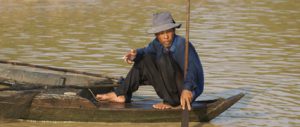
The shores of Boeung Kak Lake, a 90-hectare body of sparkling blue water on the north-eastern edge of Cambodia’s capital Phnom Penh, are home to a bustling neighbourhood. While backpackers flock to its hostels and restaurants, locals fish in the lake’s clear depths or, in dry season, plant vegetables in the lake bed.
At least, they used to. By the time I visited Boeung Kak in August, just two miserable pools remained, each several hundred square metres in size and surrounded by the detritus of a relocated community: the result of two and a half years of land reclamation.
For government and investors, the old Boeung Kak was useless, good only for sightseeing and fishing. But, situated close to the prime minister’s residence, embassies, hospital, university and train station, it was a property developer’s dream. And so the Cambodian government shelved an ecological restoration scheme selected through an international competition. And, in 2007, city authorities instead signed a 99-year lease with a firm named Shukaku, which plans to build a high-end residential and commercial district on the 133-hectare plot of land – including the lake.
This meant that more than 4,000 locals would have to get out of the way. Compulsory relocations started in July 2009. Although the community has fought back against both the developers and government, over the last two years more than 3,000 residents have found themselves with no choice but to leave their homes. Some have failed to secure reasonable compensation. Others have received nothing at all.
A range of methods has been used to persuade these locals to move. When work to fill in the lake began, water flooded residents’ homes, making many of them uninhabitable. Another move was for the government to declare the homes illegal – the majority of residents had no formal documentation to prove ownership of the land. In this way, the authorities were able to mobilise the police to back up the developer’s bulldozers.
Still, some residents held on. They petitioned prime minister Hun Sen, they protested, they wrote to the developers, they begged for assistance from the embassies of major donor nations and from the World Bank. And they paid a price – in large-scale protests in April and July, demonstrators, including elderly women, were beaten and some of the younger participants jailed.
It was only in August this year, when the World Bank said that “until an agreement is reached with the residents of Boeung Kak Lake, we do not expect to provide any new lending to Cambodia,” that some change was seen. The Cambodian government told the developer it would have to provide the remaining 800 residents with a 12.44 hectare plot of land on which to build new homes. But any sense of victory was quickly squashed by the continued destruction of the community: on September 16, two bulldozers flanked by over 100 riot-police destroyed eight homes; 91 families were told they were not entitled to any compensation; and some residents ended up in court for “insulting the village head”. Clearly, this tragic tale is not over.
And it’s a tale in which Chinese actors have been playing a behind-the-scenes role. In the autumn of 2010, Inner Mongolian firm Erdos Hongjun Investment Corporation spent US$5 million (32 million yuan) on a 50% stake in Shukaku. Documents from the Development and Reform Commission in Ordos city show that the company will invest US$98 million (622 million yuan) in the construction of 351 villas. The project broke ground in July this year.
The Boeung Kak locals tried to raise their concerns with the Chinese investor, but found no avenue for doing so. And so they turned to official channels: on January 17 this year, dozens of resident representatives submitted a petition to the Chinese embassy in the hope it would encourage Erdos Hongjun to resolve the dispute. However, the embassy refused to accept the petition and asked the police to remove the representatives.
In February, local NGO Housing Rights Task Force sent a letter on behalf of the residents – written in both English and Chinese – to Erdos Hongjun’s head office, asking that it “play a constructive role and bring interested parties together to discuss solutions, and include the hopes of the affected locals in their plans.” There was no response.
Erdos Hongjun was not the first Chinese firm to get involved in the project.
Back in April 2007, just after Shukaku had signed its lease with the Phnom Penh government, a state-owned firm based in south-west China, Yunnan International, agreed to jointly develop the project with Shukaku. In November that year, the Kunming Daily quoted Yunnan’s commerce department as saying that Yunnan International had obtained control of Shukaku – and the rights to the Boeung Kak project – in a US$50 million deal. Total investment was expected to be US$1.5 billion (9.5 billion yuan), making this Yunnan’s largest overseas investment.
But in spite of the positive publicity, the project was soon abandoned. In March 2009, Yunnan Economic Daily ran a report saying that Yunnan International’s parent company, the Yunnan Copper Group, had beaten an “orderly retreat” from three investment projects, including the Cambodia project, following a change of management in 2008. The company cited a need to “strengthen investment management”.
In early 2010, the Phnom Penh Post found a report on the website of a company called Guangdong New Golden Foundation saying that it was to invest in the project, and surmised that Yunnan International had sold its interest on to this company. The website also featured photos of company executives with senior Cambodian officials, and the project is still listed there.
Then, in July, Chinese newspaper the Global Times reported that another Chinese firm besides Erdos Hongjun was working with Shukaku, providing funding while the Cambodians provided the land.
Yunnan International’s US$1.5 billion or Erdos Hongjun’s US$98 million – either of these would count among China’s largest investments in Cambodia to date. Ministry of Commerce statistics show that Chinese firms’ non-financial investments in Cambodia amounted to only US$395 million in 2010. Yet, despite the size of the project, the Chinese investors remain shadowy figures, to the point that many Cambodian NGOs and the press are unaware of the involvement of the Yunnan and Guangdong companies and unable to track down anyone from Erdos Hongjun to interview.
Liao Ruo is a reporter based in Beijing.
Homepage image from The Course of Progress