The fight over a US$128 million waste incinerator being built in Beijing with German money appears to have reached a stalemate.
Chinese campaign groups have received no response to their request that Beijing’s authorities make public the environmental-impact assessment for the waste-to-energy plant planned for the suburb of Nangong, which critics fear will pollute the neighbourhood.
Meanwhile, the project’s German backer, state investment bank KfW, has come out to say it is confident its technical expertise and project-management strengths, combined with German technology, will ensure the scheme reaches the highest standards.
These assurances have failed to relieve the concerns of the public and green groups, who have become increasingly anxious about the environmental impact of Chinese waste incineration in recent years.
See also: Dirty truth about China’s waste incinerators
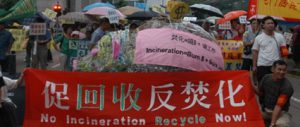
Pollution fears surrounding the Sino-German project prompted 18 Chinese green groups to write to KfW on August 8, setting out their concerns, and kick-starting China’s first environmental campaign directly targeting an overseas investment bank. KfW invited the campaigners to its offices and, on September 4, six representatives of the groups met with the bank in Beijing, but little progress was made.
The Nangong incinerator is a project under the Sino-German Financial Cooperation Framework, a financing agreement between the two countries. Ninety-nine million euros (US$128 million) of investment has been approved for the scheme. Of this, 55-million euros (US$71 million) is Sino-German cooperation funding, administered by KfW. China and Germany signed an agreement in May 2010, but no information has been published on the progress of the project or its environmental impact.
China has a well-established tradition of public opposition to waste-incineration plants and critics fear problems seen elsewhere will be repeated at Nangong. Environmental groups say China’s incinerators cause serious pollution through excessive emissions of dioxins and heavy metals; release of liquid toxic wastes; illegal handling of ash and more. In south China’s Pearl River Delta, waste incineration accounts for 21% of all manmade emissions of mercury, according to the network of NGOs campaigning against the Nangong scheme.
Li Bo, secretary general at China’s oldest green NGO Friends of Nature, said KfW’s project would inevitably meet the same opposition as other incinerator projects. The size of the Nangong project, combined with the lack of transparency, make their concerns particularly acute, he said.
Dirty truth about China’s waste-burning plants
The focus of the dispute highlights the huge waste disposal challenge faced by China.
The project’s funders say they are entirely confident they have the technology and working practices necessary to achieve the highest Chinese and European standards and calm public nerves. In a written response to the NGOs’ complaints, KfW director Christine Heimburger said: “There is a proven technology available to reduce to environmental impacts to an acceptable minimum…With our bank we have significant technical and managerial expertise available to make sure that only a solution will be realized that is in line with this approach.”
But environmental groups do not believe this is such an easy thing to do in China.
Mao Da, an environmental historian focused on waste disposal, argues that technology is not the biggest issue in China. On the surface, he says, there appear to be three major problems with waste disposal in China: the varied nature of the waste, low levels of technology and a lack of investment. But at the root of all these is a failure of government oversight.
It is common for polluters to escape proper sanction, and for information to be kept secret. Local people are often disappointed by shoddy construction or operations, resulting in widespread distrust of new incinerator projects. Planned rubbish-burning plants around the country have met with public protest as a result. The West Qinhuangdao project in Hebei province, northern China, for example, was halted thanks to such opposition.
But what really worries campaigners is the lack of attention paid to waste disposal by local government. Most local authorities in China don’t invest in waste disposal – instead, the majority of plants are built on a “build-operate-transfer” model, meaning construction and operation is contracted out to investors. This makes quality supervision even harder. And there is also a lack of strict enforcement of waste disposal standards.
Some of China’s incinerators are better than others. As waste-sorting is weak and management poor, incineration rates are low in some regions – this is already an open secret in the industry. To boost waste-burning, some plants spray diesel into the furnaces (also see “Dirty truth about China’s incinerators”). To control dioxin levels, furnaces need to be kept at a certain temperature – but under these conditions, this is hard to achieve.
In 2009, the Chinese Academy of Sciences completed a year-long study of dioxin emissions. Of 19 waste incinerators surveyed, 16% failed to meet China’s own standards, while almost 70% did not meet EU standards.
The repeated protests over waste incineration show the problem is not that waste-to-energy plants cannot be cleaner. It is that under China’s current system and market environment, the public have grave doubts about the quality of management and working practices at waste incinerators.
Back at Nangong, KfW has found itself firmly in the sights of China’s green campaign groups.
In July 2007, the State Environmental Protection Agency (later the Ministry of Environmental Protection), the People’s Bank of China and the Banking Regulatory Commission issued guidelines on environmentally friendly lending, marking the start of China’s green credit policy.
Under these rules, banks should guard against environmental or social risks associated with the construction, manufacturing or operations of projects that they fund.
Beijing’s four main waste disposal facilities all have foreign investors. The two largest landfill sites, Beishenshu and Anding, were financed by KfW. Five of Beijing’s waste-handling sites are funded by Germany – the Majialou and Xiaowuji collection centres, the two landfill sites and the Nangong composting facility .
German state bank’s controversial funding
Chinese waste isn’t the only item on KfW’s agenda being questioned by campaigners. Currently, it is funding new coal projects in South Africa, Thailand and Chile, as well as coal-infrastructure projects in Serbia and Australia. German NGO Urgewald has expressed concerns about these activities: while KfW claims it is fighting poverty and improving energy supply, its overseas coal investments all have negative impacts on the local environments, it said in a report. “The bank needs to stop promoting the global expansion of coal-fired power plants and coal infrastructure and concentrate instead on what it is already doing well at: supporting energy efficiency and renewable energies. KfW likes to point out its positive aspects but there is a dark side of the bank that is the reverse of its green front,” Urgewald said.
In 2011, KfW invested over 100 million euros in the expansion and construction of coal-power plants, coal mines and coal infrastructure. According to Urgewald and the Climate Alliance Germany, the Medupi and Kusile coal-fired power plants in South Africa have worsened energy imbalances and regional water disputes, while coal mining in Indonesia to feed the KfW-funded Krishnaptanam power plant in India has destroyed large areas of pristine rain forest and driven out local people. In Serbia, KfW invested 74 million euros in a modern quality-management system for lignite, or “brown coal”, mining – pointing the way for more open-pit mining and greater reliance on lignite in the country, impacting its ability to hit its 2015 energy goals.
Zvezdan Kalmar, climate director at CEKOR, a Serbian NGO, said that the project gave no thought to climate considerations, and resulted in more use of lignite. He wrote to KfW asking it to cancel the contract. The bank has also been criticised for investing in the Wiggins coal port in Australia, a move critics say will endanger the Great Barrier Reef.
Back in Beijing, environmental groups are still awaiting a response to their request that the Beijing Commission of City Administration and Environment publish the environmental impact assessment for the project. The story continues.
Zhang Chun is assistant editor at chinadialogue’s Beijing office and Xu Nan is deputy editor.