The great Elizabethan explorer Martin Frobisher tried three times to get from Europe to China by sailing across the Arctic circle. In the summer of 1578 he steered his ships between the Canadian mainland and Baffin Island, in an attempt to find the fabled northwest passage.
He was soon defeated by tempest, snow and ice. “There fell so much snow, with such bitter cold air, that we could not scarce see one another for the same, nor open our eyes to handle our ropes and sails”, says the account recorded in Hakluyt’s famous Principal Navigations, Traffiques and Discoveries of the English Nation.
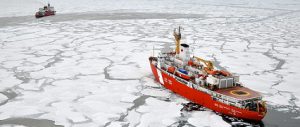
Tomorrow’s mariners may have an easier time of it, according to Laurence Smith, a geographer at University of California, Los Angeles. He reports in the Proceedings of the National Academy of Sciences that by 2059 ships, especially if reinforced for polar waters, should be able to manage the northwest passage from the east coast of North America to the west, one year in two. Right now, it is navigable perhaps one year in seven.
The northeast passage, or northern sea route along the coast of Siberia, is already in regular use, and 46 ships made the journey in 2012. The Arctic ice sheet is expected to thin with global warming to a point where polar icebreakers will be able to go straight over the North Pole between the Pacific and Atlantic Oceans, he calculates.
Smith and his co-author Scott Stephenson considered seven different forecasts for sea ice cover in the Arctic between 2040 and 2059, and took an average. They studied the emerging navigation routes and the degree of sea ice melting that has made them possible.
They then considered two scenarios for climate change: one that assumed a 25% increase in carbon dioxide emissions, and one that assumed a 35% rise. And then they looked ahead to mid-century. To their surprise, the choice of scenarios made no difference to the outcome.
“No matter which carbon emission scenario is considered, by mid-century we will have passed a crucial tipping point – sufficiently thin sea ice – enabling moderately capable icebreakers to go where they please”, Smith said.
The attraction of the polar route is that it is shorter: substantially shorter than the traditional routes through the Suez or Panama Canals. Ships heading from New York for Yokohama, or from Bremen to Vancouver, via the Arctic Ocean, could save days at sea and cut running costs.
But the possibility also raises concerns about safety, suitable ports of call, and hazard to the Arctic environment. It also raises sovereignty issues, with increasing disputes about who “owns” the polar waters.
Such questions were, until 2007, largely hypothetical. But that year the Arctic sea ice, which has been shrinking and thinning gradually for decades, hit a record low.
Some glaciologists now think – though there is plenty of room for argument – that the Arctic may have reached a tipping point, and is about to enter a new and less stable state, in which ice cover will go on shrinking in the summer months.
One day, Frobisher’s unhappy voyage will be possible and may even become routine, but only in the late summer. “This will never be a year-round operation”, says Smith.
This article was first published by the Climate News Network