Business

Toxins found in children’s clothes produced by Adidas, Burberry and Disney

Greenpeace has found toxic chemicals in children’s clothes made by 12 well-known brands and purchased all over the world
English

Toxic chemicals have been found in children’s clothes sold by Burberry, Adidas, Disney and nine other brands, according to a report published by the campaign group Greenpeace. These chemicals can be ingested via hand-to-mouth contact, and then affect development of reproductive organs and the liver.

In May and April of 2013, Greenpeace bought 82 items of children’s and infant’s clothing in 25 different countries. The samples had been made in 12 countries, with one-third made in China. All were bought in the brand’s own shops or from authorised resellers, then immediately sealed and dispatched to a Greenpeace lab in the UK for testing.

The highest level of organotins (organic tin compounds) were found in a Puma child’s shoe made in Indonesia and bought in China, while the second highest level was in an Adidas shoe, also made in Indonesia but purchased in Hong Kong.

Organotins have been proven to have a major impact on children’s development, damaging the liver and kidneys, and potentially doing harm to metabolic processes such as blood production and the enzyme system.

Swimwear from Adidas and Burberry was found to contain perflorinated compounds (PFCs). These substances are restricted by international agreement and cause reduced fertility and immune system disorders.

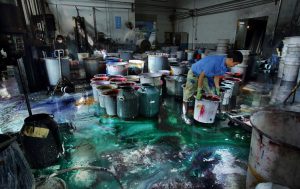
Zhang Miao, pollution campaigns head at Greenpeace, added that these toxins could harm fish populations as well as the children themselves. During the manufacturing process large quantities of toxic substances, including endocrine disruptors, are discharged into rivers and oceans. Endocrine disruptors and PFCs have been found in catfish and carp caught in the Yangtze.

The EU banned PFCs and other toxic chemicals years ago, but the investigation found that use continues in the textile industries of major clothing-manufacturing countries such as China, Bangladesh, Indonesia, Thailand, Turkey and Mexico.

Greenpeace has been campaigning for three years for the industry to deal with this problem: to date 18 brand names have committed to zero-emissions of these substances by 2020. Brands including Mango and Zara have started publishing pollution data from their suppliers; some, such as Adidas, have despite their promises taken no real action.
 
Burberry, Adidas and Disney have all denied that their clothes are a health risk.

Cookies Settings

Dialogue Earth uses cookies to provide you with the best user experience possible. Cookie information is stored in your browser. It allows us to recognise you when you return to Dialogue Earth and helps us to understand which sections of the website you find useful.

Required Cookies

Required Cookies should be enabled at all times so that we can save your preferences for cookie settings.

Dialogue Earth - Dialogue Earth is an independent organisation dedicated to promoting a common understanding of the world's urgent environmental challenges. Read our privacy policy.

Cloudflare - Cloudflare is a service used for the purposes of increasing the security and performance of web sites and services. Read Cloudflare's privacy policy and terms of service.

Functional Cookies

Dialogue Earth uses several functional cookies to collect anonymous information such as the number of site visitors and the most popular pages. Keeping these cookies enabled helps us to improve our website.

Google Analytics - The Google Analytics cookies are used to gather anonymous information about how you use our websites. We use this information to improve our sites and report on the reach of our content. Read Google's privacy policy and terms of service.

Advertising Cookies

This website uses the following additional cookies:

Google Inc. - Google operates Google Ads, Display & Video 360, and Google Ad Manager. These services allow advertisers to plan, execute and analyze marketing programs with greater ease and efficiency, while enabling publishers to maximize their returns from online advertising. Note that you may see cookies placed by Google for advertising, including the opt out cookie, under the Google.com or DoubleClick.net domains.

Twitter - Twitter is a real-time information network that connects you to the latest stories, ideas, opinions and news about what you find interesting. Simply find the accounts you find compelling and follow the conversations.

Facebook Inc. - Facebook is an online social networking service. China Dialogue aims to help guide our readers to content that they are interested in, so they can continue to read more of what they enjoy. If you are a social media user, then we are able to do this through a pixel provided by Facebook, which allows Facebook to place cookies on your web browser. For example, when a Facebook user returns to Facebook from our site, Facebook can identify them as part of a group of China Dialogue readers, and deliver them marketing messages from us, i.e. more of our content on biodiversity. Data that can be obtained through this is limited to the URL of the pages that have been visited and the limited information a browser might pass on, such as its IP address. In addition to the cookie controls that we mentioned above, if you are a Facebook user you can opt out by following this link.

Linkedin - LinkedIn is a business- and employment-oriented social networking service that operates via websites and mobile apps.