See if there are any opportunities there, some quick money to be made, nothing long-term – this is what I often hear from Chinese people with spare capital when they find out I am travelling to Africa and Latin America.
Chinese investments are having a major impact on these continents. But by ignoring the “long-term” and the “sustainable”, the investors are creating environmental and social problems.
One friend told me: “A relative of mine went to Africa a few years back and got rich. He didn’t want to say what he was doing at first, then he told us it was the timber trade.”
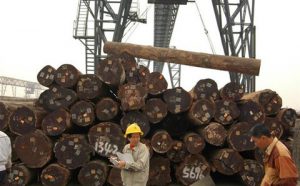
When Chinese people deal in timber in Africa, smuggling is often involved. Lax regulation means they can get locals to fell trees illegally, then bribe customs officials to ship the wood back home. They don’t care if African forests are disappearing, or if the trade is sustainable – their sole concern is the price of timber in China.
But what Chinese firms fail to anticipate is the environmental conflicts that eventually break out with locals, and their financial consequences.
In 2012 the Chinese embassy in Ecuador was attacked by local environmental, indigenous and women’s groups. Not long after there were nationwide marches against mining. I was in Ecuador at the time and saw what happened.
Chinese firm ECSA was preparing to start the country’s first large open-pit copper mine and believed it had the support of the Ecuadorean government. But it ignored the views of local civil society and failed to take environmental protection seriously. Some Chinese workers told me that the indigenous people were “conservative” and “ignorant”; that they didn’t understand the value of mining for economic development. But what the Chinese didn’t understand was that the indigenous people of Ecuador have their own set of values and a strong memory of the disastrous oil leaks when Western companies went drilling for oil. Nor do they realise that in many developing nations public opinion actually matters.
The head of one local environmental group said to me: “So what if the president signed a deal with the company? We’re going to continue working to stop the mine.” The group tried to talk to the Chinese firm, but to no avail. In the end, their frustration led to the occupation of the Chinese embassy. Many Chinese see NGOs as anti-government, or a front for Western anti-Chinese forces, and are unwilling to talk to them. International NGO Global Witness had a similar experience in the Democratic Republic of Congo: they attempted to open communication with almost all Chinese organisations there, but were given no chance for dialogue.
Failing communication
Many local NGOs tell me that Chinese firms are not actually the worst when it comes to environmental and social impacts. But they are clumsy at implementing corporate social responsibility (CSR).
Shougang Steel’s operations in Peru provide one example. A pioneer in Chinese overseas investment, Shougang set up in Peru in the 1990s. But for 20 years the company has been dogged by labour disputes, and strikes have caused financial losses. Research by US academic Amos Irwin found that wages and working conditions at Shougang are by no means worse than at other foreign companies, but Shougang has suffered more from labour disputes and bad publicity.
One major cause of this is how the companies think and communicate: “We spend a lot on newspaper advertising, but nobody believes us,” one Shougang employee told me. What he doesn’t realise is that the company does not need to advertise – it needs to communicate.
“We were interviewed by the New York Times once, but they didn’t write what we said. So we don’t do interviews with them anymore,” he continued. Chinese companies regard the foreign media as hostile, not realising that refusing interviews means reports will be written without their input, and that this is the worst possible way of responding.
Often, they regard the locals as ungrateful too, lamenting the fact that communities don’t thank them for the tax they pay or the buildings built with company donations to government coffers. They do not understand that paying tax isn’t enough for a company to earn respect, or that giving money to the government won’t earn the gratitude of the people – particularly when they’re not communicating appropriately. Corporate social responsibility needs to take the feelings of the locals into account.
More and more Chinese companies are paying attention to CSR. This has been an important change in how they work overseas in the last few years and could help to solve the difficulties they face. The experiences of Western firms investing overseas show that CSR can reduce conflict over environmental and social issues and create a positive corporate image. It can also help the company to better understand the areas it works in, to communicate and integrate, and ultimately to develop sustainably as a part of the region.
Unfortunately many Chinese firms have realised they need to undertake CSR, but have no idea how. They don’t take environmental protection seriously, but then plant some trees. Labour relations are bad, so they build new offices for the government. Their employees buy ivory products, and the company holds grand ceremonies to announce donations to environmental groups.
The last three years have seen some Chinese companies and diplomats try to change this. For example, aviation company AVIC International started its first major long-term CSR project in Kenya this year with the six-month Africa Tech Challenge. The project, which aims to help reduce Africa’s youth unemployment problem, gives technical training to young people, in turn helping Chinese firms that struggle to find qualified staff locally. AVIC International has also been open about the project, discussing it in local media and working with both Chinese and international NGOs.
Good CSR isn’t just making charitable donations with a portion of your profits. It is about linking local development with the development of your firm.