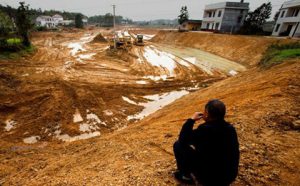
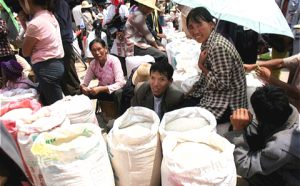
In 2011, Miyun resident, Liu Yuying, found a large number of opened bags filled with an unidentified gray powder dumped on a plot of land that she was planning to use for agriculture. The waste came from KB Autosys, a Korean company producing 300,000 sets of auto brake pads each year and whose main clients are Hyundai, GM, KIA, and Renault Samsung.
According to government reports, the waste was dumped in numerous pits measuring four meters deep and 30 meters wide. No grass could grow nearby and the bark of nearby trees was scarred and cracked. Ironically, the company describes its mission as, “Value creating corporation for safety of mankind and global environment.”
At first, the company promised to test the soil, compensate Liu, and clean up the waste. Later, KB’s Vice President at the Miyun plant denied these promises. In February 2012, the Miyun authorities wrote to Liu, confirming violation of environmental rules, but did not reveal the sampling data. Authorities fined the company ¥180,000 (€22,487) in early 2012, but Liu was not compensated.
Since brake pad manufacturing involves the use of metal lubricants, we decided to perform a preliminary sampling study of metals at the site by contracting a certified laboratory to take samples at the site and analyse them for metal content. The results showed antimony levels in wastes at the site ranged from 7700 ppm – 11,900 pm. These levels were 640 – 990 times higher than regulatory limits in China.
Antimony is routinely used in brake pad manufacturing where it serves the function of a lubricant and produces small particles that are readily inhaled. Animal studies show that exposure to antimony causes skin irritation, fertility problems, and lung cancer.
The USA State of California classifies antimony trioxide as a carcinogen. Toxic side effects of antimony treatment for leishmaniasis and schistosomiasis in humans include cardiotoxicity and pancreatitis. Antimony can also mimic estrogen in laboratory experiments. Finally, antimony appears to be toxic to plants including suppression of plant development.
To assess the degree of cleanup from the contaminated land, project personnel measured various parts of a dumping site that was also “cleaned up” by KB Autosys using a portable XRF device. It shows that 12/15 samples still exceeded regulatory limits for antimony– the highest by 55-fold.
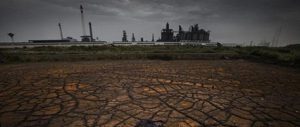
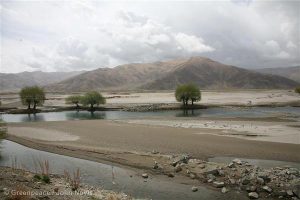
This story is just one example of the challenge China faces in cleaning up its polluted soil. According to the Ministry of Environmental Protection, 10 million hectares or 8.3% of farmland in China is polluted.
The dumping of wastes containing high concentrations of toxic wastes on farmland violates Chinese and the Solid Waste Law. As the responsible party, KB Autosys did not fulfil its complete duty of care throughout the entire manufacturing lifecycle. The company also refused to pay any compensation to the landowner after dumping more than 500 tons of toxic metal-containing wastes on the farmland over a period of five years. Neither the government nor the company ever revealed the identity or the danger of the wastes to the landowner or surrounding community.
In the Miyun case, the company washed its hands of the waste issue by contracting the problem without insuring full compliance with Chinese law. Rigorous enforcement of Chinese law would have identified this problem much sooner rather than letting it continue for five years. It appears that this was the cheaper option for the company, but highly costly for the local government, landowner, and the environment.
Public right to know is a key principle of chemical safety but neither the landowner nor the community was ever informed about the identity or possible danger of hundreds of tons of toxic metal waste openly dumped on farmland. Public access to plant emissions including waste should be regularly provided via an accessible, free, pollutant release and transfer registry. Ironically, KB Autosys has to provide this information at its manufacturing facilities in the Republic of Korea but avoids doing so in China.
Another key aspect to information disclosure is the Environmental Impact Assessment (EIA) report of the KB Autosys facility. According to Chinese law, this report should be freely available to the public, however so far, neither the company nor the local Environmental Protection Bureau has agreed to provide it after requests from Nature University.
Liability and compensation is a key principle of chemical safety. However in the Miyun case, the court did not require the defendant (KB Autosys) to take responsibility to disapprove the causal relationship between the pollution and damage and it did not designate a body that could do the evaluation.
This improper action blocked the ability for the plaintiff to receive deserved compensation from a pollution case and this problem applies to many other cases in China. Clearly, the company should pay for its waste dumping – both to the landowner and the authorities who spent public money cleaning up the company’s dumped waste.
Both KB Autosys and Hyundai were contacted about this story, but declined to comment.
Mao Da is a twinning partner on the 2014 EU-China NGO Twinning Exchange, funded by the Robert Bosch Stiftung.