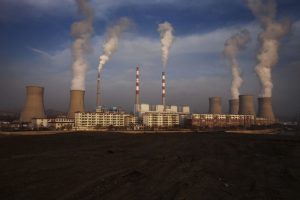
The Chinese economy would benefit from a faster switch to renewable energy and a reduction in carbon emissions, says a new report.
Following on from president Xi Jinping and Barack Obama’s climate pledges earlier this month, a study launched in Beijing by the The Global Commission on the Economy and Climate, says a low-carbon development path is now “unavoidable for China”.
One of the report’s authors, Teng Fei of Tsinghua University’s Institute of Energy, Environment and Economy, said that good policy design could limit the cost of peaking carbon emissions by 2030 to less than 1% of GDP. If the associated benefits of cleaner air and better health are taken into account, moreover, even that cost could largely be cancelled out.
The report, which follows a global overview published September, assessed Chinese energy consumption and carbon emissions under scenarios of 4% and 7% economic growth. It found that if China maintains 7% growth but allocates 1% of GDP to spending on energy-saving and developing new energy technology, it will be much easier to improve China’s environment than under the low-growth scenario.
The findings also have implications for China’s infamous air quality. If energy-saving and emissions-reduction efforts continue unchanged, then almost half of Chinese cities may still be afflicted by poor air quality in 2030, says the report. This is particularly likely in the major cities of the Yangtze Delta and the Beijing-Tianjin-Hebei group.
Even if those efforts are maintained, by 2030 China will rely on imports for 75% of its oil and 40% of its natural gas, while coal extraction will be operating far above safe and efficient limits, the authors say. Both energy supply and energy security will be hugely uncertain.
Carbon peak target will spur change
“Based on current energy-saving and emissions-reduction policy and efforts, China could not see a 2030 carbon peak,” says He Jiankun, vice-chair of the National Expert Committee on Climate Change and director of Tsinghua’s Laboratory of the Low Carbon Economy. “But now having a target will help spur economic transition, as well as establishing mechanisms which spur new energy development and the adoption of powerful measures to realise these targets.”
The report calculates that, if energy-saving and emissions-reduction measures are accelerated, China’s carbon emissions from energy would peak around 2030 and start to fall soon after, while 2030 carbon intensity would be 58% lower than in 2010. Add in strict rules on cleaning up air pollution at the point of release and structural reforms and by 2030 all China’s major cities could enjoy air up to quality standards.
The current investment-driven model of economic growth is unsustainable, says the report, while the economic drag of resource constraints are already becoming apparent. If China cannot mitigate that through new technology and efficiency gains, it may fall into the middle-income trap of low-speed growth.
If it makes the right changes, however, China can maintain a higher growth rate, it says: 7.9% between 2010 and 2020; 6% from 2020 to 2030, and 4.6% over the following two decades. By 2030 China’s economy will have overtaken that of the US to become the world’s largest.
A cap on coal growth by 2020
Following the joint China-US Statement on Climate Change earlier this month, the report recommends imposing initial emission caps only on energy-hungry sectors with surplus capacity, and in the economically developed east of the country. Those absolute caps would then, over time, be expanded to cover all industries and regions.
First, coal consumption should be brought under control, it says – by 2020 coal consumption should stop growing, with absolute falls as soon as possible. New and renewable energy sources will become the economic growth points of the future.
Teng Fei said that fossil fuel price reforms should be implemented alongside controls on greenhouse-gas emissions and total energy consumption. These reforms would account for the external environmental costs of fossil fuels and gradually create the market environment for development of clean and renewable energy sources. A competitive market would encourage companies to invest in low-carbon technology and stimulate innovation and development in the low-carbon technology sector.
“A precondition of achieving a carbon peak in 2030 is for the annual decline in carbon intensity to be higher than the rate of GDP growth, and for GDP growth to fall to about 5% around 2030,” said Teng. “If economic growth is slower than anticipated, the peak may be earlier. But the majority view is that the Chinese economy needs to continue its period of rapid growth, and to a large extent that’s determined by the economic outlook.”