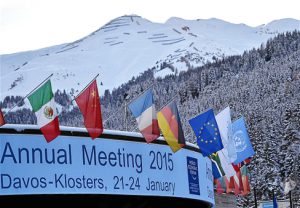
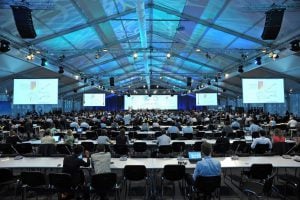
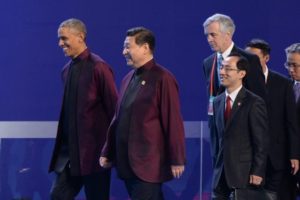
World leaders and the chiefs of the world’s biggest companies departed Davos over the weekend, following a World Economic Forum that put climate change near the top of the agenda ahead of crunch UN climate talks at the end of the year.
Cynics sneered that the "1,700 private jets" used to whisk the world’s elite to and from the Swiss Alpine venue (although in reality it was likely to be much lower ) made a mockery of comments by world leaders on the need to combat climate change.
Davos also witnessed the launch of plans for a Live-Aid-style music concert for the middle of the year to raise awareness of the Paris talks among the wider public and put pressure on politicians to agree a meaningful climate deal.
Critics point out that we have been here before, as climate change was given a high profile at Davos in the run-up to the failed 2009 Copenhagen climate summit and that the 2007 Live Earth concert did little to harness public opinion on the need for tough action on climate change.
But optimists flagged up developments outside the realm of climate talks that point to big potential shifts in the world’s energy consumption.
Last week’s event as usual attracted the heads of major resources companies, but their attendance this year came against the backdrop of weak commodities prices and heightened pressure to cancel future expansion.
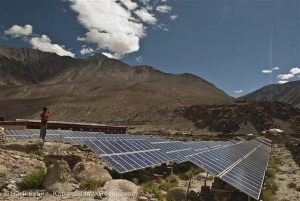
Proponents of the ‘carbon bubble’ and ‘stranded assets’ concepts also appear buoyed by falling costs for renewables, meaning that oil, gas and coal may be much less economic to burn in the future.
Meanwhile a global divestment campaign is attempting to starve funding for new capacity in the production of fossil fuels blamed most for climate change.
In a WEF survey, CEOs at Davos expressed the need for political leaders to implement carbon pricing to send a strong signal to big producers and consumers of energy to switch to low carbon alternatives.
But the calls came as the EU struggles to push through modest reforms to its ailing emissions trading scheme, which has been hindered from the outset by companies lobbying for generous supply of free permits or low prices.
The extent to which carbon markets and other financial incentives will play a role in combatting climate change will become clearer later this year as national plans on cutting carbon emissions, known in the jargon as ‘intended nationally determined contributions” are submitted to the UN.
At Davos there was much talk of the need for urgent action. But at UN climate talks this year, the devil will, as always, be in the detail. And that detail will be painfully apparent in just a few weeks when climate negotiators gather in Geneva for the first round of technical discussions aimed at refining a raft of contradictory proposals from countries into a workable text.
Quotes on climate from Davos
“We are faced with a moral responsibility, a political responsibility, because a botched solution to a crisis might result in exacerbating the consequences of climate change," French president Francois Hollande
"It is absolutely crucial that we build public will for an agreement," Al Gore, former US vice-president and joint winner of the Nobel Peace Prize in 2007 for his campaigning on climate change.
“Unless we want to be grilled, fried, toasted by climate change, we need to move fast,” Christine Lagarde, head of the International Monetary Fund.
“The key is coming up with a vision of how we are going to finance mitigation and adaptation to climate change… What we don’t want is to get to a situation where developing countries are saying to the rich countries: ‘where’s that $100bn a year you promised us’,” Jim Yong Kim, head of the World Bank.
"This year shapes the next 20. The next 20 shape the century. We have to recognise its poor people hit earliest and hardest by climate change," Lord Nicolas Stern, economist and academic, London School of Economics.
“Everyone is talking about the urgency, the risk…This a big step in itself. The next big step is you need to do it,” Paul Kagame, president of Rwanda.
“Davos is a speed-dating event, and it will not provide real leadership on climate change. Now leadership will come from the streets” Hans Joachim Schellnhuber, director at Potsdam Institute for Climate Impact Research.
“What’s still missing from the conversation is the important role of emerging markets. The time has come to show true leadership in all areas. Only with strong business support can we lay the foundation for the climate challenge to change markets and reverse political positions” Georg Kell, executive director of the UN Global Compact.
"We worry a little bit that the price signal (from weaker fossil fuel prices) may give disincentive for new energy types to develop, and could reduce investment in new non-fossil energy" Zhou Xiaochuan, governor, People’s Bank of China