Business

Chinese companies must take decisive action on climate change: report

Chinese companies will have to do much more if China is to help prevent runaway climate change, says a new report
English

Chinese companies will need to cut direct greenhouse gas (GHG) emissions of their operations by up to 2.7% a year if China is to stay on track with the level of action required to keep global warming well below 2 degrees Celsius, says a new report authored by climate consultants Ecofys for green group WWF.

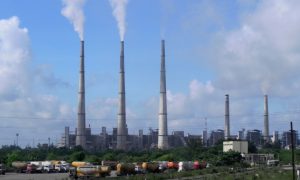
China’s power generation sector, which draws upon coal for around 68% of its output, will need to cut its carbon footprint by around 8% a year if China is to do its bit in helping the world avoid runaway climate change, the report adds.
 
Companies in the world’s second-biggest economy account for around half of China’s emissions, the report says, and it adds that a decisive shift away from fossil fuels will only happen if management is committed to low carbon energy and specific targets.
 
But the extent that many Chinese companies are willing to switch to cleaner forms of energy appears highly limited, at least in the short-term.
 
Data on air quality released by the Chinese government last month showed that policies aimed at curbing coal consumption and improving chronic air quality – which would also help drive down carbon emissions – had done little to reduce smog in Beijing.
 
Companies in heavily-industrialised, neighbouring provinces to the capital have been unwilling to take the painful steps necessary to shut carbon-intensive capacity, while their political benefactors fret about the impact of coal curbs on employment in China’s rustbelt.
 
The WWF/Ecofys report offers some solutions, however.  
 
Companies outside the utility sector have the opportunity to use on-site renewable generation, improving the efficiency of the electricity they use, and buy of renewable fuels and electricity, the report says.
 
Sze Ping-Lo, who heads WWF China, points to GHG reduction targets at Vanke (a real estate company) and Yingli (a maker of photovoltaic panels).
 
But whether most of corporate China, particularly big energy users, will even bother taking action to reduce their carbon footprint is likely to depend strongly on carbon pricing in a future nationwide emissions trading scheme, subsidies, taxes, and tough environmental laws that are enforced properly.
 
Corporate action on climate change, seen by the UN as crucial to put the world on a path to lower emissions, has been patchy at best elsewhere in the world.
 
Even in Germany, which has strong environmental controls, generous subsidies for renewables, increasingly decentralised solar and wind generation, and relatively enlightened boardrooms, companies still draw on a grid where around 50% of its electricity comes from lignite and coal
 
Foreign companies also have a major responsibility for China’s carbon emissions, given that the country is the world’s largest manufacturer of electronics for large corporations such as Apple and Samsung, and is the world’s biggest producer of primary materials such as steel, aluminium and refrigerants.   
Cookies Settings

Dialogue Earth uses cookies to provide you with the best user experience possible. Cookie information is stored in your browser. It allows us to recognise you when you return to Dialogue Earth and helps us to understand which sections of the website you find useful.

Required Cookies

Required Cookies should be enabled at all times so that we can save your preferences for cookie settings.

Dialogue Earth - Dialogue Earth is an independent organisation dedicated to promoting a common understanding of the world's urgent environmental challenges. Read our privacy policy.

Cloudflare - Cloudflare is a service used for the purposes of increasing the security and performance of web sites and services. Read Cloudflare's privacy policy and terms of service.

Functional Cookies

Dialogue Earth uses several functional cookies to collect anonymous information such as the number of site visitors and the most popular pages. Keeping these cookies enabled helps us to improve our website.

Google Analytics - The Google Analytics cookies are used to gather anonymous information about how you use our websites. We use this information to improve our sites and report on the reach of our content. Read Google's privacy policy and terms of service.

Advertising Cookies

This website uses the following additional cookies:

Google Inc. - Google operates Google Ads, Display & Video 360, and Google Ad Manager. These services allow advertisers to plan, execute and analyze marketing programs with greater ease and efficiency, while enabling publishers to maximize their returns from online advertising. Note that you may see cookies placed by Google for advertising, including the opt out cookie, under the Google.com or DoubleClick.net domains.

Twitter - Twitter is a real-time information network that connects you to the latest stories, ideas, opinions and news about what you find interesting. Simply find the accounts you find compelling and follow the conversations.

Facebook Inc. - Facebook is an online social networking service. China Dialogue aims to help guide our readers to content that they are interested in, so they can continue to read more of what they enjoy. If you are a social media user, then we are able to do this through a pixel provided by Facebook, which allows Facebook to place cookies on your web browser. For example, when a Facebook user returns to Facebook from our site, Facebook can identify them as part of a group of China Dialogue readers, and deliver them marketing messages from us, i.e. more of our content on biodiversity. Data that can be obtained through this is limited to the URL of the pages that have been visited and the limited information a browser might pass on, such as its IP address. In addition to the cookie controls that we mentioned above, if you are a Facebook user you can opt out by following this link.

Linkedin - LinkedIn is a business- and employment-oriented social networking service that operates via websites and mobile apps.