Business

CNPC fined 100m yuan for Lanzhou water, air pollution

China's largest energy company agrees to pay compensation for multiple pollution incidents in Lanzhou, but battle over relocation of chemical plant continues, Caixin reports
English
A subsidiary of China National Petroleum Corp. has agreed to pay the government of Lanzhou 100 million yuan (US$16 million) for incidents that polluted air and water in the city in the northwestern province of Gansu.
 
The money will be used to upgrade the drainage system at the CNPC subsidiary to prevent any more leaks into the city’s soil and water table, the city’s Environmental Protection Bureau said.
 
The bureau released an environmental impact study for the project on March 12 so the public could comment on it over a 10-day period. The plan is for the project to be launched at the end of March and be done in two years.
 
In January, city’s environmental protection bureau launched a scathing attack on Lanzhou Petrochemical Co., the CNPC subsidiary, over several incidents last year that it said fouled the community’s air and water.
 
CNPC has not commented. It is also unclear how the subsidiary and the Lanzhou government agreed on the payout amount.
 
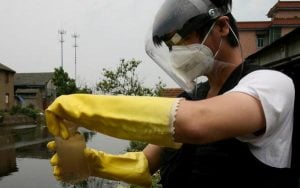
A benzene leak into the Lanzhou section of the Yellow River – the only source of drinking water for the provincial capital – left residents without running water for two days in April 2014.
 
The leak also embarrassed city government officials because it ruined Lanzhou’s bid for a status as a tourist destination.
 
The Lanzhou government has been seeking to move the plant to an industrial park 38 kilometers away from downtown areas since 2011, but little progress has been made.
 
Academics estimated that the relocation could cost 60 billion yuan – a sum the Lanzhou government cannot afford and the CNPC may be unwilling to pay.
 
Lanzhou’s development and reform commission has said the city government plans to lobby the central government to include Lanzhou Petrochemical’s relocation as part of national development plan.
 
Because that larger plan will not be ready any time soon, the city government is mulling using the Liujianxia Reservoir, 75 kilometers from downtown Lanzhou, as the source of drinking water for the city of 3.6 million people. The plan, which is expected to cost the government 2.37 billion yuan, has been shelved since 2008 because of financial constraints.

Northwest Normal University’s College of Geography and Environment Sciences said that the water conservation authorities might still have to rely on the central government to finance the project because the city could only come up with 766 million yuan. 

This article was written by Li Yan for Caixin Online 
Cookies Settings

Dialogue Earth uses cookies to provide you with the best user experience possible. Cookie information is stored in your browser. It allows us to recognise you when you return to Dialogue Earth and helps us to understand which sections of the website you find useful.

Required Cookies

Required Cookies should be enabled at all times so that we can save your preferences for cookie settings.

Dialogue Earth - Dialogue Earth is an independent organisation dedicated to promoting a common understanding of the world's urgent environmental challenges. Read our privacy policy.

Cloudflare - Cloudflare is a service used for the purposes of increasing the security and performance of web sites and services. Read Cloudflare's privacy policy and terms of service.

Functional Cookies

Dialogue Earth uses several functional cookies to collect anonymous information such as the number of site visitors and the most popular pages. Keeping these cookies enabled helps us to improve our website.

Google Analytics - The Google Analytics cookies are used to gather anonymous information about how you use our websites. We use this information to improve our sites and report on the reach of our content. Read Google's privacy policy and terms of service.

Advertising Cookies

This website uses the following additional cookies:

Google Inc. - Google operates Google Ads, Display & Video 360, and Google Ad Manager. These services allow advertisers to plan, execute and analyze marketing programs with greater ease and efficiency, while enabling publishers to maximize their returns from online advertising. Note that you may see cookies placed by Google for advertising, including the opt out cookie, under the Google.com or DoubleClick.net domains.

Twitter - Twitter is a real-time information network that connects you to the latest stories, ideas, opinions and news about what you find interesting. Simply find the accounts you find compelling and follow the conversations.

Facebook Inc. - Facebook is an online social networking service. China Dialogue aims to help guide our readers to content that they are interested in, so they can continue to read more of what they enjoy. If you are a social media user, then we are able to do this through a pixel provided by Facebook, which allows Facebook to place cookies on your web browser. For example, when a Facebook user returns to Facebook from our site, Facebook can identify them as part of a group of China Dialogue readers, and deliver them marketing messages from us, i.e. more of our content on biodiversity. Data that can be obtained through this is limited to the URL of the pages that have been visited and the limited information a browser might pass on, such as its IP address. In addition to the cookie controls that we mentioned above, if you are a Facebook user you can opt out by following this link.

Linkedin - LinkedIn is a business- and employment-oriented social networking service that operates via websites and mobile apps.