Opposing the construction of PX petrochemical plants has been one of the most common forms of environmental activism for China’s urban residents in the past decade.
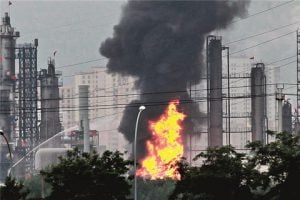
On April 4, an explosion ripped through the Gulei PX factory in Zhangzhou, leaving 15 injured, almost two years after a similar accident at the plant had prompted a local official to promise in 2013 that it would never happen again.
In response, central and local government have made huge efforts to convince the public such projects are safe – but the second explosion at the plant in the space of two years has destroyed much of that work.
The two explosions at the same complex will mean the public becomes increasingly wary of PX factories, with the government needing to do even more to rebuild trust.
Media reports of the explosion described towers of flame lighting up the night sky, with acrid smoke and a pungent chemicial odour creeping 5 km from the plant. Both firefighters and an army anti-chemical unit were rushed to the scene, and some reports on Wednesday suggest the fire took hold for a second time despite the attendance of 800 emergency workers.
Protests
An official with the Ministry for Environmental Protection’s Emergency Response Center told chinadialogue that the explosion was being treated as an industrial accident, rather than a case of pollution, and that the problem lay in safety failings, rather than PX manufacturing itself.
The Gulei Industrial Zone lies on the Gulei peninsula in Zhangzhou, about 90 kilometers from Xiamen. The history of the PX plant can be traced back to eight years ago, in 2007 when residents of Xiamen used ‘walking protests’ outside the government building to express opposition to the plant being built in their backyard – the first such case of opposition in China.
One hundred People’s Political Consultative Conference members also signed a letter opposing plans to build the plant in Xiamen, and those events are regarded as the start of large-scale middle-class environmental activism in China.
A number of anti-PX movements followed, in Dalian in 2011, Ningbo in 2012, and in Maoming in 2014. PX projects are, as the Chinese put it, as popular as a rat on a busy street.
PR offensive
In 2008 the Fujian provincial government opted to relocate the Xiamen project to Gulei. To avoid upsetting the public there was no mention of ‘PX’ and it the government refered to it as the ‘Gulei Major Chemical Project’. According to media reports, the Zhangzhou city government did everything in its power to find a home for the unpopular project, calling upon other local officials, the courts, and even the Communist Party’s disciplinary committee, to ensure the plans went ahead.
Two years ago the government launched a PR offensive to deal with PX’s image problem head on, in the hope of removing obstacles to the development of new plants, which make the plastic used in drinks bottles.
During peaks of opposition in Kunming and Chengdu in April and May 2013, central government told Zhangzhou officials to share their experiences in implementing a PX project as best practice.
The authorities also encouraged scientists to speak up in support, telling the public of China’s need for PX manufacturing. The official newspaper Global Times implored the public to remain calm, and said that China needed more PX facilities – or else the country’s huge and politically-powerful chemical industry would lose out to rivals based in South Korea and Singapore.
Suspicion
But the explosion in Gulei has left the public even less willing to trust the experts. On social media, Chinese citzens have complained that experts lying in service of the government are a greater risk than explosions.
According to the Southern Weekend newspaper, the Gulei plant was the only one in China that was regarded as being a likely success in terms of restoring faith in the industry, one which Party propaganda authorities had dubbed “a model of good mass work.”