Business

Economics thwarts China’s efforts to curb electronic waste

A thriving but environmentally hazardous informal sector hinders China's efforts to regulate the control and treatment of unwanted electrical items 
English

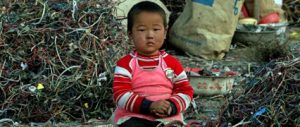
China has improved its collection and treatment of electronic waste in recent years but informal recycling of unwanted appliances and gadgets continues to pose serious harm to the environment, says a new report.

"Due to a range of social and economic factors, the informal sector continues to play a major role in the collection and recycling of e-waste, and informal recycling often leads to detrimental effects on the environment and the health and safety of workers and local communities," said the study, which was carried out by the Germany-based United Nations University.

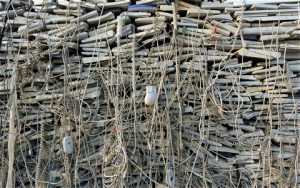
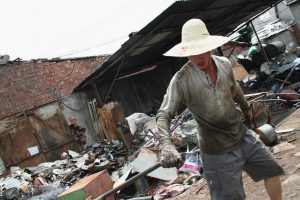
Without proper facilities, the removal of copper, lead, plastics and valuable components pollutes local air, soil and water, widening the health impacts of a sector that is already hugely hazardous to those who strip out valuable contents from discarded electrical items.

Guiyu, a cluster of towns in China’s southern province of Guangdong, is one of the world’s largest centres for e-waste, where an estimated 60,000 workers are involved in workshop-style methods to open up electrical goods – often using their bare hands – the "cooking" of circuit boards, and the use of corrosive and dangerous chemicals to extract metals such as gold and copper.

Although China has introduced new laws in the past five years to encourage the collection of electronic items and processing in centralised waste management sites (such as the ‘old for new’ subsidy programme) unregulated family-run operations like those in Guiyu often offer more money for e-waste than municipalities, says Feng Wang, one of the co-authors of the report, in an interview with chinadialogue

"The regulated e-waste sector in China is going to have to find smarter ways to compete with the scrap dealers and the small workshops," Wang adds.

In some instances, green-minded entrepreneurs have stepped in where regulation was lacking, such as the collection of used or unwanted mobile phones

China’s economic growth and increasing prosperity – mainly concentrated in urban areas – has also filtered through to rural districts, where the environmental impact of discarded items is often more noticeable.

In these areas electrical items are increasingly affordable, meaning e-waste volumes are likely to rise sharply, but many rural districts aren’t well placed to collect and recycle items such as televisions, mobile phones and household appliances, says Wang.   

In 2011 alone, Chinese consumers bought 57 million televisions, 58 fridges, 53 million washing machines, 95 million air conditioners and 74 million computers, along with 250 million mobile phones, according to a previous UN University report.

The same year, 1.2 million tonnes of televisions, 0.44 million tonnes of fridges, 0.32 million tonnes of washing machines, 0.99 million tonnes of air conditioners and 0.67 million tonnes of computers were discarded, accounting for most of China’s e-waste that year.
 
According to the UN report released over the weekend, China produced 6 million tonnes of e-waste in 2014, which was 15% of the global total and second only to the US, which generated over 7 million tonnes.
 

China officially collected and treated around 1.3 million tonnes of five types of e-waste, 28% of the total, the report said, lower than Europe (40%) but far head of the US, which had a rate of only 15%.

China’s e-waste could end up in Africa

Many unwanted electrical goods are shipped from the US to China and Africa, and clear data at federal level on safe recycling of e-waste is lacking, the UN report says.  

Increasingly much of the world’s e-waste that would previously gone to China is going to West Africa instead, where the processing of discarded items is cheaper, says Wang.
“The danger for Africa is that China may join the US as a big exporter of e-waste, and countries such as Ghana and Nigeria become even bigger dumping grounds for environmentally harmful substances in the way that China has been since the 1990s,” he adds. 
Cookies Settings

Dialogue Earth uses cookies to provide you with the best user experience possible. Cookie information is stored in your browser. It allows us to recognise you when you return to Dialogue Earth and helps us to understand which sections of the website you find useful.

Required Cookies

Required Cookies should be enabled at all times so that we can save your preferences for cookie settings.

Dialogue Earth - Dialogue Earth is an independent organisation dedicated to promoting a common understanding of the world's urgent environmental challenges. Read our privacy policy.

Cloudflare - Cloudflare is a service used for the purposes of increasing the security and performance of web sites and services. Read Cloudflare's privacy policy and terms of service.

Functional Cookies

Dialogue Earth uses several functional cookies to collect anonymous information such as the number of site visitors and the most popular pages. Keeping these cookies enabled helps us to improve our website.

Google Analytics - The Google Analytics cookies are used to gather anonymous information about how you use our websites. We use this information to improve our sites and report on the reach of our content. Read Google's privacy policy and terms of service.

Advertising Cookies

This website uses the following additional cookies:

Google Inc. - Google operates Google Ads, Display & Video 360, and Google Ad Manager. These services allow advertisers to plan, execute and analyze marketing programs with greater ease and efficiency, while enabling publishers to maximize their returns from online advertising. Note that you may see cookies placed by Google for advertising, including the opt out cookie, under the Google.com or DoubleClick.net domains.

Twitter - Twitter is a real-time information network that connects you to the latest stories, ideas, opinions and news about what you find interesting. Simply find the accounts you find compelling and follow the conversations.

Facebook Inc. - Facebook is an online social networking service. China Dialogue aims to help guide our readers to content that they are interested in, so they can continue to read more of what they enjoy. If you are a social media user, then we are able to do this through a pixel provided by Facebook, which allows Facebook to place cookies on your web browser. For example, when a Facebook user returns to Facebook from our site, Facebook can identify them as part of a group of China Dialogue readers, and deliver them marketing messages from us, i.e. more of our content on biodiversity. Data that can be obtained through this is limited to the URL of the pages that have been visited and the limited information a browser might pass on, such as its IP address. In addition to the cookie controls that we mentioned above, if you are a Facebook user you can opt out by following this link.

Linkedin - LinkedIn is a business- and employment-oriented social networking service that operates via websites and mobile apps.