The 100 members of the International Olympic Committee (IOC) had an unusual choice Friday on which city should host the 2022 Winter Olympics. Typically, there would be three-to-five cities on the final ballot representing different continents. Not this time.
There were only two cities in the running and both are in Asia: Beijing and Almaty, Kazakhstan. Citing high costs, Oslo (Norway), Stockholm (Sweden), Krakow (Poland) and Lviv (Ukraine) all backed out.
Looking at the big picture, the election came down to whether the IOC members wanted to reward Beijing, a mega-city of 19 million people that is capital of the most populous (1.3 billion) country in the world, with its second Olympics in 14 years, or give the Games to Kazakhstan, a small (the country’s population of 17 million is less than that of Beijing), remote but growing, oil-rich Central Asian country that is trying to establish itself in the global community.
There was little to choose between both countries on human rights aspects. Kazakhstan is seen by many as being vulnerable to economic shocks and also as being a potential security risk. Beijing was the strong betting favourite among bookmakers ahead of the vote.
Greensportblog‘s more narrow focus is on the environmental aspects of the respective bids.
The IOC says it is deeply committed to sustainability, both of the Games themselves and of the operations of their home headquarters in Lausanne, Switzerland.
In fact, in Olympic Agenda 2020, a strategic roadmap for the future of the Olympic Movement that was published last October, sustainability issues were numbers three and four of a laundry list of 40 recommendations for improving the Olympic Games.
And, while both bids commenced in 2013, before Agenda 2020 was published, they both moved through the IOC bid process after Agenda 2020 was part of the pubic domain–meaning sustainability was front and centre for the prospective hosts and voters.
So, let’s take a look at the relative greenness of the Almaty and Beijing bids, based on the IOC’s Report of the 2022 Evaluation Commission:
ALMATY (pp.20-25 of Report)
The IOC’s evaluators saw several green positives in the bid from Kazakhstan’s largest city:
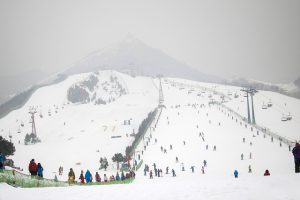
- Abundant natural snow reduces water and energy requirements for artificial snow
- Extensive use of existing venues reduces potential impacts on the environment
- Location of all venues within or close to Almaty minimizes travel distances
- Potential for the Games to act as a catalyst for air quality improvements in the city
- Emphasis on sustainability (local sourcing, supply chain management, etc.) in operation of Games
- Significant public education campaigns to raise “environmental awareness”
Four main environmental challenges/risks were identified:
- Poor air quality, particularly in the winter months. The evaluators admitted that “current levels of air pollution could impact athletes” and fans.
- Insufficient funding necessary to solve the air quality problems.
- Retaining the bio-diversity and environmental health of the site for alpine skiing and freestyle skiing/snowboarding in Alatau State National Park, an area that is under consideration as a World Heritage Site for said bio-diversity.
- Post-Games, the expansion of winter sports resorts and hosting events in the mountain zone will further stress the sensitive mountain environment.
BEIJING (pp.66-71)
“The mountain venues would rely completely on artificial snowmaking for the Games.” p. 68.
That stunning statement stands out from the Sustainability section of the Beijing portion of the IOC’s Report. I had to read it a few times to make sure my eyes weren’t playing tricks on me. But there it is. Relying 100% on artificial snow will be a massive addition to Beijing 2022’s carbon footprint, require diversion of water from existing reservoirs and is the biggest difference between the Almaty and Beijing bids from an environmental point of view.
That’s because Beijing mirrors its Kazakh competitor on green strengths (use of existing venues, emphasis on sustainability in the operation of the Games, significant government investments to improve air and environmental quality) and on other areas for concern (poor air quality, which may require aggressive mitigation efforts during the Games; Alpine skiing and sliding venues and the Olympic Village are part of the same delicate ecosystem as the Songshan National Nature Reserve).
After Beijing’s ‘green Olympics’
Green medal?
We were sceptical of Almaty’s ability to overcome the challenges listed above, in part based on the claims of local environmental groups which allege that the Kazakh government severely limited “public participation in decisions with environmental impacts.” This apparent lack of public access and transparency appears to fly in the face of Almaty 2022’s English language motto, Keeping it Real.
Potential funding shortfalls for environmental mitigation and prevention efforts that could result from downturns in the country’s relatively small and vulnerable economy during the seven-year planning/building period are also a concern.
Almaty was a legitimate winter sports city–it gets abundant snow. One would think this to be an obvious criteria when selecting a city to host the Winter Olympics but remember that the IOC went to Sochi, Russia in 2014, a city located in a tropical zone.
Of course this is in contrast to Beijing’s manmade snow problem. It is the environmental reason we would have given the Games to Almaty. But not the Green Medal. Neither city deserved a medal for environmental performance. But the Games must go on and, from a green perspective, the 2022 Games should have gone to Almaty.
This article is adapted from a posting on the greensportsblog.com website