International oil prices have fallen steadily since last year, sinking as low as US$30 per barrel this week. The most recent drop left 92-octane petrol on sale in Beijing filling stations for 5.56 yuan (US$0.85) a litre – a record low for the capital’s residents.
Normally when oil prices fall so too do petrol prices. But in China, the authorities have responded to this continued drop by capping petrol prices.
In January, China’s National Development and Reform Commission (NDRC) rolled out a policy that won’t let fuel prices fall in line with crude below US$40 a barrel. The government claimed this measure was taken to promote the conservation of natural resources and help curb the country’s air pollution.
But are lower oil prices influencing car buyers’ choices in China? The cost of petrol in China is approximately 30% cheaper than it was four years ago. Cars are now cheaper to run. However, electric vehicles are even cheaper to run (though still more expensive to buy).
The average electric car driving 100 kilometres will consume 20 kilowatt hours of electricity. With electricity in Beijing costing 0.50 yuan (US$0.07) per kilowatt hour, that is less than half the cost of driving a petrol vehicle the same distance. But the environmental advantages of electric cars are tempered somewhat by the fact that coal-fired power stations account for two-thirds of China's electricity output.
If cities start offering cheaper power electricity at off-peak hours then the cost of running an electric vehicle could fall further. But while investing in electronic vehicles makes economic sense in the long-term, consumers have other concerns.
The pros of electric
In Beijing, the use of private vehicles is restricted through a number plate lottery system. In order to buy a Beijing-approved number plate your name must be drawn in a city-wide lottery. If you are planning to go electric, your chances of winning this draw are higher.
“I only wanted to buy an electric car so I could get the registration documents – last year 30% of applicants for electric cars were successful, compared to 0.7% of those who wanted a petrol car. This year the government’s gone even further – anyone [with an electric car] who wants one can get one,” one Beijing resident told chinadialogue.
In addition, central and local government subsidies and tax breaks are available to electric car owners, with plans to offer electric vehicle drivers special exemptions from the temporary restrictions placed on road vehicles during periods of heavy smog.
In Shanghai, similarly, registration documents are auctioned and electric vehicles are exempt. That perk, and the subsidies, apply to both electric and hybrid cars.
According to one Shanghai resident: “The most popular new energy car in Shanghai is the BYD Qin hybrid [a plug-in compact saloon car developed by BYD Auto). You get free registration and over 60,000 yuan in subsidies. The owner only pays about 14,000 yuan which isn’t that much.”
In total, seven Chinese cities are currently restricting the purchase of new cars, but going electric offers a way around this.
The cons
Fuel savings are not the only consideration for Chinese car buyers.
In Beijing, the registration and subsidy benefits that favour electric cars exclude hybrids and only apply to a small number of vehicles. The choice of these electric vehicles is limited to a mere six or seven models.
Buyers complain that the list is too short, and that the cars on it have short ranges and are too expensive. Manufacturers are concerned about Beijing’s motives for excluding plug-in hybrids.
In an interview with the China Economic Weekly, Gu Xinguang, chief analyst at the Beijing Vehicle Research Institute, said: “No Beijing-based companies make plug-in hybrids, so the city kept them off the list. It’s classic local protectionism.”
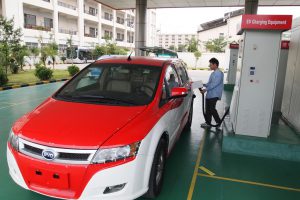
For car owners, the logistics of getting a recharging point installed is also problematic. The owner often has to waste time running back and forth between their building managers, the electricity company, the fire brigade, and the car dealership.
One Beijing resident told chinadialogue that he lacks faith in the technology behind electric cars. “Some are little more than upgraded electric bicycles,” he said.
Phasing out subsidies
So far, the reduction in the international price of oil has not had a negative impact on the sales of electric cars in China. In fact, there are indications that that the sales of electric and hybrid vehicles are up thanks to policy support from local and central government.
Statistics from the China Association of Automobile Manufacturers show that 78,499 electric vehicles were made in China in 2014, with 74,763 sold. This is an increase of 300% on the previous year. With range and lack of charging points still a problem, this demonstrates how powerful policy support can be in promoting a new technology.
But there are factors at work which may damage the industry. In early 2016, Chinese media reported a spate on subsidy fraud, with allegations that almost 30 billion yuan in subsidies had been fraudulently obtained by rogue companies.
The worst offenders were those selling commercial or special-use vehicles, but the problem affects the entire industry. Lou Xuwei, China’s minister of finance, announced that subsidies for electric vehicles would fall by 20% by 2018 from this year, and by a further 40% in both 2019 and 2020 – suggesting that subsidies for electric vehicles are being phased out.
Also, the government is to investigate how public money is used in the promotion of electric vehicles. The spate of reports was a sign that the government is determined to stamp out fraud. Meanwhile, experts say that although subsidies are supporting a young industry, they are also discouraging innovation.
As China’s authorities plot a course for the expansion of their electric vehicle sector, the impact of low oil prices internationally is giving pause for thought. While the uptake of electric and hybrid vehicles in China is growing overall, the regional picture is patchy. In Shanghai, for example, many owners of plug-in hybrids are simply running their cars on petrol.
“To be honest, the main reason I bought a hybrid was for the registration. With falling fuel prices, it’s just easier to use petrol,” a Shanghai commuter was quoted as saying in an article by People.com.cn.
As BYD hybrids can switch between sources of energy at the press of a button, they can be driven without using electricity at all. The focus of local governments should be how to convince hybrid drivers to top up with electricity. More recharging stations would be a start.