The annual NPC and CPPCC sessions (or ‘Lianghui’ – two meetings) currently underway in Beijing make up China’s most important political season. The buzzwords that emerge from the two-week session will shape the language of public discourse over the next 12 months.
In this explainer below, our Beijing deputy editor Li Ying examines the catchphrases that have cropped up during the two-week discussions, and what insight they can provide on policies related to China's future growth.
1. The Five Development Concepts (五个发展理念)
The Five Development Concepts made their debut in a communique issued at the end of the 5th Plenary Session of the 18th Party CPC Congress held in late November, 2015. They refer to new set of guiding principles that will steer the country’s economic growth and development over the next five years
The five concepts are innovation, coordination, green development, opening up and sharing – and will pave the way for a “moderately prosperous society in all respects”- according to premier Li Keqiang. In simple terms, they are values to guide China’s economic transition that involves restructuring the industrial sector, improving the environment and enhancing efficiency.
2. Craftsmanship Spirit(工匠精神)
‘Craftsmanship spirit’ can best be summed up as the quest for quality and constant improvement in one's endeavours. It may well be the first time that its mention has been written into a premier’s government work report.
Li Keqiang has made it clear that the improvement of product quality, manufacturing upgrades and a labour shift towards service industries are the key to sustainable growth in China.
“We will move faster to bring domestic quality and safety standards in line with international standards, and establish a system to make products pay punitive compensation for failing to meet product quality standards,” said premier Li on March 5.
3. Supply-side reform (供给侧改革)
Supply-side economic theory, which was elaborated in the 1970s and implemented by many western governments in the 1980s, contends that growth can be most effectively created through capital investment and removing disincentives such as high taxes and protection for particular industries.
The idea is that consumers benefit from a greater supply of goods and services at lower prices. While businesses expand as a result of the investment. Typical policy recommendations from supply-side economists are lower marginal tax rates and less government regulation.
With China’s current economic conditions in mind, the central government has come to the conclusion that demand side measures might be undesirable or unachievable in terms of stimulating economic growth. That would mean that the type of economic stimulus deployed at the start of this decade has been ruled out, mainly because it could exacerbate overcapacity in manufacturing and worsen environmental impacts.
Jia Kang, a CPPCC member and an economist from China Academy of New Supply-side Economics, argues that China’s supply-side reforms should refrain from simply applying what's in the textbooks, such as the use of tax cuts, for example. He stresses that China's supply-side reforms should focus on innovation to improve quality and efficiency on the production line.
Analysts tend to agree that China needs to curb overcapacity, cut down production costs, reduce real estate inventories and prevent financial risks to achieve reform.
Through supply-side reform – or structural reform – China aims to double its GDP by 2020 from the 2010 level. An annual growth rate of 6.5% or more is necessary to reach that goal.
4. Remove complicated procedures and cruel measures; stop officials from disturbing the public and doing unlawful deeds (简除烦苛,禁查非法)
The Chinese Premier likes to extract aphorisms from ancient Chinese texts to illustrate the finer points of his political thinking. Arcane-sounding as it is, the eight-character couplet has emerged as one of the most talked-about expressions from the Premier’s work report amid the central government's continued anti-corruption drive.
Last year, the (not so snappy either) catchphrase was: “Those in high places should abstain from executing power at will” (有权不可任性).
This year, the premier used it with reference to: “Inter-departmental data sharing, in order to ease troubles for the general public and enterprises, and make it more convenient for them to enlist the service of the government.”
The couplet was extracted from Houhanshu, or History of the Latter Han, which was written in the 5th century and appeared in the biography of Liu Chong, a royal descendant and high-ranking government official in the East Han Dynasty who was widely respected for his wisdom and benign use of power.
In layman’s terms, it stresses the importance of more efficient and people-oriented government service.
5. The Ministers’ Passage (部长通道)
This refers to an area where hordes of media gather to put questions to Chinese officials at the twin sessions.
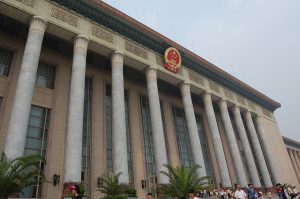
The passage is a hallway that runs less than 100-metres inside the North Gate of the Great Hall of the People to the main auditorium. It is lined with Chinese reporters who bombard senior officials with questions, hoping for impromptu remarks from China's rulers.
Prior to this year’s two sessions, Premier Li Keqiang reiterated that cabinet ministers and heads of central government departments should “actively respond to media and public enquiries” and share more of their thoughts on key issues.
This year, China’s minister of agriculture Han Changfu made a bold projection about the country's future while addressing reporters in the passage. He said the cultivation of farm lands in China should rely on what he called a “new type of professional farmer.”
He noted that the ongoing movement of rural migrant workers seeking employment in cities is unstoppable. At the same time, the vast stretches of farmland left behind are crucial to the country’s food security. Who will tend to them? The minister said the government should think more about how to train a new type of 'professional farmer' to develop modern agriculture.