Aside from smaller Caribbean nations, no other country in Latin America consumes more oil-based fuel per person than Venezuela.
As well as being the largest consumer, Venezuela is home to the world’s largest proven reserves of crude oil and is Latin America’s biggest carbon dioxide emitter per person.
Over the past few years, the Venezuelan government has promoted mining and hydrocarbons projects, and imported vehicles.
Public spending policies that underpin these industries, which have been supported by loans from China, have come under scrutiny in international fora for ignoring environmental concerns.
The story of the Venezuelan state’s peripheral role in international climate negotiations and the huge financial support of its oil sector, which provides cheap fuel to consumers through price subsidies, can be traced back over 20 years.
Venezuela has long been the country with the cheapest gasoline in the world. Prior to February 18, prices for refined oil products, above all diesel and petrol, last changed in 1996. A previous attempt to raise them in 1989 under the second administration of Carlos Andres Perez is infamously credited with causing the Caracazo street protests and a subsequent violent crackdown.
See also: China sanguine about Latin America’s economic crisis
Under the entire 14-year presidency of Hugo Chavez (1999 to 2013), prices remained frozen – a political decision rather than one grounded in sound economic argument.
The consequence of keeping prices artificially low over decades has been a devaluation in real terms of the price of combustible liquids; a situation which has been exacerbated by the soaring rate of inflation and the markdown of the country’s currency, the Bolívar (an attempt to address the inflation).
World Bank data indicates that Venezuela consumed an average of 1,272 litres of fuel per year in 2014, owing to the luxury of having to pay just one US cent per litre. Yet new president Maduro’s raise of the highest octane fuel to 60 US cents per litre, based on the official exchange rate of 10 Bolívars per US$, looks set to change very little.
Taking into account the exchange rate controls that have been in place in Venezuela since 2003, fuel prices equate to literally zero dollars per litre. As of February, a US dollar would fetch 1,000 Bolivars on the country’s black market.
Black market fuel trade
Keeping prices far lower than those of international markets has caused a booming contraband fuel trade with neighbouring countries Colombia and Brazil, and with Caribbean islands. An estimated 30,000 barrels per day leave Venezuela illegally (although some sources suggest this figure is closer to 100,000 barrels), a further driver of domestic consumption.
Venezuela’s domestic oil demand equates to around eight to ten barrels per year, according to World Bank data, while this figure is 6.5 barrels in Mexico, 5.3 in Argentina and Brazil and falls to 3.7 barrels per year in Colombia.
This correlates with Venezuela’s CO2 emissions. Venezuelans emit 6.4 metric tonnes of carbon per person per year, a level similar to that of China (6.7 metric tonnes). The rest of Latin America registers much lower figures: Argentina, 4.6; Mexico, 3.9; Brazil, 2.2; and Colombia, 1.6.
China funds
A 2007 initiative of then president Hugo Chavez, which sought to reduce Venezuela’s trade and investment relationship with the US, has ushered in a round of finance from other countries, above all China.
This money has gone into propping up domestic fossil fuel industries.
The majority of a US$20 billion long-term loan agreement from the China Development Bank (CDB), half of which is renminbi-denominated, was received by state-owned oil company PDVSA in return for crude oil or diesel.
A large proportion has also gone into funding Venezuelan infrastructure projects.
Resources channelled into the ‘China Fund’ – which has received around US$51 billion from CDB – were spent on big infrastructure projects, such as the addition of new lines to the Caracas Metro system. Similar projects were introduced in the cities of Maracaibo, with the construction of two new bridges over the Orinoco River and Valencia, with the development of its rail network.
Some of the fund was used to purchase finished products from China, such as household electrical items and around 20,000 family vehicles made by Chery Automobile worth US$50 million.
“This massive purchase is based on the negotiations for a large and long-term China-Venezuela fund to introduce to our market high-quality, economical vehicles which have available parts and after-sales service,” then minister of trade Edmée Betancourt said in late 2011, when Hugo Chavez’s electoral campaign for a second reelection was in full swing.
The other parts of the purchase agreement to supply vehicles were progressively introduced in 2013 and 2014. But four years after the first wave of car imports, domestic automobile manufacturing is still struggling.
Problems persist with the supply of parts and servicing of the imported Chinese vehicles amid claims they fail to comply with emissions standards.
No Paris Agreement
By continuing to pay expensive fuel subsidies, Venuezuala has attracted criticism in international fora that examine individual country’s commitments to reducing greenhouse gases (GHGs).
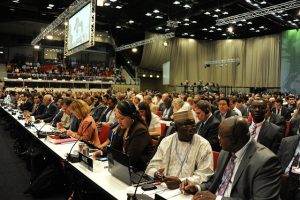
Headed by Ambassador Claudia Salerno, the Venezuelan delegation at the UN’s Paris conference avoided making a firm commitment to reducing GHG emissions by 20%. The delegation did not consider the progressive substitution of fossil fuels and technologies linked to the hydrocarbon sector for cleaner alternatives. Nor did it mention the proposed or current actions undertaken by PDVSA compared to other big oil companies, which have begun to diversify into cleaner projects such as wind and solar.
Green groups have objected to extractive projects promoted by the Venezuelan government over the past three years – most of which are financed by resources form China and which have operated on the edge of the remit of the country’s environmental authorities. There has been a distinct lack of detail on how funds are allocated to projects.
It has not gone unnoticed that president Maduro was one of the few national leaders absent from the Paris conference. OPEC nations such as Venezuela and Saudia Arabia were also cristicised for not tackling their enormous fuel subsidies, which inhibit a culture of efficiency and energy saving.
This article was originally published on Diálogo Chino.