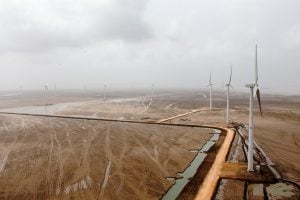
With the help of Chinese energy companies, Latin America is increasingly exploiting its renewable energy potential, with historic laggards like Argentina now embracing the region’s energy transition. New wind and solar projects are under construction across the region as partnerships with Chinese companies deliver affordable finance and materials to local governments and businesses.
Along with Costa Rica, Uruguay is now running on almost 100% renewable electricity. In 2015, the country installed more than 316 megawatts of renewables, meaning its total installed capacity is now 845 megawatts. Several others countries are following in Uruguay’s footsteps. Chile generates the most power from solar energy, while neighbouring Argentina has just completed the bidding process for 1.1 gigawatts of renewable electricity.
“China has begun to broaden its interests globally,” said Carlos Saint James, managing director of consulting firm Santiago & Sinclair and former president of Argentina’s Renewable Energies Chamber (CADER). “Initially, they secured the food sector, then natural resources and now they are going after energy. Given their growing industry and current oversupply of products, Latin America offers attractive markets,” he said.
At the conclusion of the first round of Argentina’s renewables promotion programme Renovar, the country offered 17 projects for electric power generation from renewable sources, accounting for 1.1 gigawatts. Of these, 12 are wind power projects, four are solar photovoltaic and one is biogas. The total investment required is estimated at US$1.8 billion (12.4 billion yuan).
At least half of the winning wind energy projects and three quarters of solar energy bids are linked to Chinese capital and technology, according to a survey conducted by Saint James. US and European companies account for a much lower share as they still consider Argentina to be a risky investment environment.
China’s company Envision Energy was awarded the largest contract, securing four projects, totalling 185 of the 708 megawatts granted to other international and local bidders, including some of the largest wind farms, which will be located in the southern provinces of Neuquén and Rio Negro. Other winners included Genneia, Central Puerto, Pan American Energy and the EREN Group. Of the solar energy projects, 75% stand to benefit from low-cost Chinese capital thanks to agreements with Argentine provincial governments.
“China has become a major player in the Argentine energy sector,” said Ernesto Fernández Taboada, executive director of the Argentine-Chinese Chamber of Production, Industry and Commerce. “They provide bank financing at very reasonable rates and this is always very attractive,” he said.
Andrés Napoli, director of Argentine environmental NGO FARN welcomed the bidding programme but pointed out that the government is still promoting fossil fuels too. “The country continues subsidising the oil industry in all its facets and is developing environmentally risky energy projects such as Vaca Muerta in Patagonia,” he told Diálogo Chino.
By 2017, Argentina aims to have 8% of its electric power generated from either wind, solar or small hydroelectric plants, according to a law approved by Congress late last year. The legislation also mandates that this figure increase to 20% by 2020.
Regional developments
Chinese investment in renewables in Latin America is viewed as an opportunity to expand trade with the region. Increased oil and gas production in the US is forcing China’s major renewables players to seek alternative partners and export markets.
Brazil, Mexico, Chile and Uruguay are investing heavily in clean energy generation, according to data from the International Energy Agency (IEA). China ranks highest as the country with most installed solar energy capacity in these countries.
The pragmatic Uruguayan approach to stimulating development of renewable energy, which auctions new generating capacity to deliver fixed profits to energy suppliers rather than offering subsidies, promotes strong private sector involvement and has become a global benchmark. The country has outstanding natural resources for developing renewables, such as predictable and constant wind energy along with high levels of water flow discharge.
According to Jorge Dosil Decaro, secretary general of the Uruguayan Wind Energy Association, Uruguay’s political stability and its reputation for having low levels of corruption have been instrumental in the success of the partnership. “All state entities are oriented towards promoting the development of renewables,” he told Diálogo Chino.
More than 80% of the solar water heaters imported by Uruguay come from China, according to official data from the Ministry of Energy. In a recent visit to Beijing, Uruguayan president Tabaré Vázquez underscored the importance of signing a free trade agreement with China, which would provide even greater stimulus for Chinese investment in renewables.
Private sector players were the main drivers of the development of renewables in Uruguay. Most technology is imported from China because Uruguay’s own manufacturing sector is unable to compete. The low prices for Chinese products are a “major factor” in this partnership, according to Andrés Eliseo Cabrera, President of the Solar Chamber of Uruguay.
Similarly, Chile plays a prominent role in Latin America’s development of renewables. The country’s goal is to derive 20% of its energy from renewables by 2025. It has developed specific policies for the sector, such as tax exemption mechanisms for renewable energy projects. In 2015, the sector attracted US$3.4 billion in investment, up 151% from 2014.
China is Chile’s main trading partner, and this has increasingly been reflected in the wind and solar sectors in recent years.
Chinese companies such as Goldwind Americas, Jinko Solar and Sky Solar Holdings are already working on numerous projects in Chile. Of the total energy produced in the country, 38% is supplied to the mining sector. Consequently, a large portion of investment is carried out directly by mining companies, in many cases, using Chinese capital.
“Chile has very good conditions for the development of clean energy, particularly in the north, where there is an abundance of wind and solar energy resources,” said Li Baorong, China’s Ambassador to Chile. “Chile needs to develop such energy. As a result, there is significant potential for China-Chile cooperation in the energy sector,” he said recently.
This article is republished from Diálogo Chino