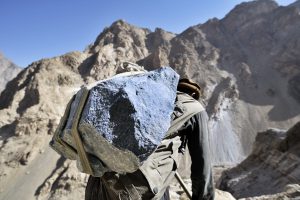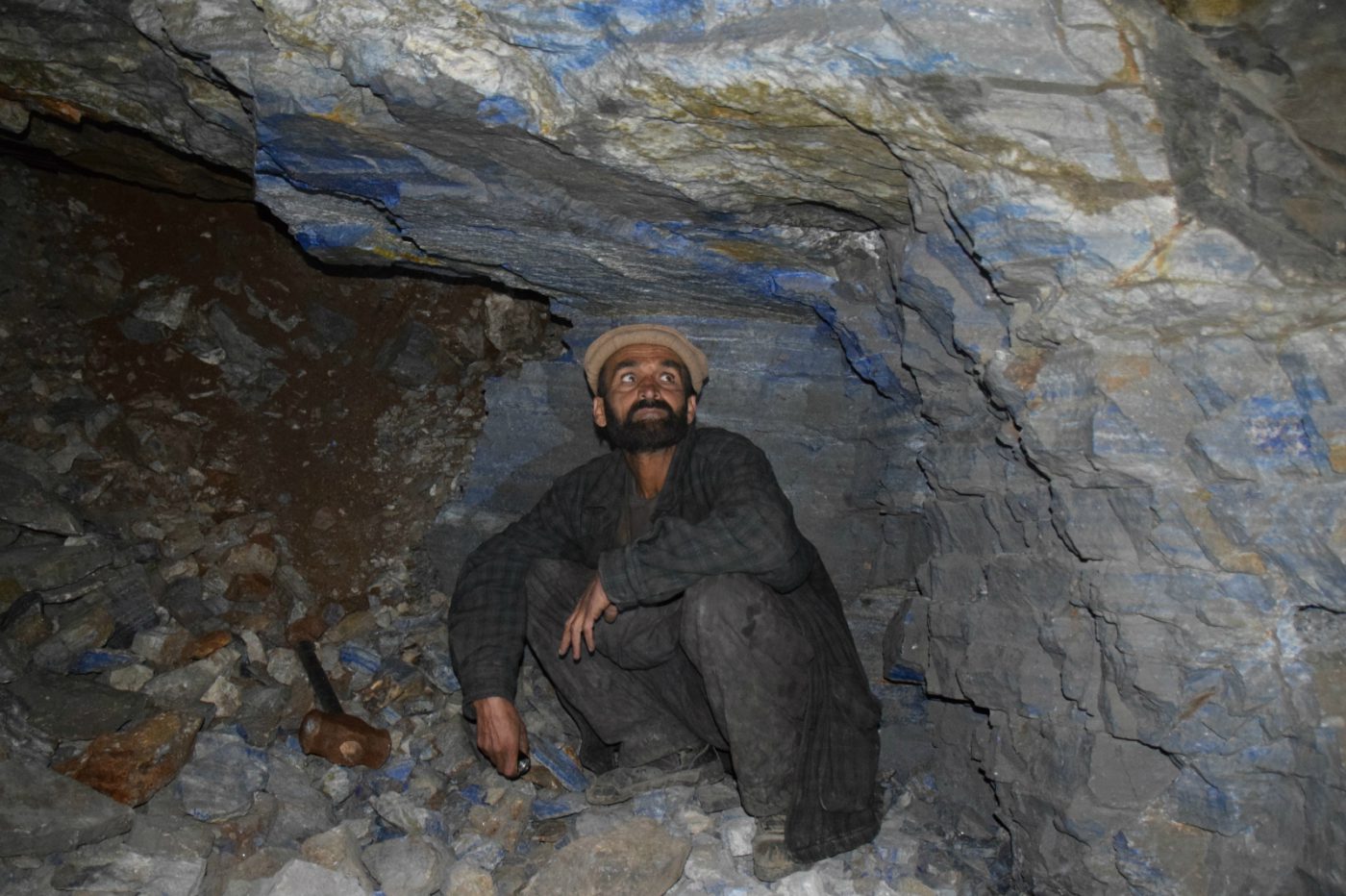
It is quiet, high up on a bleak slope in front of a mine in Afghanistan’s northeastern province of Badakhshan. In the past, loud explosions echoed through this valley in the district of Kuran wa Munjan. These were not from war but from the extraction of lapis lazuli, a deep blue semi-precious stone.
A recent investigation by Global Witness, an international non-governmental organisation working on corruption, conflict and natural resources, claimed mining of the precious stone in this remote region is funding illegal armed groups and driving extremism and corruption.
But mining has now come to a virtual standstill. The Afghan government has cut off transport of what it declares illegally extracted lapis lazuli from mines that were taken over by armed militias in January 2014. The Chinese buyers have left Afghanistan and prices have plummeted depriving the region of its major source of income. Much of that stone passed through Pakistan to China, where it is used to make jewellery.
The value of mining
Mining, in theory, has the potential to generate significant revenue and growth for Afghanistan, one of the world’s poorest countries despite its massive mineral wealth. A 2010 report by the US military estimated that the country’s mineral wealth was as much as US$1 trillion (6.9 trillion yuan). Badakhshan, especially, has few other sources of employment beyond mining.
But so far, the highly unregulated activity has not helped local people and the vast profits have fallen into the hands of a few powerful individuals.
When I visit the mining settlement marked Sar-i Sang on maps, which locals call Mahdani Lojward (lapis lazuli mines) in Dari, one of Afghanistan’s national languages, it is mostly deserted. Thousands of men reportedly used to stay here to mine the blue lapis treasure from deep inside the mountains but now there is only a handful who live in the crumbling stone huts in the encampment.
I meet Haji Abdul Malek, the purported leader of the local armed group that controls the mines. According to Global Witness, Haji is a former district police chief and commander with the Jamiat-e Islami party. Before this the mines were allegedly exploited by another former Jamiat commander, serving Badakhshan MP Zulmai Khan Mujadidi. When I spoke to him Zulmai Khan denied he has ever had any involvement in the Lapis mines.
Haji rejects all allegations that he or his group have unduly enriched themselves. He tells me that while he profited on a modest scale, so did everyone in Kuran wa Munjan, and that the revenue was mainly used to provide security to the mines and fix roads and bridges.
Malek also rejects allegations of paying off the Taliban, which control the neighbouring district of Yamgan, to prevent them from interfering with the mines. He says these accusations are fabrications by government officials, in particular, Zulmai Mujadidi, who used to control the mines.
Though neither the allegations nor Malek’s rejection can be verified, from visiting the area it is clear that the majority of locals apparently have seen little benefits from the mines and still live in overwhelmingly poor conditions. The vast majority of miners and merchants I meet come from other districts of Badakhshan or even other provinces. Some locals say they were refused jobs at the mines, but it is unclear whether this experience was widespread.
Mining techniques are crude, using simple hand-operated jackhammers and dynamite that is lit with fuses and matches, and have little effect on the environment. The same is true for the miners and merchants living in the nearby encampment, as their lifestyle is basic, requiring little energy and producing little waste.
Miners and merchants in Mahdani Lojward blame the government for halting work and destroying their livelihoods. However, the government says it has only taken necessary measures against illegal mining and the armed group that took over the mines in January 2014.
After the Afghan government lost control of the area around the mines, it blocked the transport of mined stone along the main transport artery to Fayzabad, the capital of Badakhshan, in early 2015. Then, in early 2016, it also intercepted the smuggling route along the Anjumon Pass to the neighbouring province of Panjshir and the Afghan capital Kabul.
Despite the blockade, some traders continue to transport smaller amounts of stone over the Anjumon Pass. However, merchants deposit most of the lapis lazuli in the first settlement of Panjshir on the other side of the pass to avoid the first police check-points. Some sources say merchants might also stash their treasures in hope of prices rebounding in the future.
Stephen Carter, head of the Afghanistan section of Global Witness, says that “during 2015, the lapis prices quoted by traders dropped by between 30% and 75%, and it is quite possible that they have fallen even further since then.”
Chinese buyers
The majority of the lapis lazuli goes to China. One Chinese official, who requested anonymity, confirmed that some Chinese merchants used to buy lapis directly in Kabul. Yet the identities of buyers remain unknown.
Some local traders allege that the Chinese buyers were ethnic Uyghurs from China’s north-western autonomous region of Xinjiang, though this could not be verified. In fact, Haji Abdul Basir, a merchant of semi-precious stones in Kabul, claimed that the 25 or so Chinese partners he has done business with come from different regions in China, but do not include ethnic Uyghurs. It is also unclear in what capacity the Chinese buyers were acting. Most sources, among them Abdul Basir, described them only vaguely as private entrepreneurs.
However, nearly everyone agrees that Chinese buyers are currently staying away from Afghanistan as a consequence of the political problems surrounding the mines and deteriorating market conditions.
With Afghanistan’s lapis lazuli trade in a deadlock between the government and a local armed group, and with international buyers pulling out, no one is profiting from the azure treasure of Badakhshan’s mountains. That said, the threat of the mines falling prey to a long and violent resource-driven conflict remains.
Images by Franz J. Marty