As the pace of the global low-carbon transition quickens, large-scale nature-friendly investment products are emerging that provide a new opportunity for institutional investors to diversify their investment risk while maintaining attractive, long-term returns.
With the Covid-19 crisis continuing, governments are fervently trying to prevent a widespread economic meltdown. What we’re seeing though is different from past economic crises – governments are writing new playbooks for recovery stimuli, building in measures for stronger, cleaner and more resilient economies. Environmental and climate concerns are now at the forefront of creative economic thinking.
While too few countries are seizing this opportunity, world leaders are promising hundreds of billions of dollars of government money for green stimulus projects. For example, the European Union will direct more than a third of its €750 billion “Next Generation EU” recovery package towards green initiatives, including measures to reduce dependence on fossil fuels, enhance energy efficiency and invest in preserving and restoring natural capital.
Such green stimulus is cementing in the minds of institutional investors the immediate risks of being stuck with stranded legacy assets, and the reputational risk of being on the wrong side of public sentiment.
For a growing pool of capital looking for reallocation, there is a need for new, low-carbon and decarbonised investment opportunities that deliver strong cash flow and reliable, long-dated returns. So far, renewable energy projects have taken the lion’s share of funds due in part to a lack of alternatives. However, natural capital is now emerging as a new investment theme.
Widening investment opportunities
Natural capital investing recognises the intrinsic value of our ecosystems, such as wetlands, soils and forests, and the benefits they provide for people, including reliable water, crop pollination, pest control and carbon sequestration. If we are to sustain our way of life, we must place a value on our quality of water, the importance of biodiversity, the health of our soils and oceans, and the need to prevent climate change’s catastrophic impacts.
Examples of investable natural capital assets include sustainable and regenerative agriculture and farming practices, sustainable timberland management, aquaculture, sustainable water production and water preservation, biodiversity and wildlife protection and restoration, and ocean-related investments, such as sustainable fisheries, coastal restoration and blue carbon.
In many cases, these assets are already providing a baseline return from current operations, such as food, fibre and timber. As a natural capital investment product, they also have the potential to generate additional returns through carbon sequestration and land restoration. As the resource is regenerated, it offers the potential for higher yields and higher value outputs.
In the case of carbon sequestration, many governments and companies already value and pay for carbon assets arising from reductions in greenhouse gas emissions, such as carbon offsets traded in voluntary and regulated carbon markets.
US$10 trillion
of economic growth created by “nature-positive” paths by 2030
Over time, we expect increasing revenue flows from investments in biodiversity, wildlife and natural assets such as reefs, oceans, mangroves and rainforests. For example, in Australia the Queensland government already pays for nature-based co-benefits through its Land Restoration Fund. Mangrove reforestation, for example, reduces the severity of storm damage, provides breeding grounds for fish species, and has been found to be one of the most effective carbon sinks available.
As an uncorrelated asset class – i.e. one that is not affected by general financial market movement – natural capital investing offers diversification in the shift to decarbonise the economy and still derive a healthy return. It can help pension and sovereign wealth funds meet their need for mandated returns in a way that is not only less harmful but has the potential to restore the environment.
Investment products can be adapted from traditional financial tools. For example, we have already seen new financial innovations with Reef Credits, Rainforest bonds and Rhino Impact bonds successfully launched into the market, building on a rapidly growing market in bonds linked to environmental performance such as the fulfilment of renewable energy targets.
Nature needs action on a much bigger scale
We know that the opportunity is there. The World Economic Forum (WEF) has recently noted that transitioning three major sectors of the economy onto “nature-positive” paths could create US$10 trillion of economic growth and 395 million jobs by 2030. The total annual investment necessary to capture all the opportunities across the three sectors is estimated at about $2.7 trillion.
Public policy demand for specific projects is there, too. The European Commission is calling for $22 billion per year over the next decade to be invested in planting over three billion trees, restoring 25,000km of rivers, reducing fertilisers by 20% and increasing agricultural lands under organic farming management to 25%.
To help address this, HSBC Global Asset Management and Pollination have formed a partnership, with the ambition to mainstream natural capital as an asset class. This new company – HSBC Pollination Climate Asset Management – intends to establish a series of natural capital funds, investing in a diverse range of activities that preserve, protect and enhance nature over the long-term, and address climate change.
In addition to seeking financial returns, we also seek to develop new markets for natural capital, through our investments. The opportunities for this range from regenerative agriculture in Australia with co-benefits such as soil carbon sequestration that can be monetised in regional schemes, commercial forestry projects with conservation benefits in the US and integrated landscape projects in Latin America and Europe with multiple revenue streams including from forestry, agriculture, carbon credits and eco-tourism. Measurable, additional and long-term impact is a fundamental principle of the investment approach. Each investment opportunity will be evaluated against high environmental standards, and needs to demonstrate the potential to deliver positive environmental impacts over their lifetime.
The potential for natural capital value creation will be quantified at the start of each investment and positive impact targets will be developed across six impact areas. Progress against these targets will be monitored and reported, leveraging an industry-leading, proprietary impact measurement tool – setting a new standard for impact measurement when it comes to natural capital.
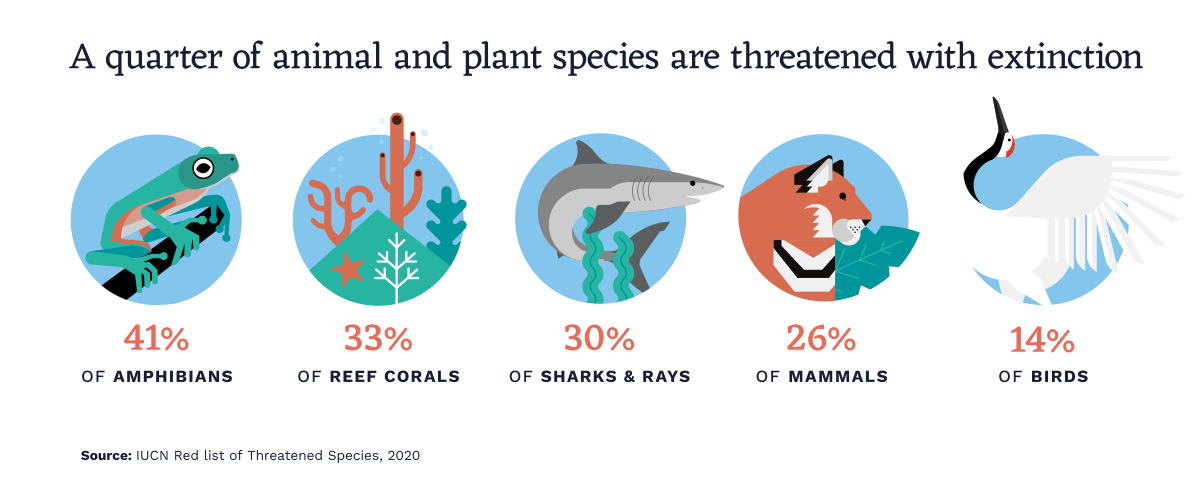
We know that our economic relationship to nature must change. We are fast approaching environmental tipping points, including rapid and accelerating losses of wildlife, habitats and even entire species, because we have not been able to properly quantify or value the importance of our ecological systems.
It’s time to tip the balance back in nature’s favour. At a time when trillions of newly created capital are looking for a home, our home – the Earth – is the most fertile investment we have.