



It is not just the snow and ice that’s disappearing from the roof of the world. Animals and plant species, crop diversity and ecosystem diversity are also being lost in one of the earth’s richest biodiversity hotspots. This is the evidence presented recently in the landmark ICIMOD assessment report on the state of the region.
The report paints a bleak picture for the region that is the source of Asia’s 10 major rivers and which provides water, food, energy and carbon storage for almost two billion people. Biodiversity is in steep decline, driven by human development, pollution, overexploitation of resources and climate change, according to the report chapter authored by Xu Jianchu from the World Agroforestry Centre in Kunming, China, among others.
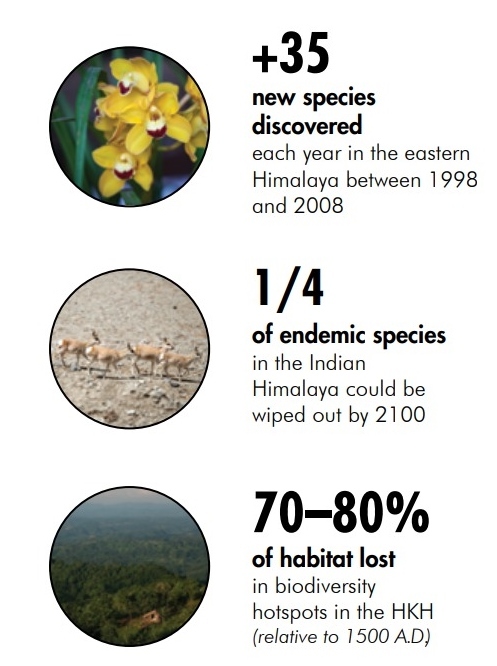
According to data cited in the report, 70-80% of the region’s original habitat has been lost and that may increase to 80-87% by 2100. A quarter of endemic species in the Indian Himalayas alone could be wiped out by 2100. Climate change is set to worsen this, along with new infrastructure development, trade routes and hydropower dams planned for the fragile region.
This will mean the loss of key environmental services the region provides, such as water and carbon storage, to the rest of Asia.
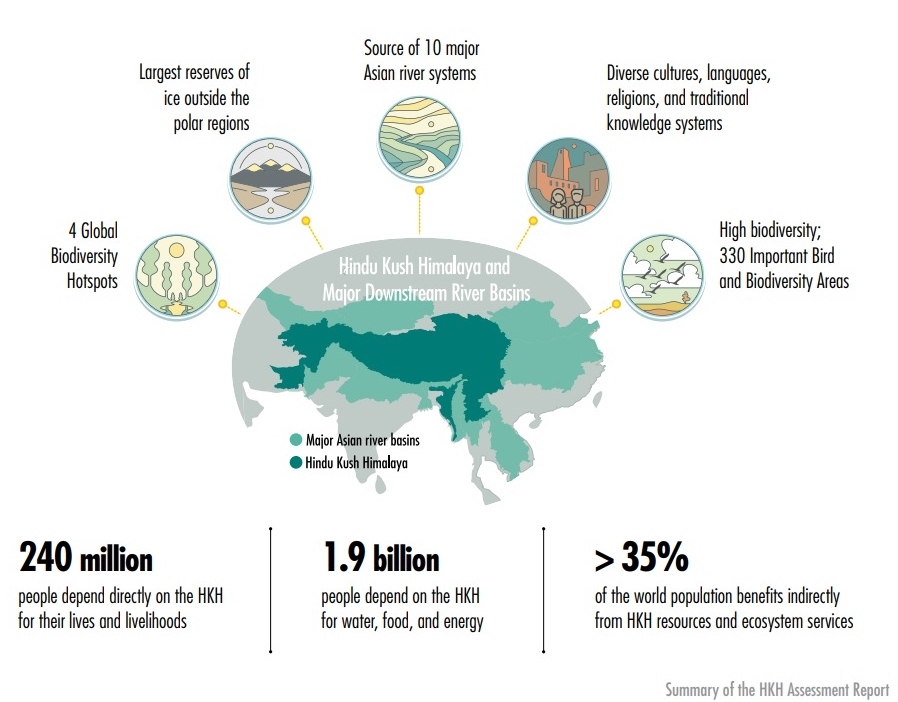
Image: HIMAP
Global biodiversity hotspot
The mountains of the Hindu Kush Himalaya contain the most biodiverse regions in the world – some of it still undiscovered. About 35 new species were found every year in the Eastern Himalayas between 1998 and 2008.
Spanning a vast distance from Afghanistan in the west to China in the east, the region is not only vast tracts of snow and ice. It encompasses lush tropical valleys, mountain forests, alpine meadows, high altitude grasslands and wetlands, as well as arid steppes.
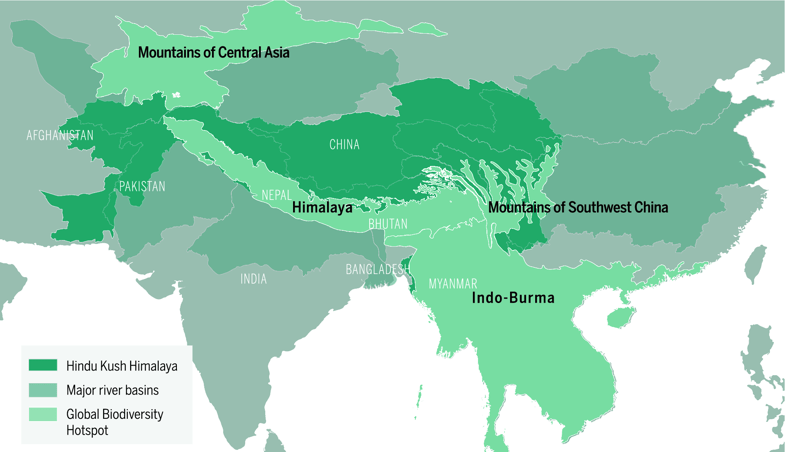
Image: HIMAP
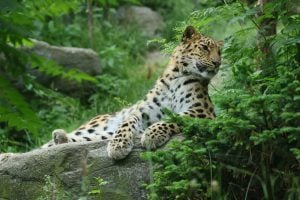
These provide habitat to a diversity of rare endangered animals including tigers, elephants, musk deer, red panda and snow leopards. Most of these species – apart from the Tibetan antelope and giant panda of which numbers have rebounded in the past decade – are being driven to extinction. Rhododendrons, orchids, rare medicinal and wild edible plants are also under threat.
 The ICIMOD findings corroborate earlier studies showing that as temperatures rise with climate change, large areas of grasslands, alpine meadows, wetlands and permafrost will disappear on the Tibetan plateau by 2050. The Tibetan plateau is warming at up to three times the global average, according to recent reports.
The genetic diversity of the Hindu Kush Himalaya also has global significance, the new report highlights. There have been 2,500 species of rice identified in Nepal alone, and 100 types of basmati in the Western Himalayas. The variety of crops grown by farmers could serve as a genetic resource for improving crop yields and pest resistance. This will be essential to support global food security in a world where shrinking crop diversity has left us vulnerable to climate change. There has been little research so far on the genetic diversity of the region, the report points out.
Human impacts
Ecosystems are becoming less resilient to stress. This has led to a loss of wildlife populations, and plant productivity, and changes in growing seasons, with entire ecosystems shifting to higher altitudes. At the same time the region is facing an increase in the severity of natural disasters due to climate change and a breakdown of traditional systems of management.
This will have huge impacts, particularly for the 240 million people in mountain regions who still live in poverty and depend on natural resources for their daily food and livelihood. The role of Himalayan biodiversity in health has been overlooked, the report points out. The area has been known for millennia as the home of numerous medicinal plants. This will also have an effect on large pharmaceutical corporations, since the discovery and development of medicines is linked to understanding the effects of plants and herbs on the human body. Many of these may be lost before they’re utilised. Biodiversity loss will see the expansion of vector-borne diseases as pathogens move to new habitats, and new diseases due to changes in water availability.
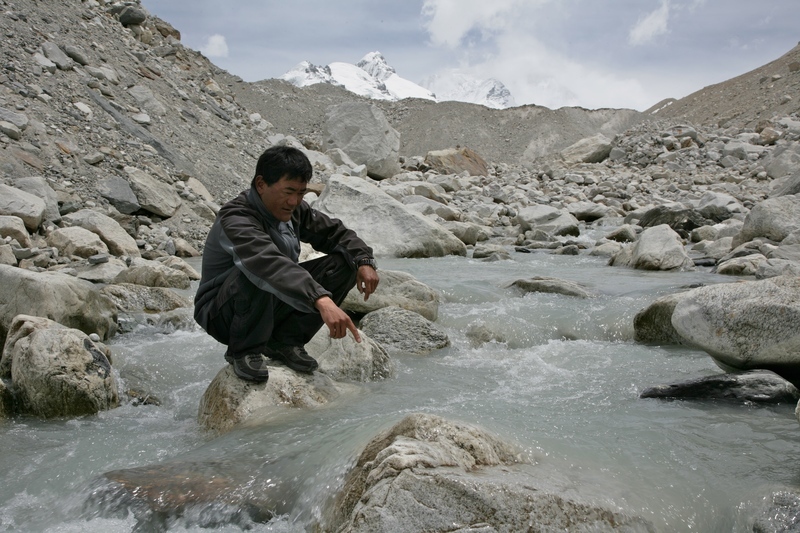
A Tibetan guide talks about climate change at Everest. (Image: Greenpeace / John Novis)
The Hindu Kush Himalaya is also one of the world’s most culturally diverse regions. Its densely populated and cultivated valleys are home to over 1,000 different ethnic groups, each with their own traditional practices, agriculture crops and deep local knowledge.
The vast and vibrant trade networks along the old mountain silk roads facilitated the exchange of culture, knowledge and biodiversity over centuries. This resulted in a rich migration of species, and different farming systems and plants. Many of these routes were shut down in the 1960s as China turned inwards and border disputes broke out – but are now being revived. Many more remain closed, largely due to political tensions between India and Pakistan as well as India and China.
Community conservation
The report notes a positive shift over the past decades in conservation approaches – from focusing on species by excluding people from protected areas, to a more community-centred approach. Participatory approaches have brought positive change – regenerating degraded forests and restoring wetlands for example. And biodiversity is much richer around religious sites such as sacred groves.
But bigger threats loom
Community action can’t do enough to stem the tide of wide-scale biodiversity loss. Hydropower is a big threat, with over 550 large projects operational or under construction. New trade routes under China’s Belt and Road Initiative, such as new rail and roads cutting through fragile landscapes, will bring opportunities to remote regions, but could facilitate greater resource extraction and illegal wildlife trade.
Climate change is driving massive ecosystem changes, particularly on the permafrost and widespread desertification at the source areas of major rivers on the Tibetan plateau in China, turning vast swathes of precious grasslands and wetlands into desert.
More ambition needed
About 40% of the Hindu Kush Himalaya region is designated as protected areas but implementation of conservation measures is patchy. Many of these areas are remote and authorities have little control over border regions sometimes plagued by conflict. The Indo-Burma hotspot is one example. Straddling India and Myanmar, it has one of the highest levels of endemic species but lags far behind other regions in conservation.
The report’s authors call for countries in the region and donor governments and the private sector to step up financial commitments for conservation. The report is a bit thin on concrete measures national governments, investors and civil society should take but it emphasises that greater regional cooperation is a necessity.
This article is republished from The Third Pole



![Fears of river diversion have led to protests against a Chinese funded hydropower project in Kashmir [image by: Ghulam Rasool]](https://dialogue.earth/content/uploads/2019/03/Neelum1-Ghulam-Rasool-300x200.jpg)