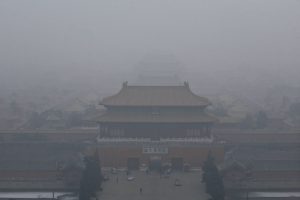
China is now believed to be the world’s largest emitter of carbon dioxide, the most important greenhouse gas, overtaking the United States to take the number one spot. This has led to renewed calls for China to act in reducing the environmental impacts of its phenomenal growth. These calls have been resisted, inside and outside China, on the grounds that industrialised countries are responsible for the majority of emissions to date. Moreover, it has been argued that the steep rise in China’s carbon emissions has been fuelled by exports of cheap goods from its factories to western consumers.
China is rapidly becoming the world’s manufacturing hub. The country is now exporting an increasingly large quantity of labour and energy-intensive goods to developed countries. A high-profile example is the arrival of the world’s largest cargo ship – the Emma Maersk – in the UK just before Christmas 2006. It was carrying more than 45,000 tonnes of Christmas goods from Chinese factories for sale to consumers in the European Union.
Trade surplus
China’s trade surplus with the rest of the world has accelerated sharply since its accession to the World Trade Organisation (WTO) in 2001. In 2004, China’s exports contributed 34% to the total GDP, and generated a surplus of some US$32 billion. By 2006, China’s trade surplus had reached US$177 billion, and many predict that the figure for 2007 will be at least US$200 billion. The WTO estimated in 2005 that China’s exports could overtake the US and Germany by 2010. Only two years later, China has already surpassed Germany as the world’s largest exporter.
The rise of China as a global trading power has led to tensions in the EU and the US over competitiveness and safety issues. Trade conflicts with the US have been a regular occurrence for many years – and have often arisen alongside wider political tensions. In recent times, issues of food safety and steel subsidies have attracted particular attention. Meanwhile, retailers in the EU have had to recall a series of Chinese-made toys amid safety concerns. In addition, the European Commission has recently extended anti-dumping duties on energy saving light-bulbs from China for a further year due to lobbying from German lighting companies. This seems counter-productive given moves within the EU to phase out incandescent lighting and encourage consumers to make the switch to more expensive compact fluorescents.
While the large trade surplus is a major driver of economic growth in China, it has its downsides. According to a recent speech by Bo Xilai, China’s then minister for commerce, 58% of China’s exports are from multinational ventures in China. This led some to argue that the Chinese economy is failing to capture enough of the economic wealth generated by such ventures, since much of it is retained by parent companies abroad. Of concern also is the polluting, energy-intensive nature of products such as rolled steel, which are being increasingly manufactured for export as well as domestic markets. While their overall share of exports has been small to date, rapid growth is contributing to China’s local, regional and global environmental impacts. The Chinese government cut the export rebate three times in 2007 alone on these energy intensive goods, and imposed a 10% export tariff on some. However, their efforts have so far been ineffective due to strong international demand.
Exporting emissions
Despite some discussion of the implications of China’s trade surplus on its emissions, there has been little work to quantify this. In a recent Tyndall Centre briefing note [pdf], we set out an initial assessment of the emissions from goods and services that China exports. Our analysis concludes that in 2004 – the most recent year for which comprehensive data is available – net exports accounted for 23% of China’s total CO2 emissions. This is due to both China’s large trade surplus and the relatively high carbon intensity of the Chinese economy. It is a figure comparable to Japan’s total CO2 emissions, and more than double the UK’s emissions in the same year (see figure 1). The equivalent emissions figures for 2005 and 2006 could be larger, since China’s trade surplus has grown.
A number of other studies have been conducted, some of which reach similar conclusions. A report in 2005 by Bin Shui, of the US National Centre for Atmospheric Research, indicated that 7% to 14% of China’s CO2 emissions in the period from 1997 to 2003 were due to exports to the US alone. Jiang Kejun of the Energy Research Institute, which is based in the Chinese government’s National Development and Reform Commission, suggests exports account for around 20% of China’s total national energy consumption.
These results are inevitably subject to uncertainties and simplifications, not least because of a lack of data on the carbon intensity of different exported products. However, the implications are clear. The extent of “exported carbon” from China should lead to a re-think by government negotiators working towards a new climate-change agreement beyond 2012.
International footprints
The nation state may be at the heart of most international negotiations and treaties, but global trade means a country’s carbon footprint is international. Should countries only remain concerned with emissions in their borders? Or should they also assume responsibility for pollution from the production of goods and services they consume? The scale of emissions due to exports from countries such as China, not to mention the emissions caused by international air and marine freighting of goods, provide strong arguments for the latter approach.
This analysis also strengthens the case for early action by the developed world in two respects. Firstly, it provides evidence to the international negotiations around climate change that not only are industrialised countries historically responsible for the majority of carbon emissions to date, but industrialised countries may also have significant responsibility for driving the rapid growth in emissions from industrialising countries such as China. Secondly, it supports the expansion of efforts to help developing countries reduce the carbon emissions from economic growth through technical assistance and finance, helping developing countries to transition to a low-carbon economy before too much investment is locked in a carbon-intensive economic model.
Tao Wang and Jim Watson, Sussex Energy Group, University of Sussex and Tyndall Centre for Climate Change Research, UK
Homepage photo by Ian Koh