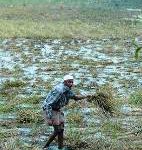
Dependra Das stretches out his arms to show his flaky skin, covered in raw saltwater sores. His fingers submerged in soft black clay for up to six hours a day, he spends his time frantically shoring up a crude sea dike surrounding his remote island home in the Sundarbans, the world’s largest delta.
Alongside him, across the beach in long lines, the villagers of Ghoramara island, the women dressed in purple, orange and green saris, do the same, trying to hold back the tide.
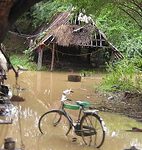
For the islanders, each day begins and ends the same way. As dusk descends, the people file back to their thatched huts. By morning the dike will be breached and work will begin again. Here in the vast, low-lying Sundarbans, the largest mangrove wilderness on the planet, Das, aged 70, is preparing to lose his third home to the sea in as many years. Here, global warming is a reality, not a prediction.
Over the course of a three-day boat trip through the Sundarbans, The Observer found Das’s plight to be far from unique. Across the delta, homes have been swept away, fields ravaged by worsening monsoons, livelihoods destroyed. Events confirm what experts have been warning: that the effects of global warming will be most severe on those who did the least to contribute to it and can least afford measures to adapt or save themselves. For these islanders, building clay walls is their only option.
Lying one-third in India and two-thirds in Bangladesh, the Sundarbans are where two of Asia’s biggest rivers, the Ganges and the Brahmaputra, broaden and roll powerfully into the Bay of Bengal. The source of the problem is about 2,400 kilometres (1,500 miles) away, at the source of the Ganges, where melting Himalayan glaciers are raising river and sea levels.
Lohachara island, once visible from Ghoramara — less than two kilometers to the east — has already gone beneath the waves. The island succumbed to the ocean two years ago, leaving more than 7,000 people homeless. Ghoramara itself has lost a third of its land mass in the past five years. To the north, Sagar island now houses 20,000 refugees from the tides.
According to the geologist Sugata Hazra, director of the School of Oceanographic Studies at Kolkata’s Jadavpur University, the people of the Sundarbans are the first climate-change refugees.
“These people are victims of global warming,” Hazra said. “The accelerated melt of the Himalayan glaciers is producing larger volumes of water in the rivers, water that violently carves its way through the flat delta where they live. The Sundarbans and the four million people who inhabit the Indian side are dreadfully vulnerable. The area has lost 72 square miles [nearly 190 square kilometers] of land in the past few decades. This entire region is holding back a disaster and could ultimately serve as a warning of what is to come.”
The hamlet on Ghoramara in which Gita Pandhar, 25, lives is reached by a narrow path along a mud dike braced against the sea. Each day, to get to the market, she must walk through three kilometres of deep, slippery mud.
“When I was young,” Pandhar said, “this was all rice fields and herds of cows. It was beautiful, a wonderful place to grow up, in isolation away from the mainland. The farmland my grandfather first tended is now poisoned with salt. All the arable land has been replaced by swamp. We used to burn dung as fuel, but there is nowhere to graze and now we have to cut the last of the wood here to cook with.”
Flooding is normal in the Sundarbans. Hundreds of waterways flow through it, carrying 92% of the water from Tibet, Bhutan, India and Nepal. Most of this water arrives during the monsoon, flooding on average 33% of the countryside.
According to Pandhar, the severity of the storms has made the area one of the most dangerous places to live in the world. “The sea is so violent at night,” she said. “We know nothing of global warming. The scientists who visit tell us the West and their pollution is to blame. This is a very backward area, so we are the first people to suffer from global warming and the last to find out why we are suffering.”
She added: “You can see our houses; they are made of the same mud that props up the dikes. When the water rushes through the dikes, it does the same to our homes. When the typhoons come, we lose everything. Nature used to give us food and crops. Now all it gives us is misery, a cruel sea that covers us in sores, destroys our homes and threatens to take our families’ lives. We are living in hell.”
As rising sea levels in the Sundarbans continue to destroy lives, critics argue that the Indian government remains consumed with protecting its own interests rather than those of the vulnerable. Over the past few years, in a construction project that eventually will reach across about 3,300 kilometres, India has been quietly sealing itself off from Bangladesh, its much poorer neighbour. Fence sections totalling about 2,500 kilometres have been built since 2004, many traversing the fringes of the Sundarbans.
Today the frontier between the countries is defined by two rows of three-metre-high barbed-wire barriers. In New Delhi, the belief is that the fence is being built to “keep in” an anticipated influx of refugees from Bangladesh, a crowded country more prone to devastating floods than any other on earth.
“You’ve got an increasing population with a violently shrinking land mass,” said Ajai Sahni, head of the New Delhi-based Institute for Conflict Management (ICM), who worries that the Indian government is not building the fence fast enough.
At night, Ghoramara’s landscape dramatically comes alive as water pours onto the beaches and through the mud dikes protecting the villages. At high tide, the water flows inland as the sea builds up, submerging most of the mangroves. Everywhere, narrow channels of brackish water burrow into the land and snake their way through the dense brush. Each evening, tens of thousands of people go to sleep in fear of the sea.
“We have no safety net when the sea comes,” says one islander, Malata Bala Das. “So many times, the embankment we have built collapses under the weight of the rising tide. We can’t rest our heads at night. We all listen for the water. Many of our young people have already left for Kolkata or the Andaman Islands to find work. It is a struggle here, but we are too old, we know no other life. Soon there will be only old people and grandchildren left, until our island is gone.”
In Rudranadar colony, a Sagar refugee camp for the latest exiles from Ghoramara, families huddle around oil lamps in tiny huts. A woman called Angurbala recalls the night last year when she lost her home: “Everything changed when the water burst through our home. My grandson drowned, the water took everything. We left for a government camp, but here is no better. We were promised our own freshwater well, but the land here on Sagar is also bad. Now all the water is salty and you can’t use it.”
“We worry that the same thing could happen to us here,” she adds. “It feels like we have no escape from the sea.”
Copyright Guardian News & Media Ltd 2008
Homepage photo by Frances Voon