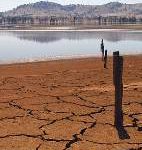
There is a common saying in Spain that during a drought, the trees chase after the dogs. Now it is ringing true as the country struggles to deal with the worst drought since the 1940s: reservoirs stand at 46% of capacity and rainfall over the past 18 months has been 40% below average.
But before the scorching summer sun threatens to reduce supplies to a trickle, a bitter political battle is raging over how to manage Spain’s scarcest resource — water.
Catalonia, in the parched north-east, has been worst affected, with reservoirs standing at just a fifth of capacity. Faced with the prospect of having to cut supplies, authorities in Barcelona, the Catalan capital, have brought in hitherto unheard of fines of €30 (nearly US$50) for watering gardens or €3,000 (more than US$4,700) for filling swimming pools of over 300 square metres in size. Municipal fountains, some lit up at night for tourists, are empty. Beach showers have been turned off.
In an emergency measure, the Catalan regional government is planning to ship in water from one of Spain’s driest regions, Almería in the south-east, and from Marseille in south-east France. It may bring in even more water by train.
The crisis has forced the fiercely nationalist Catalans, who like to see themselves as separate from Spaniards, into a humiliating plea to the central government in Madrid. Uttering a phrase which must have stuck in his throat, José Montilla, the socialist president of the Catalan regional government, reminded the central government: “Catalonia is also part of Spain.”
Montilla had hoped that water would be transferred to Catalonia from the river Segre in neighbouring Aragon. But Spain’s prime minister, José Luis Rodríguez Zapatero refused, even taking time out from the Nato summit in Bucharest in early April to deny there was a “water war” with Catalonia.
Zapatero prefers the costlier solution of shipping in water in tankers or trains to diverting it from other rivers to the Ebro, which supplies most of Catalonia.
Experts say that, despite three years of drought, Spain should have enough water for everyone. But the latest dispute reveals that no one can agree how to share it.
Zapatero’s government believes the answer lies in a controversial series of desalination plants. Spain already has 950 desalination plants which produce two million cubic metres of water a day, enough to supply 10 million people. Another plant is due to open near Barcelona next year. The socialists contend that the plants will end Spain’s almost yearly scramble to stop its reserves drying up.
But the Spanish Association for the Technological Treatment of Water says that each desalination plant indirectly produces one million tonnes of carbon dioxide (CO2) a year.
Supporters of the plants say that, while they may be costly and produce high emissions, diverting rivers causes more damage to animal life by introducing new species, such as the zebra mussel, which has been blamed for damaging river eco-systems.
But the opposition Popular Party supports diverting river courses, contending that it does less environmental damage. “I would transfer water anywhere,” said Mariano Rajoy, the Popular Party leader. “The desalination plants emit CO2 and contribute to climate change.”
According to Angel Cajigas, president of the water treatment association, “Despite their problems, [desalination plants] produce an unlimited amount of water, can adapt to demand and reduce concern about supplies.”
But ecologists say that, in a country where water is cheap compared to how much it costs its neighbours, Spaniards do not value the resource and much of it is lost due to outdated, leaking drainage systems. One faulty system in Barcelona is reportedly losing 800,000 litres of water a day.
“We should raise the price of water, which is very cheap,” according to Alberto Fernández, head of water for the environmental organisation WWF in Spain. “We need better systems of storage and distribution and to create banks of water, so we could buy and sell the rights to it.”
Other experts have grown tired of Spain’s annual “water war”. Edelmiro Rúa Álvarez, president of the College of Engineers, says: “Spain has enough water for everyone. We shouldn’t be at each others’ throats every year. In five years, we shouldn’t be wrangling over this again.”
www.guardian.co.uk/
Copyright Guardian News and Media Limited 2008
Homepage photo by tracX