Editors’ note: chinadialogue is in Cancun! Read Joydeep Gupta’s first-day reflections from Mexico here.
On the morning of 25 November, Xie Zhenhua, China’s chief climate negotiator, met with chinadialogue and local NGOs to discuss China’s approach to the next round of United Nations-led talks, which begin in Mexico today. He said that, in Cancún, China would use openness to tackle disagreements and misunderstandings at both government and non-governmental levels.
“We now realise that in the past we took action, but didn’t tell anyone about it,” Xie said in relation to transparency in emissions reductions. “Now we think: if we’ve done something, why not say so? What China has done, what it has not done, what difficulties it faces – I’m willing to tell anyone about these.
“It’s that lack of communication that, in the past, led some media to distort our policies and measures. If we make everything public and transparent, they would have no reason to do that anymore, even if they wanted to. So for this reason, China is willing to be transparent. But we want to get the details clear and principles decided.”
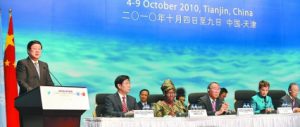
The Chinese attitude towards transparency visibly relaxed during the last round of UN climate talks in Tianjin in October. Xie, who is also vice chairman of China’s National Development and Reform Commission, said at the time that – as long as sovereignty is not infringed – China has no problem with either measureable, verifiable and reportable (MRV) mechanisms or transparency.
In the lead-up to Cancún, Xie – in his capacity as head of the Chinese delegation – again indicated that China would actively cooperate on the International Consultation and Analysis (ICA) mechanism, a global system designed to measure the efforts of developing nations to combat climate change. The ICA is distinct from the MRV requirements for actions by developed nations and thus embodies the principle of “common but differentiated responsibilities”.
Xie indicated that, during ministerial-level negotiations on ICA, majority consensus had been reached on the principles – for example that all developing nations are subject to the mechanism, not just major emitters such as China, India and Brazil; and that sovereignty will be respected during implementation. Other principles are that the ICA mechanism will be non-invasive, non-punitive and progressive and will take into account the actual capability of different developing nations. “Some countries don’t even have the capacity to produce a national report. Situations like that need to be taken into consideration,” said Xie.
Members of the Chinese delegation seem to agree on the need to increase transparency of action, but remain extremely cautious. “China has no issue with accepting ICA. However there are still several developing nations that have not accepted the Copenhagen Accord and therefore reject the ICA concept,” said senior negotiator Li Gao.
“Another issue is that the developed nations’ current ICA text has stricter requirements for the examination of developing nations’ voluntary emissions-reduction actions by developed nations than the existing convention. I’m not sure if proposing a text like that is meant to represent a constructive attitude towards the talks or an attempt to put obstacles in place.”
Li Gao believes that, if there is no progress on MRV mechanisms for developed-nation reductions, there is little chance of seeing much progress on voluntary emissions reductions from developing nations.
The Copenhagen talks exposed difference between various participants, and in particular a deepening of the rift between developed and developing nations. By the time of the Tianjin meeting, these differences had spread beyond just the key issues, and were reflected in increasingly fierce arguments over the negotiation mechanisms themselves.
In discussion with the Chinese environmental groups, Xie said that the most important outcome of the Tianjin negotiations was clarification of the issues – where there was common ground and where there were still disagreements. The two biggest points of difference are whether or not the Bali Roadmap should be stuck to – that is, a single track or two-track approach for the negotiations; and how to describe the responsibilities of the United States in a way comparable with commitments made under the United Nations Framework Convention on Climate Change (UNFCCC).
The European Union also maintains that the US target of 17% reduction in emissions is too low. And there is the issue of emissions-reduction targets in developing nations with high carbon emissions.
Xie said: “The two working groups presented reports to the ministerial-level preparatory meeting. But what’s the next step? Do we still need the Kyoto Protocol? They’re looking to the ministers for clear political direction.”
As far as negotiations under the Ad Hoc Working Group on Long-Term Cooperative Action(AWG-LCA), are concerned, emissions reductions are the key issue. Xie said that, although the United States has made a political commitment to cut emissions by 17% on 2005 levels by 2020, it has also made it clear that it will not sign up to the Kyoto Protocol. Moreover, Congress has not passed – and thus made legally binding – even that low target, and some developed nations are also unhappy about this. “There are also issues of fairness among the developed nations,” Xie pointed out.
During the Cancún summit, he said real achievements will need to be made on the issues of most concern to developing nations – funding and technology transfer – in order to lay the foundation for a legally binding agreement to be concluded during talks in South Africa next year.
“We have been told that US$28.5 billion of the US$30 billion fast-start fund the developed nations undertook to provide is in place. But only US$5 billion of that is actually new or extra money – most of it has just been repackaged,” said Xie. But he added that China understands the economic crisis many nations are facing and is not criticising this.
As for technology transfers, developing nations have called for an executive committee to be formed, while developing nations want an online information centre to provide consultancy services. The current compromise is to have both – but the responsibilities of the committee need to be further discussed.
“Success in South Africa next year requires a positive outcome in Cancún as a foundation,” said Xie. “The final outcome should be one which nobody is happy with, but that everyone can accept – that’s the ideal result.”
China came in for a lot of criticism after Copenhagen, especially from western media. But during discussion with the Chinese NGOs, Xie expressed understanding: “China has become the world’s second largest economy and the largest emitter of carbon dioxide – of course they’re going to have a few things to say.”
But media distortions are a frustration. During Copenhagen, the Chinese government tried to be more open with the media and Xie was interviewed by a number of foreign journalists. “But what was published wasn’t at all what I’d wanted to say. I made 10 points, they only wrote about four,” Xie said.
Responding to this, one British reporter said to chinadialogue: "The Chinese delegation need a better communications strategy: they should not expect international journalists to reproduce every one of their talking points. It’s a question of space and style, not bias. Regardless of nationality, it’s rare to see even three or four points from any official reproduced in a western media report, let alone 10."
In Cancún, Xie hopes to be interviewed by both Chinese and overseas media at the same time, to let the public see different viewpoints. “Some nations have done nothing, despite having talked plenty, and are treated fine. We can’t just work our butts off all day without making it known. We need to keep improving and adjusting communication with NGOs and the media.
"Previously the European Union said our target of a 40% to 45% cut in carbon intensity was too low, and should be 60%. So we organised three expert hearings, and even EU experts admitted China’s target was reasonable and scientific. So this time we’re bringing along Chinese experts to participate in the dialogue.”
In response to chinadialogue’s questions about China-US bilateral dialogue, Xie said that there are very frequent discussions and collaborations at the governmental and think-tank level across energy, finance and the environment, on MRV issues and emission-reduction targets. However, he was not willing to reveal more details, only adding: “We hope the United States will play a leading role and push the entire negotiation process forward.”
Although the Chinese government has always wanted to display a positive attitude, Xie said the country would never commit to more than it can do. After all, China’s per-capita GDP still comes somewhere between numbers 100 and 105 in the world rankings. “If we committed to too much, we would face the sack when we got home,” Xie said. “The Chinese people wouldn’t let that pass.”
Editors’ note: chinadialogue is in Cancun! Read Joydeep Gupta’s first-day reflections from Mexico here.
Meng Si is associate editor in chinadialogue’s Beijing office.
Homepage image from gov.cn