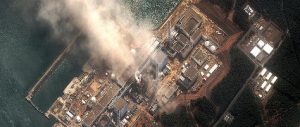
Editor’s note: At UN-led climate-change talks in Bangkok in April, Japan did not discuss its climate-change actions, or its 25% emissions-reduction target – instead saying that, with the Fukushima nuclear crisis still unfolding, it is too early to talk about changes in energy supply and demand and the impact of those changes on climate-change negotiations. Tang Wei, of the Shanghai Academy of Social Sciences, and Li Jin, of the Shanghai Environment and Energy Exchange, argue that a post-earthquake Japan may shift its climate policy.
On March 11, a massive, 9.0-magnitude earthquake in Japan’s north-eastern region of Tōhoku crippled the country. The resulting tsunami and the radiation leak that it, in turn, triggered at the Fukushima nuclear-power plant have profoundly impacted Japan’s political economy and national psyche and affected international relations and even global security.
The earthquake, nuclear power and the global response to climate change are closely linked. Japan is the world’s third largest economy and a key member of the Umbrella Group (a loose coalition of non-EU developed nations in climate negotiations). How will this trauma affect the nation’s climate policy? And what impact will there be on the geopolitics of climate change?
Climate change is the only truly global issue and is closely linked to both lifestyles and production. Tackling it involves saving energy, cutting emissions, developing new energy sources, adjusting industrial structure and making lifestyle changes. The global community must limit emissions while taking into account economic growth, intergenerational justice and people’s basic needs – and this has led to a struggle between environmental capacity and space for development.
Japan is a key member of the Umbrella Group and, since the 1990s, its climate policy has wavered between falling in line with the United States and independence. On one hand, it has attempted to use climate diplomacy to win markets for its green industries and become a political power; on the other, it has failed to come close to meeting its emissions-reduction commitments under the Kyoto Protocol.
As an island nation, Japan is vulnerable to changes in sea level. The Climate Change Vulnerability Index (CCVI) produced by risk consultancy Maplecroft lists Japan as a “high risk” country – only slightly better off than Bangladesh and small-island nations, which are classed as “extreme risk”. It is also poor in natural resources and is classed as an Annex 1 industrialised nation under the United Nations Framework Convention on Climate Change – giving it an unavoidable moral responsibility to participate in joint action to combat climate change.
In fact, since the 1960s, Japan has been proactive in developing and using energy-efficient and green technologies and fostering awareness of energy-saving needs, with the result that, between 1973 and 2007, energy intensity dropped from 146 tonnes of oil equivalent per US$1 milllion to 105 tonnes of oil equivalent per US$1 million – a 30% fall that made Japan one of the most energy efficient nations in the world. In response to oil crises and the rising cost of oil, Japan made nuclear-power development a national strategy. Prior to this year’s earthquake, 30% of Japan’s electricity was nuclear-generated.
But despite these major technological and policy successes, the fact remains that fossil fuels are still Japan’s main source of energy. Development figures from the World Bank show that, in 2007, coal, oil and natural gas accounted for 83.2% of Japan’s energy use. As a result, Japan’s carbon emissions in 2008 (not including those arising from changes in land use) were 1.28 billion tonnes of carbon-dioxide equivalent – almost 10% higher than in 1990, making it impossible for the country to achieve the 6% emissions cut below 1990 levels by 2012 required of it under the Kyoto Protocol. It may also help to explain the country’s position at UN-led climate talks in Copenhagen and Cancún, where it repeatedly demanded that major developing nations also undertake binding emission-reduction commitments.
The devastating earthquake and tsunami paralysed much of Japan’s road, rail and power infrastructure, and many factories and businesses have been forced to shut down. Inevitably there will be a resulting slump in energy demand and carbon emissions, similar to that caused by the 2008 financial crisis. But given the scale of Japan’s industry and its technological capability, the demand for fossil fuels will surely rise rapidly as production recovers and reconstruction starts.
Meanwhile, the Fukushima crisis has, at least in the short term, created an atmosphere of mistrust around Japan’s nuclear sector, much as attitudes to the oil sector were affected by BP’s spill in the Gulf of Mexico. This creates social and political risks for nuclear development, in addition to economic and safety concerns. Investors believe that global nuclear investment has already been affected by the crisis in Japan and that many projects will be delayed.
An analyst at emissions-trading firm Orbeo has suggested that, if Japan replaces nuclear energy with fossil fuels, it will emit an additional 74 million tonnes of carbon dioxide equivalent – and the country’s political will on climate-change action may weaken further.
The earthquake also caused international carbon credit prices to rise. The reduction in nuclear power, combined with post-disaster reconstruction needs, led to expectations that Japanese demand for oil, coal and natural gas would increase. Those expectations affected the futures market, thus pushing up global energy costs.
Meanwhile, expectations of increased fossil-fuel demand led the market to assume the demand for emissions permits would also increase, inevitably pushing up carbon prices. After the nuclear incident in Japan, the cost of carbon in the European Union rose from €15.80 (US$23) per tonne to €16.10 (US$23.5) per tonne, and when German premier Angela Merkel announced a halt to plans to extend the life of nuclear power stations, EU emissions allowances rose again to €16.65 (US424.18) per tonne.
The higher cost of carbon credits makes participation in carbon trading more expensive for Japan, while the financial constraints caused by post-disaster spending and the manufacturing halt mean both government and business lack liquidity. It will be hard, in the short term, for the country to spend extra funds on carbon credits and, the 2011 earthquake may reverse Japan’s full participation in carbon markets.
While it is too early to know what the full impact of the natural disaster will be on Japan’s climate policies, we believe Japan may cite “an act of God” – or force majeure – in future climate-change negotiations in order to reduce its responsibilities under the Copenhagen and Cancún climate agreements, or it may request special treatment during the second commitment period of the Kyoto Protocol, after 2012.
Tang Wei is assistant researcher at the Shanghai Academy of Social Sciences’ Ecological Economics and Sustainable Development Institute. Li Jin is deputy director of the research and development department at Shanghai Environment and Energy Exchange.
Homepage image from Save the Children