Debarati Guha-Sapir is director of the WHO Collaborating Centre for Research on the Epidemiology of Disasters (CRED) and professor at University of Louvain School of Public Health in Belgium. CRED runs the Em-dat database of global disasters and their impacts on humans.
Olivia Boyd: Your database points to a remarkable rise in natural disasters over the past 30 years. What’s happening?
Debarati Guha-Sapir: The numbers of natural disasters – those events that qualify for the Emdat database – have maybe even tripled in the last three decades. There are a few reasons for this increase.
One of them of course is simply better reporting – better telecommunications, cheaper telecommunications. Today there are very few disasters that go unreported. Then there is the effect of actually going out and looking for disasters: we have a whole team that does that. That also increases the numbers.
And the third reason would be, plausibly, that there is a real increase. There are, in fact, more disasters, even if you take account of these “statistical” biases. We separated the natural disasters into two groups – geological disasters and hydro-meteorological disasters. Geological disasters are volcanoes and earthquakes and hydro-meteorological disasters are storms, cyclones, hurricanes, droughts and so on. And we see that most of the increase is due to these hydro-meteorological disasters. If it was only statistical bias, then you would have seen the same kind of increase in geological disasters.
So we can conclude that although some of it might be better reporting, most of the increase is a real increase and this real increase, most of it is in the hydro-meteorological category.
OB: How is China being affected?
DGS: If you look at the data, divided by regions, a very large proportion of the natural disasters – about 60% or more – occur in the Asia region. And a much larger proportion of the victims are in Asia. You’re talking essentially of about 80-85% of the total number of victims of natural disasters being in Asia. That’s a lot.
Part of it is because China and India are in Asia. Because you have such large and highly populated countries, the absolute numbers of victims become very high whenever there is any natural disaster in one of these countries.
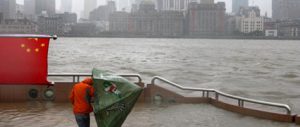
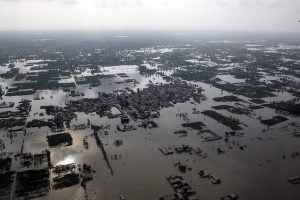
And both of these countries suffer significantly more from floods than almost any other natural disaster. This is really unfortunate because, of all the natural disasters, floods are probably the only phenomena for which we have low-cost technology or effective prevention methods, things like flood zoning and building embankments.
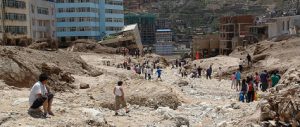
Earthquakes, landslides, volcanic eruptions, hurricanes and cyclones we can do very little about – there’s really no such thing as an early warning for earthquakes, so you just have to live with it. For cyclones, you can have very effective early warning, but it’s very hard for low-resource countries to actually prepare in such a way that it’s effective and inexpensive. But floods are actually something for which we have very good, low-cost engineering solutions.
OB: So why aren’t we better at implementing them?
DGS: I think there are two things. First, most people who live in highly flood-prone areas tend to be the very poor. People who are wealthier – I don’t mean driving Mercedes, but just a little bit better off – will choose not to live by river banks and will choose not to live in the sea-level areas of Bangladesh, for example. They will choose to live on slightly higher plains.
In the Middle Ages, you could see that kings and noblemen all lived on top of hills, while poorer people lived on the slopes and down below. And it’s the same thing here. Most of these poor people are in fact disenfranchised people. If it’s a democracy, their vote banks are not worth very much and so nobody really cares. And, in China, I don’t know how much power they have. I think most of them are poor peasants who have very little pull as it were when it comes to resource distribution. So flood zoning or prevention methods, they just don’t want to put the money up.
The second thing I think is happening is that high rates of urbanisation – not only deforestation around large cities but also concretisation of very large spaces for parking cars, or shopping malls, the urban sprawl as it were – is creating a very significant effect on water run-offs. Small rains and small rivulets from those rains are now becoming very intense torrents because they accumulate over these very large areas and create massive urban flooding. So a country like China where urbanisation is growing is probably going to face increasing problems with urban flooding.
I think the tendency of urban planning to put very large shopping malls, hypermarkets, supermarkets, parking, all those on the outside perimeters of the city should be reviewed. This has been a general idea – let’s just push it out of the city. We saw this in Rio, where there were huge floods last year. That policy needs to be reviewed because of the deforestation and concretisation and, therefore, the increase of flooding.
OB: What problems does more flooding tend to bring with it in terms of human impacts?
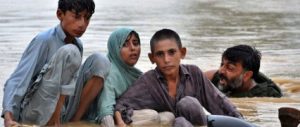
DGS: Urban flooding and rural flooding can have different impacts on the populations affected. In rural areas, there is definitely a very high risk of diarrhoea and diseases because of contamination of water. If you have poor populations whose immune systems or resistance is weak, where the children are a little bit malnourished, then the diarrhoea problem can become quite severe.
You can also have an increase in breeding sites of mosquitoes or other vectors, and in China in particular both malaria and dengue are an increasing problem, as is schistosomiasis, a disease carried by snails. The strain of schistosomiasis that you see in China was a very, very big problem and then they got rid of all the snails – they mobilised millions of people. Now it’s coming back again. These are all diseases of concern and do have a link to the heavy precipitation and increases in breeding sites.
In rural areas, you also have the problem of delayed malnutrition, when lots of people have lost their crops and they’re unable to sell anything anymore, or they were eating those crops. You can argue that the children of those families, although they may be given some food aid or something, they will have a drop in the required calorie intake for the next six months or so, until the family gets back on its feet.
In the urban areas, we have seen the problems of sanitary systems breaking down and floodwaters overflowing sanitary systems. This of course has the same effect on diarrhoea and disease. Since urban areas are much more densely populated and people tend to live close to sanitary infrastructure, this can become a very big problem for some categories of people.
The other problem we have seen in Jakarta is that there is an epidemic level increase of diseases like leptospirosis. Leptospirosis is carried in the water through the urine of cats or dogs or rats and then infects human children or adults when they play or walk barefoot in these waters and if they have small lesions in their feet, then it enters by that. Leptospiroris in itself is a benign disease but, like dengue, is more and more showing hemorrhagic forms.
OB: Is there any sign we’re getting better at dealing with these impacts as flooding becomes more common?
DGS: To me, the first thing with a flood is what I call primary prevention. A flood is one thing you can actually stop from happening. The second line of action is to reduce the impact of it – reduce the diseases, or any kind of drownings, electrocutions and so on. With those effects too, we have much further to go.
I don’t think we’ve done enough and I have a feeling what’s going to happen is we’re just going to let things slide, literally, until we get such catastrophic events that then suddenly we’re going to have to stand up and say hey, 200,000 people have died and we have to do something.
In China, on the floods end I think there’s a lot to be done. It’s a really low-hanging fruit. I’d say they should begin with a better understanding of how floods actually affect their populations and based on that develop preparedness and prevention programmes that target real problems.
OB: We’re already seeing extreme events. At what point does something become catastrophic enough to trigger the right reaction?
DGS: Bangladesh is a very good case in point. Bangladesh has done very well with floods. It’s a country that used to get hammered by cyclones, hurricanes and famines. Every three to four years, you would see Bangladeshi children on posters. You don’t see that anymore. Bangladesh has really gone a long way in getting primary flood prevention in place – so very low cost technology to prevent the floods from happening. But they have also gone a long way in having community-based things like small loans to women to help them get back on their feet after they’ve lost everything. And those have worked really, really well. They hardly ever ask for international aid anymore.
There are lessons there for other countries. Bangladesh is a desperately poor country. And politically unstable, but they’ve still managed to do it because of community mobilisation and Red Cross involvement. So it can be done.