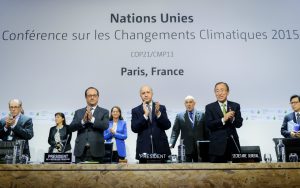
Christiana Figueres, one of the main architects of last December’s Paris Climate Agreement, on February 19 said she would step down from her stewardship of the UN’s climate arm in July. This was accompanied by the resignation of the Paris climate summit’s president Laurent Fabius, which, in the view of some, has left the management of the treaty on shakier ground.
The Costa Rican diplomat will leave her post as executive secretary of the United Nations Framework Convention on Climate Change (UNFCCC) in a year that is critical to the implementation of the Paris Agreement needed to avoid runaway climate change.
The deal made in Paris at the end of last year was hailed as a historic breakthrough – delivered in large part by adroit diplomacy and tireless energy deployed by Figueres and the also-departing Conference of the Parties (COP) president Laurent Fabius.
The text of the agreement can be read in six languages, including Mandarin, here.
However, much more needs to be done to put countries’ commitments into action and implement what was agreed in Paris.
While the Agreement has been received as a vast improvement on coordinated action following years of deadlock, greater clarity on finance for countries most at risk of climate change is needed. A ‘stocktake’ among big emitters will be required by 2018 to inspire least developed countries (LDCs) to have trust in the UN process.
LDCs, along with other blocs, are likely to push for one of their own to be chosen to fill Figueres’ shoes as UNFCCC executive secretary.
“I think it is time for the least developed countries to fill that particular slot,” said Bangladesh-based Saleemul Huq, senior fellow at the International Institute for Environment and Development who spoke at a conference in London last week.
Whoever that person may be, he or she can thank Figueres for removing much of the distrust between developed and developing countries during her five years of tenure. Her optimism, drive and commitment has yielded deals despite the notoriously complex UN talks framework.
Figueres has acknowledged there were times when she almost buckled under the pressure, and she turned to the spiritual guidance of Thich Nhat Hanh, a Vietnamese Buddhist monk, to help her through a personal crisis and the weighty responsibility of chivvying over 190 countries towards a deal.
Powers of persuasion
Monica Araya, a climate policy analyst as well as a compatriot and friend of Figueres, told Diálogo Chino that the can-do attitude of the UN climate chief even extended to persuading delegates at climate talks to dance at a concert during rare downtime.
“Despite their hesitance, even those who were refusing to dance had to yield, go with the music and it was fantastic. Just like she did in more serious situations: Figueres helped the most unlikely people to think and act as a group and come together. It is a precious gift,” Araya said.
“Impossible isn’t a fact; it’s an attitude,” was the code that Figueres said she abided by as UNFCCC executive secretary.
‘Non-state actors’
The success of the Paris talks has depended on a number of key individuals, such as the UN secretary general Ban Ki-moon; French foreign minister Laurent Fabius (who in mid-February was replaced in that role by Jean-Marc Ayrault), and members of the French foreign ministry who marshalled its outposts worldwide.
Leaders of the world’s major religions, and many others, such as NGOs, enlightened companies and campaigners, also played a major part.
Figueres, who has always adhered to the consensual nature of the UN climate process, has acknowledged that this huge joint effort was critical in motivating many countries at the Paris climate summit.
“She had the knowledge of the issues, the understanding of the politics and the willingness to engage with non-state actors and use them to build momentum,” said Alden Meyer, director of strategy at the Union of Concerned Scientists. “She was an essential part of the success in Paris,” he added.
Filling shoes
When Figueres was told she was to be executive secretary of the UNFCCC in 2010, she arrived on stage with a giant shoe which she presented to Yvo de Boer, the departing head of the UN’s climate arm. Her speech was all about how she was too small to fit into de Boer’s shoes, but she would try.
Almost six years on, and the ink barely dry on the Paris Agreement that for the first time secured agreement from developed and developing countries to cut carbon emissions, it is now Figueres’ turn to hand the shoe (probably not literally) to someone else.
Her successor may not be in place by the next major climate conference in Marrakech, Morocco, in November. The world’s climate hub needs an appointee with a secure footing if the Paris Agreement is to succeed in its mission.
With additional reporting by Joydeep Gupta of India Climate Dialogue, Rob Soutar of Diálogo Chino, and Charlotte Middlehurst at chinadialogue.