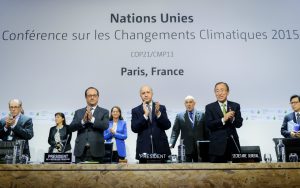
Six months and a couple of days ago, 195 countries hadn’t yet agreed a global deal under which all would constrain their greenhouse gas emissions; and we weren’t entirely sure that they would.
The tension, in the converted aircraft hangar on the outskirts of Paris which hosted the UN climate summit, was considerable; would the brilliantly managed process crumble like a piece of overdone French toast at the final moment?
If it did, would we see another attempt to secure a global climate deal within the current generation?
Then, French Foreign Minister Laurent Fabius brought his gavel delightedly down. The deal was done, and a new era dawned.
It’s fair to say that interpretations of that deal made just over six months ago on 12 December 2015 vary widely. For some, it changed little; the radical end of the green movement argues that it will do nothing to prevent dangerous climate impacts, while brown movement commentators insist that developing countries will not follow through on the pledges they made.
However, there is also a broad middle-ground consensus that actually, the Paris Agreement is worth the paper it was printed on; that while it didn’t ‘solve’ climate change, it will make a meaningful impact on carbon emissions, accelerate investment in low-carbon technologies, raise the perceived risks of fossil fuel investments, unleash financial and technical assistance for poor countries, and build a new confidence behind international climate action.
So… six months on, who’s right?
See also: Paris Agreement gives hope in fight against climate change
Signing the future
On a formal level, 174 nations signed the Agreement as soon as it opened for signature two months ago at UN headquarters. That didn’t just break but smash the record for the first-day signing of a UN agreement (for anoraks everywhere, it previously stood at 119 for the Convention on the Law of the Sea in 1982). By any standards, that’s some fair degree of political endorsement.
However, collecting signatures doesn’t bring the Agreement into force. For that, at least 55 countries accounting for at least 55% of global emissions need to adopt it formally by whatever method each country uses (such as ratification by a parliament).
To date, just 17 countries have formally adopted the Agreement, and they account for less than 1% of global emissions.
However, the European Commission and individual European nations intend to get the job done as soon as possible – Hungary already has, and France intends to join it tomorrow.
More importantly, Indian President Narendra Modi and his US counterpart Barack Obama have vowed to join the party this year (the latter stimulated by the prospect of one Donald J Trump following him into the Oval Office); and more importantly still, so has China. So, entry into force this year looks more likely than not.
Governments agreed the Paris deal largely because it reflected what’s happening in their countries anyway. So it should come as no surprise to find that the low-carbon transition is alive and well in different corners of the world.
For Pacific island states, the decision to go large on renewable energy isn’t just a mark of concern about climate change, it’s economic good sense when otherwise you have to import fossil fuels from thousands of miles away. Nevertheless, whoever said ‘developing countries will never give up fossil fuels’ clearly hasn’t been paying attention to the Cook Islands (on track to obtain all of their electricity from renewable sources by 2020), Tuvalu (the same goal) or Samoa (due to reach the 100% renewable electricity milestone next year).
The trumpets of Paris have, though, sounded loudest in East Asia.
In January, Vietnamese Prime Minister Nguyen Tan Dung stunned observers by announcing his government would review its development plans for coal, apparently citing the Paris Agreement as the driver (‘following strictly international commitments on cutting emission and promoting the development of renewable energy.’)
Like Ronald Reagan’s worst nightmare, this set off something like a low-carbon domino effect in neighbouring countries. In March, the Chinese government told 13 provinces to halt approvals for new coal-fired power stations, and told 15 to stop building ones that had already been approved. A month later came news of plans to stop approvals for coal-fired plant in all but three provinces.
Earlier this month, the incoming Philippines government said it would review plans to build dozens of coal-fired units; and now it’s emerged that Indonesian President Joko Widodo is also thinking again, with 16GW of planned coal capacity stalled by the government’s desire to increase investment in renewables. China and Indonesia are scaling back coal mining too – and so is India.
It’s hard to argue that the Paris Agreement is solely responsible. Usage rates of coal-fired plants have been going down in China and India because there’s too much capacity, so a slowdown would have been expected even without the UN deal.
But equally, it’s not a negligible factor. Lenders, particularly regional development banks, are feeling new pressure to make their lending decisions compatible with the Paris Agreement target of keeping global warming ‘well below’ 2 Celsius.
And for China, there’s a special incentive; Paris confirms that the world is on track to a low-carbon future, and China wants to build a lot of the low-carbon stuff that other countries will need. Investing at home – walking the walk – therefore makes even more sense than it did before December’s deal.
Business as unusual
In the commercial sector, long before the Paris summit many businesses were already moving towards becoming entirely reliant on renewable energy.
But since then, more have joined up. They include food processing and packaging multinational TetraPak, advertising, media and marketing group Dentsu Aegis, and, perhaps most remarkably, Tata Motors, the giant Indian car manufacturer.
In Britain, Mars products are now made using entirely renewable energy.
But across all of the corporates, the most remarkable change since December is in oil and gas, where – for the first time – two of the world’s giants, Shell and Total, published scenarios for future energy use consistent with global warming of 2C.
The scenarios have holes, and other oil giants didn’t join them; but this is already a profound change from previous years.
In large part it’s happened because climate change campaigners, encouraged by the Paris outcome, have doubled and redoubled their efforts to reform oil and gas companies. If they have their way, the companies will come a lot further very soon; expect every year’s AGM season to throw up new shareholder resolutions on climate and investment risks.
Does all this add up to a world changed enough to reach the ‘well below 2C’ target enshrined in the Paris Agreement? As yet, no. But equally, it’s surely impossible to look back with an open mind and argue that the Agreement changed nothing.
As far as I could tell through my hangover, the world looked very different on the morning after. Six months on, it still does.
The original version of this article was published on eciu.net and can be found here