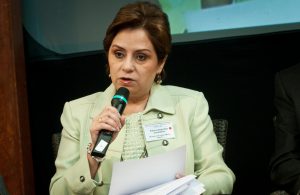
United Nations climate chief Christiana Figueres has announced her candidacy to be the next UN secretary-general.
Figueres, who orchestrated a historic global climate change accord in Paris last year, stepped down as head of the UN Framework Convention on Climate Change on July 1, and today formally declared her interest in replacing the current UN Secretary-General Ban Ki-moon.
Ban’s term ends in December, and so far, 11 candidates are openly vying for the position of the world’s top diplomat. Sources say Figueres has reached out to the diplomatic community, funders and the CEOs of major companies like Unilever and Ikea that played a major role in delivering climate commitments for the Paris deal.
Hers would be a dark-horse candidacy, many people noted. A longtime Costa Rican diplomat from a political family — her father, José Figueres Ferrer, was thrice elected president of Costa Rica — Figueres nonetheless has little of the national security chops traditionally sought in a top UN leader. Her resume also falls short in some other major UN focus areas like humanitarian aid and peacekeeping.
But admirers also describe Figueres, the face of the United Nations’ most successful recent venture, as a dynamic leader who would bring new energy to the position. She also could be counted on to make implementing the Paris Agreement a global priority.
“The traditional, almost exclusive focus on peace and security credentials is a historic legacy of the past that needs to be broadened to include the new functions of the secretary-general, which have grown with every passing year,” said Robert Orr, a UN undersecretary-general and special adviser to Ban on climate change.
Orr said Figueres’ presence in the race would be “healthy” because it would put climate change “front and centre” as an issue that candidates for the job would be questioned about and evaluated on. “Until now, it’s been virtually absent,” he said.
János Pásztor, Ban’s senior adviser on climate change, said it is critical for the next secretary-general to make global warming a top priority.
“If the next secretary-general does not prioritize climate change, the world will lose a person who can regularly remind government as well as non-state-actor leaders about their opportunities and their responsibilities for ambitious implementation of the Paris Agreement, a person who can engage the heads of UN agencies to support member states in their implementation of the Paris Agreement, and one key leader who has not stopped reminding the world of the importance and urgency of acting on climate change,” he said.
The process for selecting a successor to Ban is already skewed toward issues of global security. The UN Security Council will make recommendations to its General Assembly, which will then choose a candidate. A decision is expected to come down in October.
This year’s process is touted as the most open and democratic in history, but the Security Council still has disproportionate influence over the process. Any successful candidate must have the approval of its five permanent members: Russia, the United Kingdom, France, China and the United States.
Reprinted from ClimateWire with permission from E&E Publishing, LLC. Copyright 2016. E&E provides comprehensive, daily coverage of essential energy and environmental policy, politics and business news online at www.eenews.net.
For the original story and more click here.