The first meeting of German Chancellor Angela Merkel and US President Donald Trump on Friday is an opportunity for both leaders to discuss areas of common interest around the pressing issues of trade, security and the international refugee crisis.
But the outcome of the talks could also have major consequences for the future of international climate policy.
Merkel, once dubbed the “Klimakanzlerin” (Climate Chancellor) for her commitment to transform Germany’s energy sector and phase out coal power in favour of renewables, views climate as a major issue on the international agenda and a pivotal opportunity for cooperation.
Her visit to the White House follows those of prime ministers Theresa May of the UK and Justin Trudeau of Canada, who both notably avoided discussion of the global energy and climate agenda during recent visits to Washington. However, there is an expectation that Merkel will succeed where they failed.
In a statement delivered on November 30, 2016, the German leader pledged to work on climate policy with the newly elected President Trump. “Of course I will say that I believe that climate change is absolutely caused by people,” she announced at a press conference.
Amid speculation that the US could seek to leave the Paris Climate Agreement at any moment, there is both domestic and international pressure on the Chancellor to defend it and “make a deal” with Trump on climate.
The G20
On July 7 and 8, Germany will host the G20 in Hamburg, a prosperous city on the River Elbe. Climate and energy are expected to feature highly on the agenda. The timing is critical, as two months after the summit the long-serving Chancellor will face her fourth Federal election.
Merkel will be judged by German voters on her performance at the G20 meeting and abilities as an international leader. Can she succeed in uniting a fractured Europe around the negotiating table? Will she engage the US administration that has so far proven antagonistic to strong environmental regulation and climate action? Her most obvious opportunity to bring climate change into her conversation with Trump will be in the context of the G20.
Friday’s meeting also comes at a critical time for the Trump administration, which sooner or later must clarify its position on the Paris Agreement, which the Obama administration so passionately championed.
The Paris Agreement
The Trump administration has not formally announced that it will take the US out of Paris. But signs do not look good given how quickly the administration has moved to dismantle the climate and environmental policies put in place by Obama.
The terms under which the US might seek to exit the Paris Agreement, which is not legally binding, remain unclear. Under the first scenario, President Trump could invoke the formal withdrawal mechanism, which would then take four years to complete.
An easier route would be to pull out of the UN Framework Convention on Climate Change (UNFCCC.) This would take one year to process and in effect signal a US withdrawal from all international efforts to tackle climate change.
Neither pathway is likely to prompt other signatories to re-evaluate their existing commitments under Paris as the evidence on climate change is clear.
Furthermore, investment in the green economy is widely recognised as a pathway toward future economic growth. Bloomberg estimate that US$7.8 trillion will be invested globally in renewables between 2016 and 2040, two thirds of total investment in power generating capacity.
Although contagion is unlikely to spread, a US departure could blunt the global momentum that has been building behind the Paris Agreement.
It is therefore likely to come up in Friday’s talks.
Merkel is likely to engage Trump on the economic opportunity that the low carbon transition provides, as well as the costs to the US of being left behind, both to its economy and international reputation.
“Other leaders have made it clear that they are watching carefully and have strong views about the US’s role in Paris, including President Xi and Chancellor Merkel. There will be serious political repercussions,” says David Waskow, director of the World Resource Institute’s International Climate Initiative.
The threat of a US withdrawal has been met with alarm in Germany especially, which in recent months has emerged as the last staunch defender of liberal democracies in the face of rising populist, right-wing movements across Europe.
“[Trump] is a role model for populist movements here in Europe…People are particularly alert to cuts to science and the work of the Environmental Protection Agency, and to [projects] connected to climate aid,” says Susanne Dröge, senior fellow at the German Institute for International and Security Affairs.
China
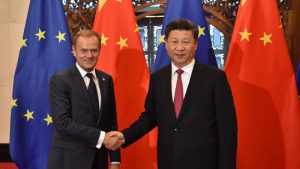
In the new context, Climate alliances are shifting and a new alignment between China and the EU is very likely, along with other key players such as Mexico and Canada, and the small island states.
“As hosts of last year’s meeting, China has a very strong interest in making sure what they worked very hard on in terms of a positive climate outcome last year gets included in this year’s outcome. If the Chinese do not come out strongly on the side of Merkel it will be very difficult to get the US to agree to an ambitious climate outcome,” says Andrew Light, distinguished senior fellow at the World Resources Institute.
“These are unique circumstances and when you have the secretary of state who is the former head of an oil company the issue of fossil fuel subsidy reform is a difficult one,” he adds.
Rather than relying on cooperation from the US, it seems likely that China and Germany will move forward by focusing on new entry points that connect the two countries, most notably clean technology markets, such as smart grids, battery storage and renewable energy. The future of the Paris Agreement may just depend on it.
Also see: The leadership void on climate change