“We’re going to Alashan when the weather gets warmer to plant a forest in his memory,” says Zhang Li, secretary-general of the Alashan SEE Foundation. That seems an appropriate way to remember Liu Xiaoguang, the founder of Alashan SEE an non-governmental organisation dedicated to combating desertification in Inner Mongolia.
Liu passed away in January 2017 after falling seriously ill, just one month shy of his 62nd birthday. Born in 1955, his career spanned a range of professions. As a government official he was regarded as a rising political star and even considered for the prestigious position of Beijing’s deputy mayor. But Liu chose to quit officialdom for business, where he excelled, turning a state-owned firm that was struggling to pay staff wages into an international conglomerate worth 200 billion yuan (US$29 billion). The Beijing Capital Group now has five listed subsidiaries.
But Liu Xiaoguang also leaves behind a different kind of legacy. As China’s real estate sector began to boom he partnered with influential friends from the business world to establish a charitable endeavour called Alashan SEE (founded in 2004) that remains dedicated to tackling desertification.
“Liu Xiaoguang is gone but we will always remember him and carry on his spirit,” says Zhang Li, a professor of ecology and the current secretary-general of the Alashan SEE Foundation.
Founded in 2004 on World Earth Day, the Alashan SEE Ecological Association was China’s first charity with a “social” mission, made up of “entrepreneurs”, aimed at protecting “ecology” – hence “SEE”. In 2014 it was given permission to raise public funds.
To date it has provided assistance to over 400 Chinese environmental organisations and or activists, furthering its aim of building a platform on which entrepreneurs, non-governmental organisations and the public can work together to protect the environment.
Entrepreneurs awaken
Liu’s aim was to mobilise the financial resources of China’s newly-rich entrepreneurs to help solve the root causes of the country’s environmental crisis, which were hampering development. Desertification and sandstorms were particular concerns.
His call created a new phenomenon; entrepreneurs and businesspeople working to protect the environment. Years later, when China’s “smog” was recognised as a serious threat to public health, a number of those early members also became opinion leaders on air quality issues.
Liu’s own awakening was inspired by a trip to the desert in October 2003 when he was chairman of the Beijing Capital Group, a huge real estate developer. He happened to visit the Alashan desert in the far west of Inner Mongolia where it’s believed the sandstorms that strike Beijing originate. Liu found the sight of the vast desert thought-provoking: “When we’re taking from nature, what can we do to repay it?” he once asked.
Liu used poetry based on his experience of walking through the desert to call on China’s entrepreneurs to stand up and use their wealth and talent to tackle the problem. For Liu’s peers, who like him had experienced being sent to rural areas in their youth, this struck a chord.
On returning to Beijing, he made over one hundred phonecalls to friends, and more than sixty soon agreed to contribute 100,000 yuan (US$14,500) a year to a decade-long project to combat desertification in Alashan.
On World Earth Day in 2004 they travelled there to announce the foundation of Alashan SEE.
The “Alashan Declaration” reflected Liu’s intent.
“We recognise that while China’s economy is developing rapidly some of our environmentally-unfriendly ways of thinking, working and living are causing us to destroy the natural environment on which we rely… As modern China’s first generation of entrepreneurs… we cannot hand the next generation a China environmentally damaged and trapped in an economic vicious circle.”
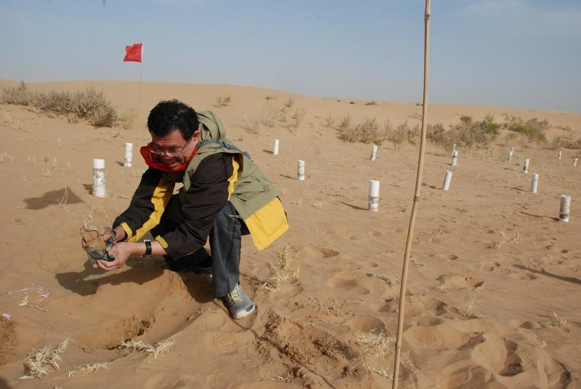
Liu Xiaoguang planting trees in Alashan (Image: Alashan SEE)
Procedural justice
Alashan SEE had plenty of well-known tycoons backing it: Ren Zhiqiang, Wang Shi, Pan Shiqi. All representing a variety of backgrounds. Some had lived overseas and were used to clean air while others were bosses of state-owned firms. Liu’s first problem was how to get such people to work together.
An executive board was needed. Liu drafted a list of 15 names, which was initially rejected. This forced the preparatory group to come up with a voting system.
Yang Xin, founder of environmental group Green River and a recipient of assistance from the Alashan SEE Foundation, witnessed this process. He describes the entrepreneurs crowded into a yurt by the side of Moonlight Lake arguing fiercely for votes. Liu’s character and the esteem in which he was held meant he was unanimously elected head of the organisation.
Speaking at an event to mark the group’s10th anniversary in 2014, Liu recalled: “They stood up one after another to speak against me, into the middle of the night. But that taught me that only with democracy and discussion can everyone come together to move forward in the same direction.”
Yang Peng, former secretary-general of the group said that there was never a “chairman’s seat” at their meetings, members would sit where they wanted when they arrived. “That way everyone was equal.”
Perhaps it’s because businesspeople are particularly concerned with the process of management and decision-making but Alashan has applied the same procedure to all their project funding applications.
Yang Xin showed China Dialogue a certificate signed by Liu for a project located where the Qinghai-Tibet railway passes through the source of the Yangtze River. The sum of 200,000 yuan (US$29,000) had been awarded by the evaluation committee following a presentation about the project and a swift decision.
Teaching people to fish
Although Alashan SEE started out by focusing on desertification, nowadays much of the foundation’s work is in providing assistance for environmental NGOs.
Zhang Li told China Dialogue that when founded the group had seen that China’s environmental NGOs were growing only slowly and required help both with funding and developing capacity to deliver services. As the foundation has grown its work has shifted from simply providing funding to helping with capacity-building.
Currently, Alashan SEE helps environmental NGOs grow and encourages companies to take up environmental protection.
Ma Jun, founder of the Institute for Public and Environmental Affairs (IPE) told China Dialogue that a green supply chain initiative in the property development sector, run by Alashan SEE in partnership with a number of real estate firms, uses data from the IPE’s public pollution database to help select steel and concrete suppliers and monitor corporate environmental performance.
According to the organisation’s website, as of December 2016, 71 real estate firms were participating in the initiative. Those firms had sales of almost 1,300 billion yuan (US$189 billion) in 2015, about 15% of the total for the sector, with their supply chains reaching over 2,000 other firms.
Next in line
Protecting the environment was very important to Liu Xiaoguang.
“He attended the SEE member’s conference, fundraising event and board meeting in October last year. You could see it was exhausting for him, but he kept on raising questions. SEE was a part of his life,” says Li.
By that point Liu was only able to sleep for one or two hours a night, and only with the aid of sleeping pills.
“Enlightened” entrepreneurs such as Liu are crucial for environmental protection. Although overall awareness of the need to protect the environment is increasing in China, rapid economic development means the environment is facing unprecedented challenges.
But thankfully, Liu’s work will be carried on. Over one hundred corporate members of SEE have requested lifetime membership since Liu passed away, committing to a lifetime of following in his footsteps.


![The use of standing water to grow rice in India and Pakistan leads to large water loss [image by sandeepachethan/Flickr]](https://dialogue.earth/content/uploads/2017/05/agricultural-fields-300x200.jpg)