Climate

The aftermath of Kyrgyzstan’s viral glacier collapse

Scientists and activists react to the dramatic avalanche filmed last month in the Tian Shan mountains
<p>The Dzhuku Pass, photographed in late July after the collapse of the glacier. The equivalent of 800 Olympic swimming pools of snow and ice poured down from the mountain on 8 July. (Image: <a href="http://danilusmanov.com/">Danil Usmanov</a> / The Third Pole)</p>

The Dzhuku Pass, photographed in late July after the collapse of the glacier. The equivalent of 800 Olympic swimming pools of snow and ice poured down from the mountain on 8 July. (Image: Danil Usmanov / The Third Pole)

In his speech at COP26 last year, Kyrgyz president Sadyr Japarov spoke of the dangers that melting glaciers pose to mountain communities, and urged world leaders to act to save Central Asia’s glaciers and water sources.

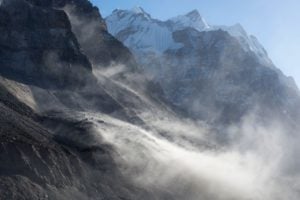
Less than a year later, the world was transfixed by the sight of the precise danger Japarov had warned of. Last month, a British tourist hiking in the eastern Tian Shan mountains of Kyrgyzstan captured the moment a glacier collapsed at the Dzhuku Pass. His footage shows an avalanche of ice sweeping down the slope and over the hiker in a matter of seconds.

A video taken by British tourist Garry Shimmin on 8 July 2022, courtesy of ViralHog

The video, filmed on 8 July, attracted global attention to the effects of the climate crisis in Central Asia. The incident also happened just days after a glacier collapsed in Italy, killing 11 people.

“Glaciers are now melting and moving like snow avalanches when the weather warms up,” said Anara Sultangazieva, an environmentalist in Kyrgyzstan.

“Summer has been very hot in Europe and Central Asia for several years [and] extreme heatwaves have hit both regions,” said Peter Neff, a glaciologist and climate scientist at the University of Minnesota. He told The Third Pole that these warmer conditions, driven by climate change, “cause the ice on the mountain ranges to melt from the ground” and lead to glaciers collapsing.
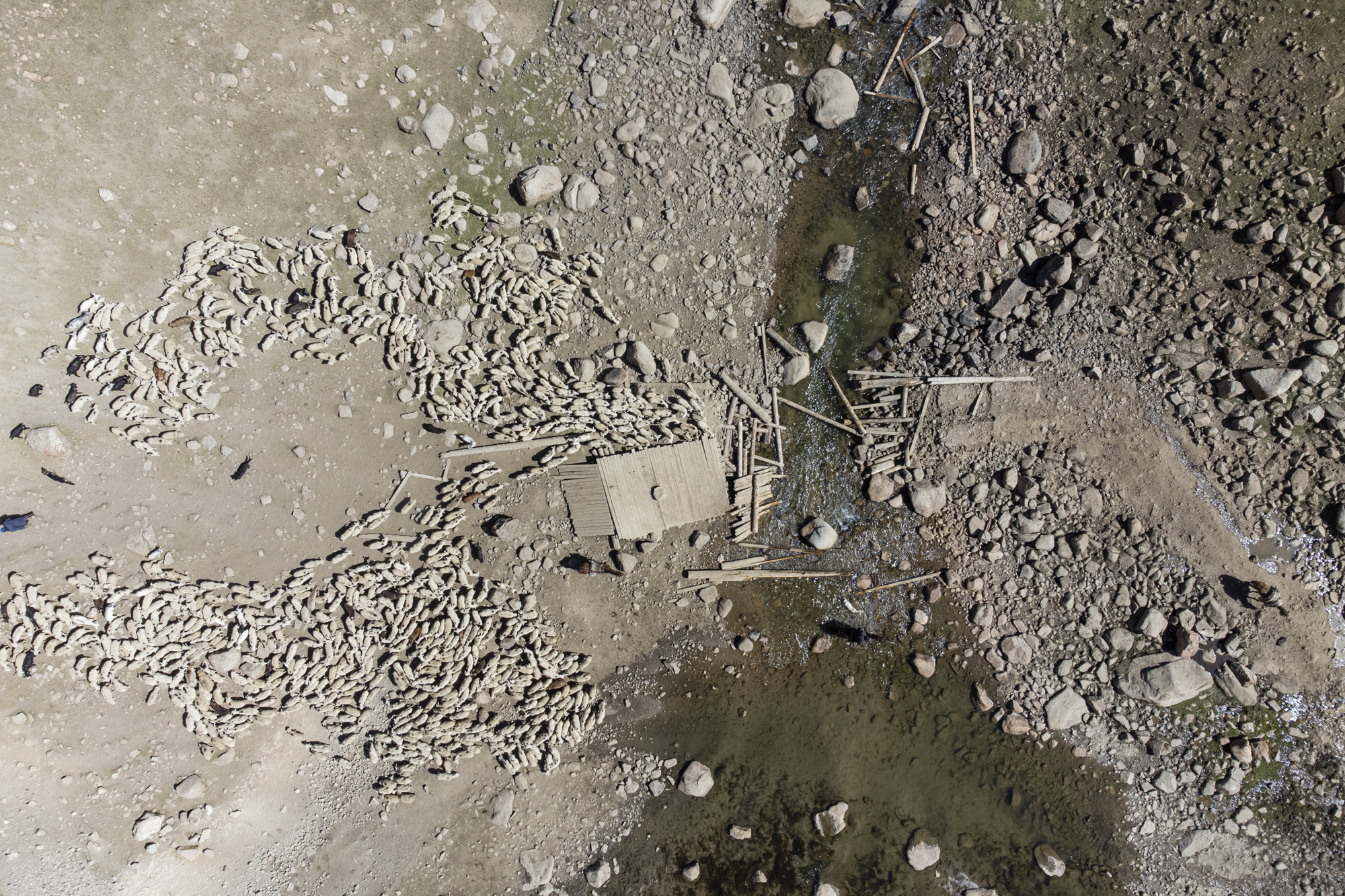
A drone photograph of a flock of sheep trying to cross a river next to a broken bridge, Dzhuku pass Kyrgyzstan
A bridge that was destroyed by the avalanche (Image: Danil Usmanov / The Third Pole)

According to the Kyrgyz Ministry of Emergency Situations, more than 2 million cubic metres of ice and snow was brought down by the avalanche – the equivalent of about 800 Olympic swimming pools.

Satellite images from 2013-16 show nearly 10,000 glaciers in Kyrgyzstan, covering 6,700 square kilometres. Between 1940 and the 1970s, the Catalog of Glaciers of the USSR recorded about 8,000 glaciers in the country, covering almost 8,000 sq km. While over time the number of glaciers – a crucial source of water for people in drought-vulnerable Central Asia – has increased, the area they cover has shrunk by 19%.

Glaciers and the mining industry
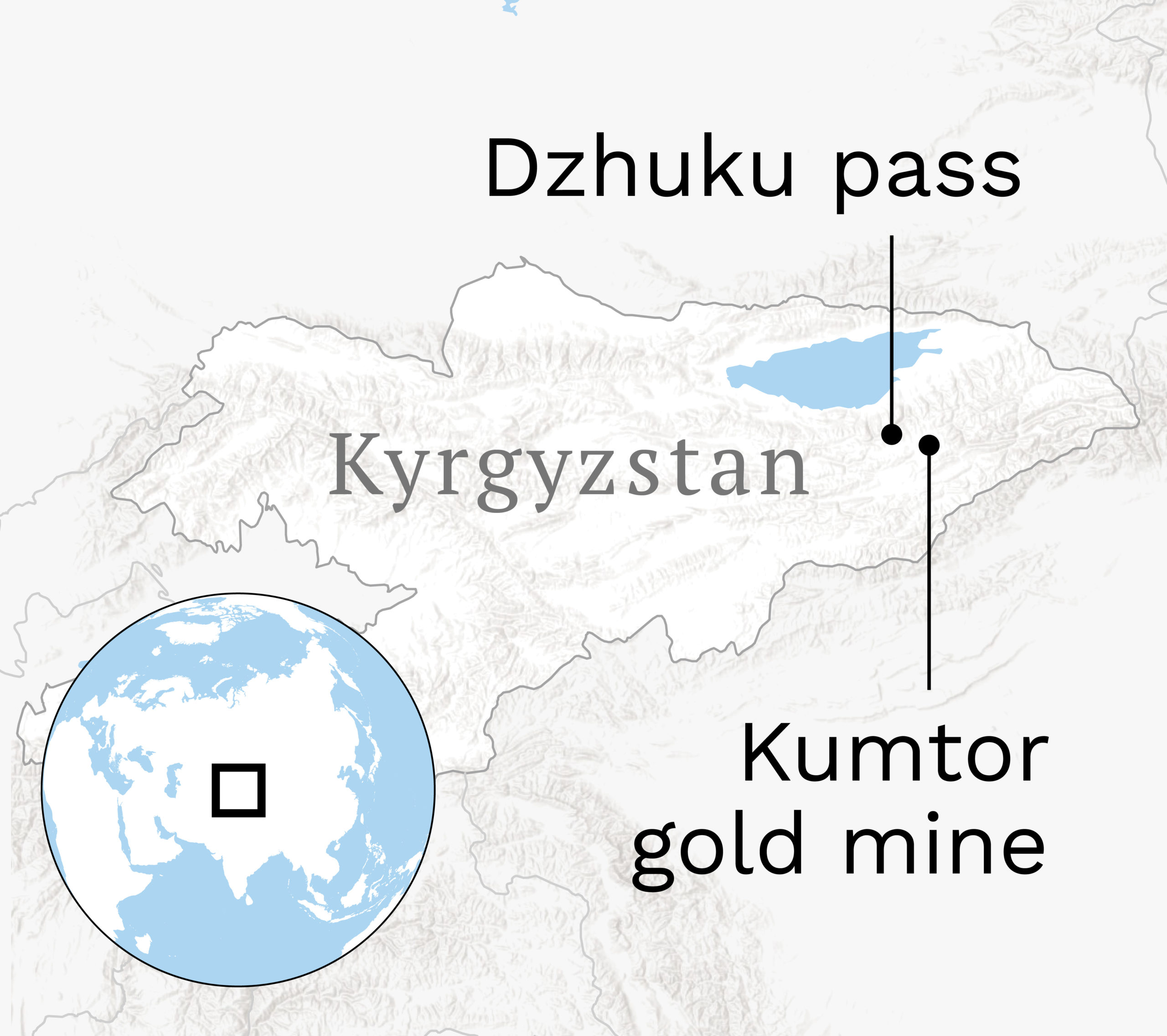
Graphic: The Third Pole

The Dzhuku Pass is not just a popular hiking route. It is also near Kyrgyzstan’s biggest gold mine, Kumtor – about 30 km as the crow flies.

Activists The Third Pole spoke with said that, as well as climate change, mining activity is degrading the glaciers around the Kumtor mine.

“Mining operations contribute to [glaciers] shrinking, whether through direct removal of ice or the deposition of waste and other dark materials on their surfaces,” explained Kalia Moldogazieva, an ecologist and director of Bishkek-based Tree of Life, an environmental NGO. Moldogazieva added that more disasters will occur if mining industry regulations are eased.
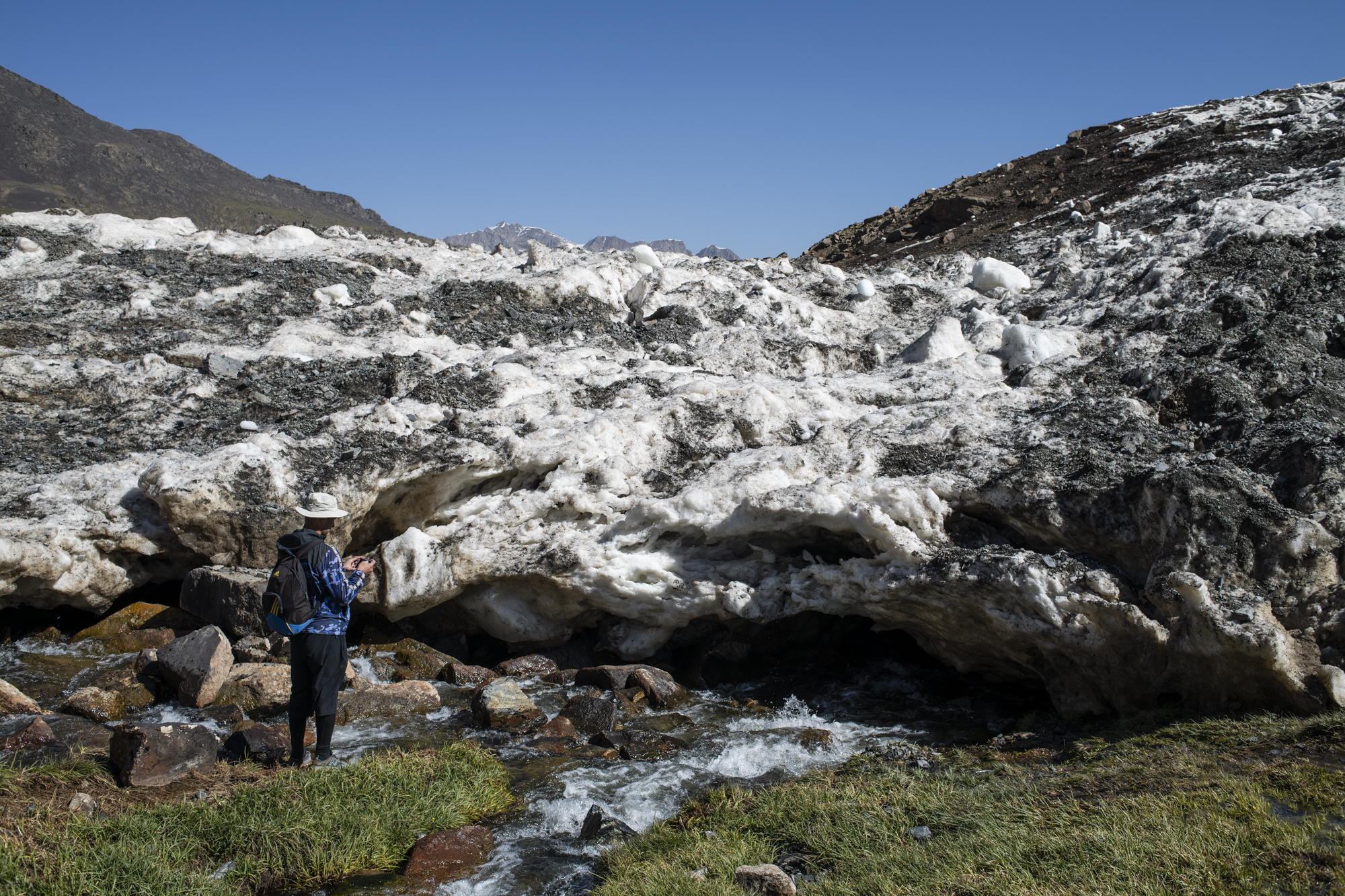
Tourist takes a photo of collapsed part of glacier Dzhuku pass in Kyrgyzstan.
The remains of the mass of snow and ice that broke off from the glacier in early July 2022 (Image: Danil Usmanov / The Third Pole)

In early July, the Kyrgyz government announced plans to develop mining projects in the Tian Shan mountains. But it has also acknowledged the adverse effects of mining activities. In February this year, Dinara Kutmanova, minister of natural resources, ecology and technical supervision, made a statement regarding the dumping of industrial waste onto two glaciers near the Kumtor mine. Since last year, a legal dispute has been underway between the Kyrgyz government and Canadian mining company Centerra Gold, with the Kyrgyz government alleging the company has violated environmental laws, posing a danger to human health and the environment. (Centerra has denied these allegations.)

Moldogazieva said: “Since the early 2000s, scientists and climate activists in Kyrgyzstan have tried to implement new laws to protect the Davydov and Lysyi glaciers in Kumtor from industrial destruction. In 2017 some changes to the Water Code of the Kyrgyz Republic were made by our initiative, but these changes were not implemented at all, and I am afraid due to the new regulations letting foreign investors dig our mining places, we will have more environmental issues than before.”

“The mountain ecosystem should be treated with kindness and immediate attention,” said activist Anara Sultangazieva. “It is necessary to switch to the use of technologies that do not harm nature. Surely gold is expensive, but glaciers are more valuable. By 2050 water will be the most expensive [resource]: we should protect glaciers.”
Cookies Settings

Dialogue Earth uses cookies to provide you with the best user experience possible. Cookie information is stored in your browser. It allows us to recognise you when you return to Dialogue Earth and helps us to understand which sections of the website you find useful.

Required Cookies

Required Cookies should be enabled at all times so that we can save your preferences for cookie settings.

Dialogue Earth - Dialogue Earth is an independent organisation dedicated to promoting a common understanding of the world's urgent environmental challenges. Read our privacy policy.

Cloudflare - Cloudflare is a service used for the purposes of increasing the security and performance of web sites and services. Read Cloudflare's privacy policy and terms of service.

Functional Cookies

Dialogue Earth uses several functional cookies to collect anonymous information such as the number of site visitors and the most popular pages. Keeping these cookies enabled helps us to improve our website.

Google Analytics - The Google Analytics cookies are used to gather anonymous information about how you use our websites. We use this information to improve our sites and report on the reach of our content. Read Google's privacy policy and terms of service.

Advertising Cookies

This website uses the following additional cookies:

Google Inc. - Google operates Google Ads, Display & Video 360, and Google Ad Manager. These services allow advertisers to plan, execute and analyze marketing programs with greater ease and efficiency, while enabling publishers to maximize their returns from online advertising. Note that you may see cookies placed by Google for advertising, including the opt out cookie, under the Google.com or DoubleClick.net domains.

Twitter - Twitter is a real-time information network that connects you to the latest stories, ideas, opinions and news about what you find interesting. Simply find the accounts you find compelling and follow the conversations.

Facebook Inc. - Facebook is an online social networking service. China Dialogue aims to help guide our readers to content that they are interested in, so they can continue to read more of what they enjoy. If you are a social media user, then we are able to do this through a pixel provided by Facebook, which allows Facebook to place cookies on your web browser. For example, when a Facebook user returns to Facebook from our site, Facebook can identify them as part of a group of China Dialogue readers, and deliver them marketing messages from us, i.e. more of our content on biodiversity. Data that can be obtained through this is limited to the URL of the pages that have been visited and the limited information a browser might pass on, such as its IP address. In addition to the cookie controls that we mentioned above, if you are a Facebook user you can opt out by following this link.

Linkedin - LinkedIn is a business- and employment-oriented social networking service that operates via websites and mobile apps.