


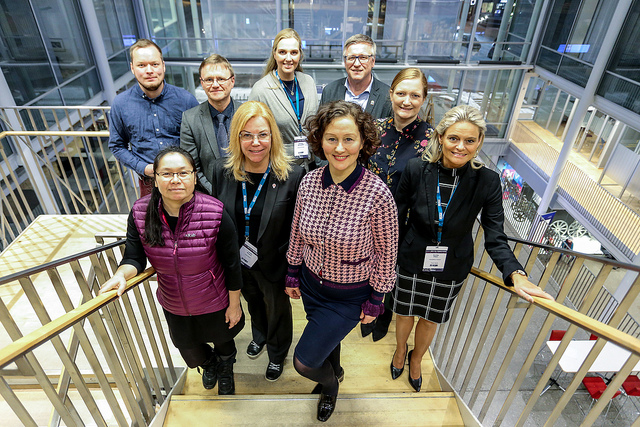
One event in Tromsø, Norway, marked the range of political action – as well as the scope of challenge – before the people living in the Arctic. Just before the official inauguration of the Arctic Frontiers conference – the 13th edition of a global conference discussing science and policy of the Arctic region – Kristin Røymo, mayor of Tromsø, invited some of her counterparts for an Arctic Mayors Forum. Mayors from across cities in the Arctic Circle from Norway, Sweden, Canada, and Denmark attended the session.
People living in these areas have been impacted by overfishing, climate change, sea level rise and global pollution, although they have contributed only marginally to these problems. As sea ice retreats, they also face the threat of the extraction of resources like oil and deep sea mining, while sudden inflow of tourists threaten to destabilise the small communities while, at the same time, providing much-needed revenue.
The first such meeting of mayors from the Arctic had occurred in May 2017, in Fairbanks, Alaska, in the United States. This forum was aimed at finding ways for the municipalities of the region to cooperate across borders on issues that affected the people living in the areas.
Similar challenges face Himalayan communities
In some ways the communities in the Arctic resemble those of the high Himalayan region, in that these tend to be small concentrations of populations across vast regions, whose connections to people across borders is deep. For example, the mayor of Vardo in northern Norway, emphasised how his town, whose population had dwindled from 4,000 to a little over 2,000 since the 1970s due to the decline of fishing, has had links to communities in Russia since the eighteenth century. This is much like the relationships among indigenous communities across the Tibetan Plateau that predate modern borders.
On the other hand many cities in the Arctic have significant access to funds. The mayor of Iquilat, with a population of 8,000, spoke about CAD 1 billion in investment from the Canadian government on infrastructure. The mayor of Lulea, in Sweden, emphasised that her city had one of the biggest ports in Europe, and the mayor of Akrurei spoke of how her city was the second city of Iceland. Despite the significant economic and political capital that some of these cities have – the Faroe Islands, for example, has significant autonomy from Denmark, with its own Parliament – they struggle to make a combined impact on policies shaped primarily by states rather than just communities that live in the region.
“Climate shift” in the Arctic
The challenges faced by these communities was highlighted by a presentation by Sigrid Lind of the Marine Research Institute at the opening ceremony of Arctic Frontiers. Lind presented the outcome of research in the Barents Sea, off the coasts of Russia and Norway, often referred as the frontier of the Arctic – since here the salty warm water from the Atlantic Ocean meets the cold freshwater produced by melting sea ice. The Barents Sea is known both for its rich marine life with a spring bloom of phytoplankton that feeds zooplankton, which in turn is fed upon by cod, whales, and other sea life. It contains the largest stable cod population in the world, jointly managed by Russia and Norway.
Based on salinity and ocean temperatures from 1970 to 2016, as well as satellite data, Lind’s research suggests that the Barents Sea is undergoing a “climate shift”, changing from an Arctic area, with ice and stratified columns of freshwater and saline water, to becoming a part of the Atlantic – significantly warmer and saltwater and freshwater mixing together. Newly released research also shows that oceans are warming far faster than previously thought, having an impact on the Arctic, as well as sea level rise globally.
Such a change would make a radical impact on the Arctic communities, with unknown effects on local biodiversity. The cod stock on the Norwegian-Russian border, is the largest sustainable fish stock in the world, but the ingress of warm water, and the species that come with it, is likely to have a significant impact on this important resource. The transformation of a part of the Arctic into an Atlantic zone will also significantly impact global weather patterns, affecting the atmospheric global jetstream. Given the close links between ice in the Arctic and the South Asian monsoon, these changes will have a significant impact on the weather patterns in the Himalayan region.
See: Interview: How Arctic ice melt affects the monsoon
Urgency and hope
The people most impacted with swift change will be, first and foremost, the communities represented by the Arctic Mayors Forum, many of which are indigenous communities. They can gather some hope from the fact that the Arctic Council which is one of the few multilateral fora where indigenous communities have formal recognition, including above that of non-Arctic states that are “observers”.
There is, though, doubt how much they will be able to influence the big actors that drive national decisions on issues such as oil and resource extraction. Nevertheless the inclusion of indigenous communities as formal actors in the Arctic Council has meant giving a voice to people previously marginalised due to their small population and limited economic power. The municipalities represented by the Arctic Mayors, many of whom have a large proportion of indigenous people in their populations, are better integrated already into the governance structures of their states. It remains to be seen, however, how the Arctic Mayors Forum will actually be able to do to deal with the massive challenges the Arctic faces.
There is much less hope for mountain communities in the Himalayan region, which will be impacted by the changed reality of the Barents Sea through changed weather patterns. There is no such multilateral forum in the Himalayas, and these communities are often marginalised within their own states, and have limited funds or political power to influence the countries of their region. It is impossible to imagine the mayors of Srinagar, Thimphu, Kathmandu, Lhasa, Peshawar, Kabul and other Himalayan cities sitting together and discuss the issues of waste management, glacier retreat, floods, and droughts, which affect, in some form or other, all of these populations. The Arctic Mayors Forum, though, may be a model for hope, while the changing nature of the Arctic should highlight why such cooperation cannot be put off much longer without critically endangering the well-being of those living in the mountains.

![Arctic frontiers emerging leaders programme: The group of Arctic leaders at Tromso, Norway, with Jadhav 5th from right, first row [image by: Pål Brekke]](https://dialogue.earth/content/uploads/2019/01/50408647_10156965855024715_8346070978907865088_o-300x178.jpg)
![Trucks queing up in Timure, three kilometres from Nepal Tibet border to get clearance from Nepal's security force [image by Nabin Baral]](https://dialogue.earth/content/uploads/2017/07/Nepal6-300x200.jpg)
![Arctic ice continues to melt, we must approach the challenge with some hope [image by: NASA/Kathryn Hansen]](https://dialogue.earth/content/uploads/2017/04/Arctic-ice-NASA-300x200.jpg)