Climate

As the Arctic melts, carbon creeps out

New research on how permafrost melting in the Arctic releases carbon dioxide and methane show cause for concern, and some limited optimism
<p>Sampling site from the peat samples were taken from the permafrost near in Kilpisjärvi, Finnish Lapland [image by: Carolina Voigt / University of Eastern Finland]</p>

Sampling site from the peat samples were taken from the permafrost near in Kilpisjärvi, Finnish Lapland [image by: Carolina Voigt / University of Eastern Finland]

We know that Arctic ice is melting. The latest Snow Water, Ice, and Permafrost Assessment  (SWIPA) estimate showed that the change is happening so fast that if things go along as before, there will probably no ice coverage of the Arctic at all during the summer by the end of the 2030s.

See: Interview: Arctic may lose all its summer ice by end of 2030s

This has led to both excitement and consternation. Excitement among nations on what that might mean for transport and mineral extraction, consternation because the water from the melting ice will flood nations and displace millions of people that live along the coastline – many of them in poor nations like Bangladesh, India and Pakistan.

We are now learning more about an additional consequence which is likely to supercharge global warming – the release of carbon deposits from the peatlands buried under the Arctic permafrost.

Unaccounted carbon in the Arctic

A recent study has some detail on how this may add to our challenges. To give an idea of what is at stake, the research paper mentions that permafrost soils in the Arctic store “~1035 Pg ( around 1,035 billion tons) of organic carbon in the upper 3 metres”. This amount of carbon would overwhelm our ability to keep global temperature rise below 2 degrees Celsius as pledged by all nations (except the US) in the Paris Climate Agreement, leave alone the aspiration to limit warming to 1.5 degrees Celsius above the pre-industrial level.

Permafrost carbon release has been poorly understood, partially because it is difficult to study in laboratory conditions as well as in the field. The new paper by researchers from Canada, Scandinavian countries and Germany states, “the magnitude of this permafrost–C feedback is poorly constrained (McGuire et al., 2018) and not included in current Intergovernmental Panel on Climate Change projections, likely underestimating the climate feedback of the Arctic. Recent climate simulations predict an additional warming of ~0.2°C caused by permafrost C loss by the end of this century.”

In this study, the scientists dug out 16 sections of peat permafrost from Finnish Lapland, half of them bare, half of them covered in vegetation, and moved them to laboratories where they were frozen, and the conditions of the Arctic simulated.  After storage for five months at -5 degrees Celsius, the samples were allowed to unfreeze in controlled stages over 32 weeks, and the release, as well as the method of release, of both carbon dioxide and methane (which has a warming potential 30 times higher than carbon dioxide) from the permafrost.
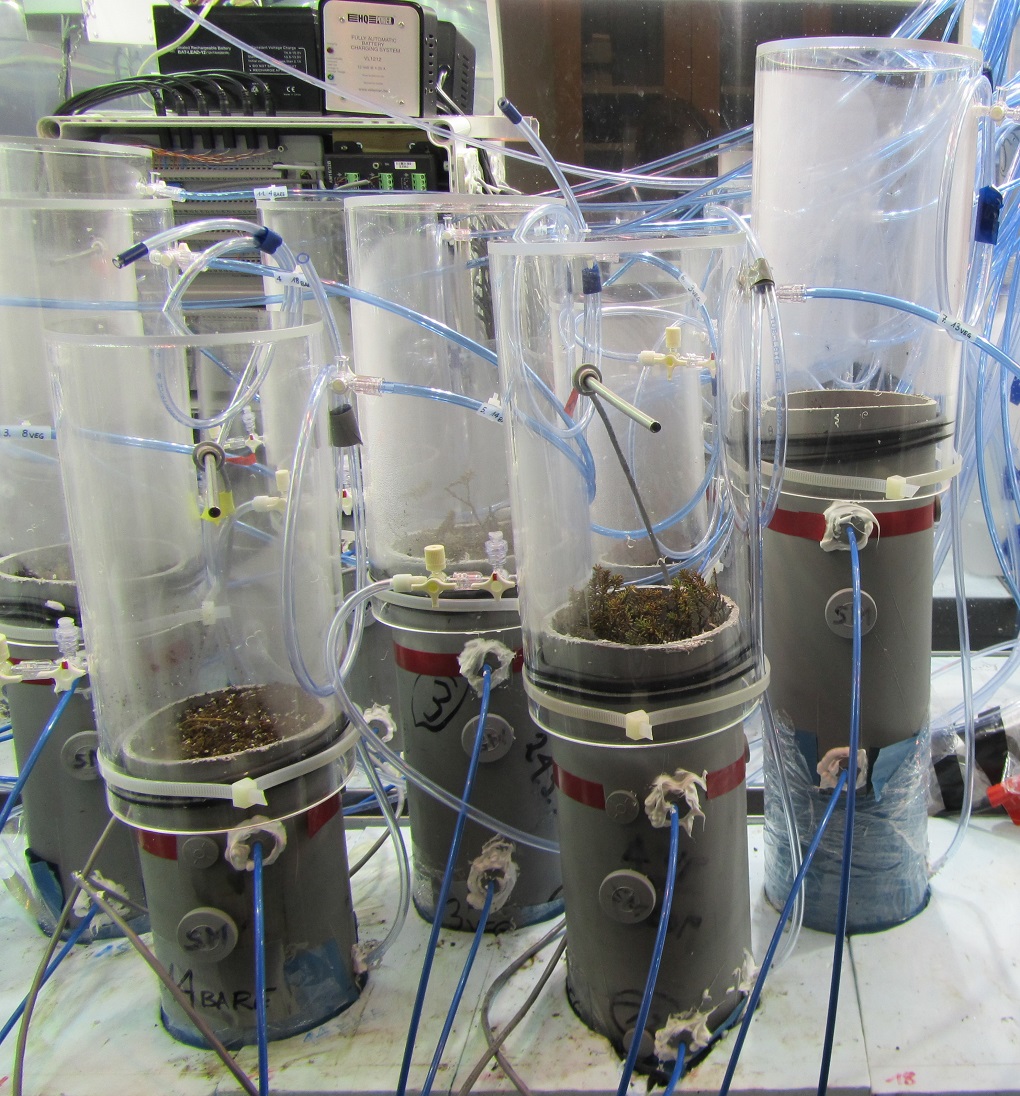
Intact plant-soil systems (peat mesocosms) set up in a climate-controlled chamber [image by: Carolina Voigt / University of Eastern Finland]
Their studies showed an initial peak of carbon dioxide release, as well as a continuing slow release of carbon dioxide as the permafrost melts. The good news, though, was that methane was not released in large abundance, and in dry conditions, the peat could act as a methane sink. This is an important discovery, and one that may help countries deal with the issue as the Arctic ice melts.

There are two additional challenges that the study does not focus on, but is worth thinking about. First, the Arctic is melting very fast, and thus the scope for quick response is difficult. Second, the Arctic is not the only place where the permafrost is melting. As the International Centre for Integrated Mountain Development’s recently-released HIMAP report made clear, higher temperatures in the Hindu Kush Himalayan region are also creating a more active permafrost layer.

See: Water dangers loom for South Asia

It is unclear how much carbon will be released from the Himalayan region, the world’s largest reservoir of frozen was after the two poles but still one of the most understudied transboundary regions in the world. Given the latest round of conflict between India and Pakistan, in which China was also involved at a secondary level, cooperation on research looks increasingly difficult.
Cookies Settings

Dialogue Earth uses cookies to provide you with the best user experience possible. Cookie information is stored in your browser. It allows us to recognise you when you return to Dialogue Earth and helps us to understand which sections of the website you find useful.

Required Cookies

Required Cookies should be enabled at all times so that we can save your preferences for cookie settings.

Dialogue Earth - Dialogue Earth is an independent organisation dedicated to promoting a common understanding of the world's urgent environmental challenges. Read our privacy policy.

Cloudflare - Cloudflare is a service used for the purposes of increasing the security and performance of web sites and services. Read Cloudflare's privacy policy and terms of service.

Functional Cookies

Dialogue Earth uses several functional cookies to collect anonymous information such as the number of site visitors and the most popular pages. Keeping these cookies enabled helps us to improve our website.

Google Analytics - The Google Analytics cookies are used to gather anonymous information about how you use our websites. We use this information to improve our sites and report on the reach of our content. Read Google's privacy policy and terms of service.

Advertising Cookies

This website uses the following additional cookies:

Google Inc. - Google operates Google Ads, Display & Video 360, and Google Ad Manager. These services allow advertisers to plan, execute and analyze marketing programs with greater ease and efficiency, while enabling publishers to maximize their returns from online advertising. Note that you may see cookies placed by Google for advertising, including the opt out cookie, under the Google.com or DoubleClick.net domains.

Twitter - Twitter is a real-time information network that connects you to the latest stories, ideas, opinions and news about what you find interesting. Simply find the accounts you find compelling and follow the conversations.

Facebook Inc. - Facebook is an online social networking service. China Dialogue aims to help guide our readers to content that they are interested in, so they can continue to read more of what they enjoy. If you are a social media user, then we are able to do this through a pixel provided by Facebook, which allows Facebook to place cookies on your web browser. For example, when a Facebook user returns to Facebook from our site, Facebook can identify them as part of a group of China Dialogue readers, and deliver them marketing messages from us, i.e. more of our content on biodiversity. Data that can be obtained through this is limited to the URL of the pages that have been visited and the limited information a browser might pass on, such as its IP address. In addition to the cookie controls that we mentioned above, if you are a Facebook user you can opt out by following this link.

Linkedin - LinkedIn is a business- and employment-oriented social networking service that operates via websites and mobile apps.